
NVIDIA's Nemotron-70B Quietly Beats GPT-4o and Claude 3.5 Sonnet
NVIDIA's RLHF-tuned Llama 3.1 70B variant beats GPT-4o and Claude 3.5 Sonnet on three major alignment benchmarks, weights available on Hugging Face.
 Pro
Takeaways
- NVIDIA released Nemotron 70B Instruct, a Llama 3.1 70B fine-tune aligned with RLHF.
- Scores 85.0 Arena Hard, 57.6 AlpacaEval 2 LC, 8.98 MT-Bench, beating GPT-4o and Claude 3.5 Sonnet.
- Trained with REINFORCE plus HelpSteer2 preference data and NVIDIA's own reward model.
- ChatBot Arena Elo of 1267, overall rank 9, style-controlled rank 26 as of late October.
- Requires 2+ 80GB GPUs, supports 128k context, free hosted API on build.nvidia.com.
- Tuned for general helpfulness only, not specialized math or reasoning domains.
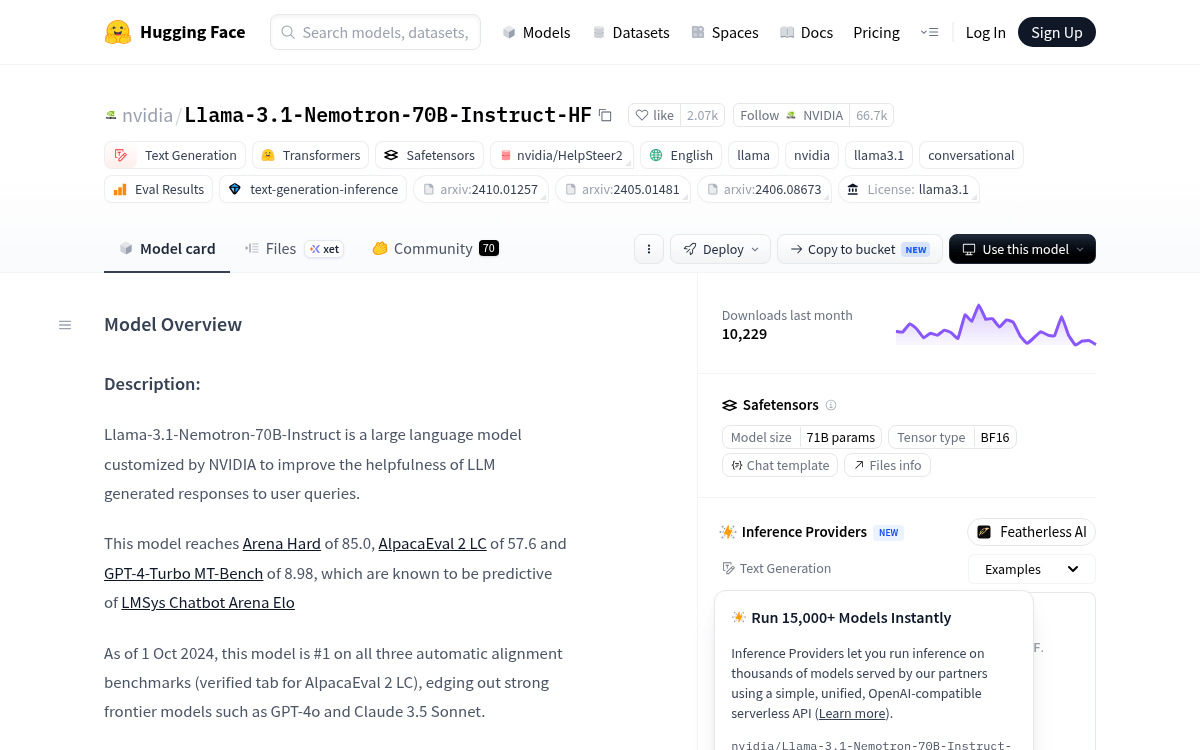
NVIDIA quietly dropped a fine-tune of Llama 3.1 70B that punches well above its weight class. Llama-3.1-Nemotron-70B-Instruct-HF is the Hugging Face Transformers conversion of a model NVIDIA aligned using reinforcement learning from human feedback, and the numbers it posts on standard chat evaluations are what caught everyone's attention.
The starting point is Meta's Llama 3.1 70B Instruct, and NVIDIA's contribution sits entirely in the alignment stage: a new reward model, a curated preference dataset, and a REINFORCE-based policy optimization loop aimed at making generated responses more helpful.
Punching up at the frontier
On the automatic alignment benchmarks, the model posts Arena Hard 85.0, AlpacaEval 2 LC 57.6, and GPT-4-Turbo MT-Bench 8.98. As of October 1, 2024, that put it at #1 on all three (verified tab for AlpacaEval 2 LC), edging out GPT-4o and Claude 3.5 Sonnet.
Here is how it stacks up against the models it displaced:
| Model | Arena Hard | AlpacaEval 2 LC | MT-Bench |
|---|---|---|---|
| Nemotron 70B Instruct | 85.0 | 57.6 | 8.98 |
| Llama 3.1 70B Instruct (base) | 55.7 | 38.1 | 8.22 |
| Llama 3.1 405B Instruct | 69.3 | 39.3 | 8.49 |
| Claude 3.5 Sonnet | 79.2 | 52.4 | 8.81 |
| GPT-4o (2024-05-13) | 79.3 | 57.5 | 8.74 |
The jump over the base Llama 3.1 70B Instruct is the striking part. Arena Hard climbs from 55.7 to 85.0 and AlpacaEval from 38.1 to 57.6 without touching a single pretraining parameter. The live human-judged leaderboard tells a more modest story: as of October 24, 2024, the model sits at Elo 1267 (±7), rank 9 overall and rank 26 with style controls on ChatBot Arena. The gap between raw and style-controlled ranks suggests some of the win comes from verbosity and formatting flourish rather than raw reasoning.
How it was actually trained
Training used REINFORCE with Llama-3.1-Nemotron-70B-Reward and HelpSteer2-Preference prompts, starting from Llama-3.1-70B-Instruct as the initial policy. A few things are worth unpacking:
- REINFORCE instead of PPO. REINFORCE is the classic policy-gradient algorithm, older and simpler than the PPO variant most RLHF pipelines lean on. NVIDIA argues in its HelpSteer2-Preference paper that with a strong reward model, the extra machinery of PPO is unnecessary.
- A dedicated reward model. Llama-3.1-Nemotron-70B-Reward scores candidate responses during rollouts, and the policy is nudged toward higher-scoring generations.
- HelpSteer2-Preference data. The HelpSteer2 dataset contains 21,362 prompt-responses designed to make models more helpful, factually correct, coherent, and adjustable for complexity and verbosity, with 20,324 used for training and 1,038 for validation.
The whole alignment run was orchestrated in NVIDIA's NeMo Aligner toolkit. The Hugging Face release is a format conversion of the original .nemo checkpoint so it plugs into standard transformers pipelines.
Running it locally
You need serious hardware. The model works with the Hugging Face Transformers library on two or more 80GB GPUs (NVIDIA Ampere or newer) and at least 150GB of free disk space for the download. Context window is 128k tokens in, 4k tokens out. A minimal load looks like this:
import torch
from transformers import AutoModelForCausalLM, AutoTokenizer
name = "nvidia/Llama-3.1-Nemotron-70B-Instruct-HF"
model = AutoModelForCausalLM.from_pretrained(
    name, torch_dtype=torch.bfloat16, device_map="auto")
tok = AutoTokenizer.from_pretrained(name)
msgs = [{"role": "user", "content": "How many r in strawberry?"}]
inputs = tok.apply_chat_template(msgs, add_generation_prompt=True,
                                 return_tensors="pt", return_dict=True).to("cuda")
out = model.generate(**inputs, max_new_tokens=512,
                     pad_token_id=tok.eos_token_id)
print(tok.decode(out[0][inputs["input_ids"].shape[-1]:], skip_special_tokens=True))
If you don't want to burn two A100s just to kick the tires, NVIDIA hosts it free through an OpenAI-compatible API at build.nvidia.com. The weights themselves are governed by the NVIDIA Open Model License plus the Llama 3.1 Community License, so commercial use is on the table with the usual Meta caveats. Community quantizations for llama.cpp, Ollama, LM Studio, and vLLM are already circulating on Hugging Face.
Strengths, and the ceiling
The famous demo is the strawberry question. Without special prompting or reasoning tokens, the model walks through the letters one by one and lands on three R's. That is not a magic trick, but it does illustrate what the alignment run optimized for: being methodical, following instructions literally, and structuring answers in ways human raters like.
Good fits for this model:
- General-purpose chat and assistant applications where response quality and instruction-following matter more than benchmark scores on MMLU-style trivia.
- Content generation, summarization, and rewriting where verbosity and structure are features rather than bugs.
- Workflows currently pointed at a frontier API where you want to bring inference in-house on your own GPUs.
Look elsewhere for specialized domains such as math, which NVIDIA explicitly notes was not a target. Mean response length on MT-Bench is 2,199 characters versus roughly 1,600 to 1,750 for GPT-4o and Claude 3.5 Sonnet, so if you care about token cost or terseness, you will need to prompt against the model's natural tendency to be chatty. The gap between its style-controlled Arena rank (26) and raw Elo rank (9) also suggests real-world users find it less differentiated than the automatic judges do.
The cheap path to a leaderboard
The interesting signal here is how cheaply the win was bought. NVIDIA did not train a new base model, did not use PPO, and used a preference dataset of roughly 20k examples. The lift came from a strong reward model plus a clean REINFORCE loop, described in HelpSteer2-Preference. That is a much smaller compute footprint than the industry norm for chasing frontier alignment scores, and it suggests any team with a good reward model and a modest preference set can push an open base model surprisingly far.
The release also shifts the open-weights conversation. A model you can download, license commercially, and run on two A100s that trades punches with closed frontier APIs on instruction-following makes the build-versus-buy calculus harder for anyone currently paying per token for a hosted assistant.