
NVIDIA's Nemotron-3-Super Hits 91% Accuracy Across 1M-Token Contexts
NVIDIA drops a 120B-parameter open hybrid Mamba-Transformer MoE with 12B active parameters, 1M context, and native speculative decoding.
 Pro
Takeaways
- NVIDIA released Nemotron-3-Super-120B-A12B, an open hybrid Mamba-Transformer MoE with 12B active parameters
- Uses novel LatentMoE routing plus Multi-Token Prediction head for native speculative decoding
- First Nemotron trained end-to-end in NVFP4 4-bit precision on 25T tokens
- Supports 1M token context; RULER stays at 91.75 while GPT-OSS collapses to 22.30
- Runs on 8x H100 (BF16) or single B200 (NVFP4); supports vLLM, SGLang, TRT-LLM
- Released under updated Nemotron Open Model License with open datasets and NeMo Gym RL environments
NVIDIA has released Nemotron-3-Super-120B-A12B, an open-weight reasoning model built on an unusual mix of ideas: sparse Mixture-of-Experts, state-space Mamba-2 layers, a sprinkle of attention, and native multi-token prediction. The pitch is efficiency. With 120B total parameters and only 12B active per forward pass, it targets complex multi-agent workloads such as software development and cybersecurity triage. Weights, training data, RL environments, and recipes are all being released under the NVIDIA Nemotron Open Model License.
The intended niche is agents that need to churn through long contexts, call tools, and stream tokens fast enough to feel interactive. A hybrid Mamba2-Transformer LatentMoE backbone with Multi-Token Prediction (MTP) projects tokens into a smaller latent dimension for expert routing, delivering more than 5x the throughput of the previous Nemotron Super generation.
Inside the architecture
Three ideas are stacked together. The backbone interleaves Mamba-2 layers (linear-time state-space blocks that handle long sequences cheaply) with sparse MoE layers, and drops in select attention layers where they matter most. On top of that, the LatentMoE design projects tokens into a smaller latent dimension for expert routing and computation, improving accuracy per byte.
The Multi-Token Prediction head is the other half of the story. Instead of decoding one token at a time, the model predicts several future tokens per step. That extra signal is used both during training and at inference, where the head doubles as a native draft model for speculative decoding. NVIDIA is also shipping an updated MTPv2 head as a separate checkpoint for users who want more aggressive draft lengths.

The Super variant is also the first in the family trained at 4-bit precision end to end. Most linear layers use NVFP4 for weights, activations, and gradients, while latent projections, MTP layers, QKV/attention projections, and embeddings stay in BF16 or MXFP8 for training stability. The released BF16 checkpoint is essentially the upcast of a natively 4-bit-trained model rather than a post-hoc quantization.
How it was built
Training happened in three stages, all with open recipes in the Nemotron Developer Repository:
- Pre-training: Around 25 trillion tokens of curated web, code, math, and science data, plus heavy synthetic augmentation. The corpus totals over 15.5T deduplicated tokens across 153 datasets.
- Supervised fine-tuning: Synthetic reasoning traces, tool-calling trajectories, structured outputs, and long-context QA distilled from teacher models like GPT-OSS-120B, DeepSeek-R1, and Qwen3-235B.
- Reinforcement learning: Multi-environment RL using asynchronous GRPO (Group Relative Policy Optimization) across math, code, science, instruction following, multi-step tool use, multi-turn conversations, and structured output environments. Training and inference are fully decoupled across separate GPU devices, with in-flight weight updates and MTP accelerating rollout generation.
The RL setup is worth a second look. Rollouts and gradient updates run on separate GPU pools with in-flight weight sync, and the same MTP head that accelerates production inference speeds up on-policy sampling during training. Environments are being released as part of NeMo Gym.
Where it lands on benchmarks
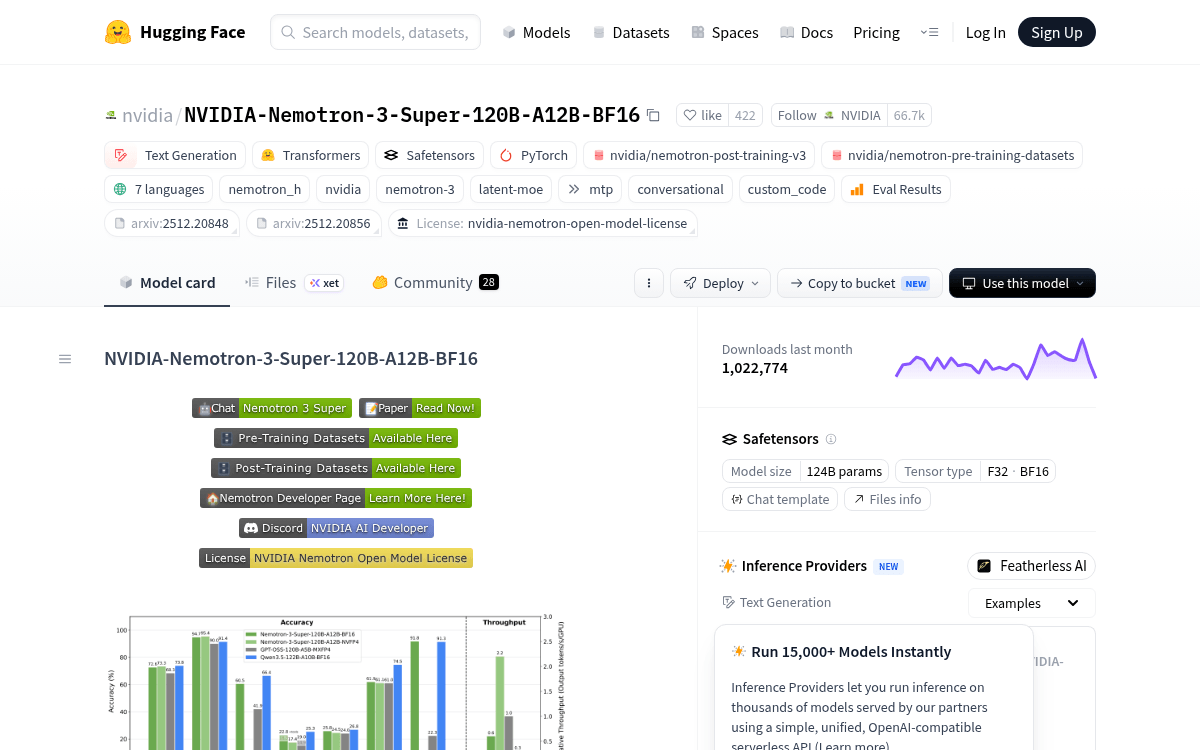
NVIDIA compares head-to-head against Qwen3.5-122B-A10B and GPT-OSS-120B, two obvious peers. Results are mixed: Nemotron 3 Super wins on some agentic and long-context tasks, loses on others, and trails Qwen3.5 on general knowledge.
| Benchmark | Nemotron 3 Super | Qwen3.5-122B | GPT-OSS-120B |
|---|---|---|---|
| MMLU-Pro | 83.73 | 86.70 | 81.00 |
| AIME25 (no tools) | 90.21 | 90.36 | 92.50 |
| HMMT Feb25 (with tools) | 94.73 | 89.55 | — |
| GPQA (with tools) | 82.70 | — | 80.09 |
| LiveCodeBench | 81.19 | 78.93 | 88.00 |
| SWE-Bench (OpenHands) | 60.47 | 66.40 | 41.9 |
| Terminal Bench Core 2.0 | 31.00 | 37.50 | 18.70 |
| RULER @ 1M | 91.75 | 91.33 | 22.30 |
| BIRD Bench (SQL) | 41.80 | — | 38.25 |
The RULER numbers at 1M tokens are the standout. Both Nemotron 3 Super and Qwen3.5 stay above 91, while GPT-OSS-120B collapses to 22.30. If your workload genuinely uses hundreds of thousands of tokens of context, the shortlist of viable open models is much shorter than it looks. On agentic coding benchmarks like SWE-Bench and Terminal Bench, however, Qwen3.5 has the edge. Chat quality on Arena-Hard-V2 also lags at 73.88 against 90.26 for GPT-OSS.
Running it
The BF16 checkpoint is aimed at 8x H100-80GB nodes. On Blackwell hardware with larger HBM, the same checkpoint fits on 2 GPUs. For single-GPU B200 or DGX Spark deployments, there is a separate NVFP4 checkpoint, which runs on any device with 64GB of RAM, VRAM, or unified memory and can be fine-tuned locally.
vLLM, SGLang, and TensorRT-LLM are all supported. A minimal vLLM launch looks like:
vllm serve nvidia/NVIDIA-Nemotron-3-Super-120B-A12B-BF16 \
  --tensor-parallel-size 8 \
  --max-model-len 262144 \
  --enable-expert-parallel \
  --kv-cache-dtype fp8 \
  --reasoning-parser nemotron_v3 \
  --enable-auto-tool-choice \
  --tool-call-parser qwen3_coder
Context defaults to 256k. To reach the full 1M window, set VLLM_ALLOW_LONG_MAX_MODEL_LEN=1 and bump --max-model-len to 1048576. NVIDIA recommends temperature=1.0 and top_p=0.95 for every mode, a departure from the low-temperature defaults most reasoning models suggest.
Three dials for reasoning
Reasoning is toggled through the chat template rather than a separate model variant. The API supports three modes:
- Full thinking (default):
enable_thinking=Trueproduces a full reasoning trace before the answer. - Reasoning off:
enable_thinking=Falseskips the trace for latency-sensitive chat. - Low-effort reasoning:
low_effort=Trueuses significantly fewer reasoning tokens, recommended as a starting point before tuning explicit budgets.
A budget-controlled mode is also available, where you set a hard ceiling like reasoning_budget=512. The model will attempt to close the trace at the next newline before the budget hits, and cut off within 500 tokens if it cannot. That kind of granular control is genuinely useful in production, where token spend on hidden reasoning can dominate cost.
Reception, and one bump in the road
Community reaction has centered on the architecture and licensing. The hybrid SSM LatentMoE design and open-weight availability drew the most attention. Early on, the original license contained clauses users described as restrictive, which NVIDIA revised shortly after release. Discussion also flagged the absence of vision capabilities as a trade-off against some contemporaries, with users weighing long context and speed against multimodal support.
What actually shifts
Two things are worth flagging. First, this is a serious existence proof for training frontier models directly in 4-bit precision. Most FP4 work so far has been post-hoc quantization; here, weights, activations, and gradients sit in NVFP4 for most of pre-training, and the resulting model competes with BF16-trained peers. Second, the combination of Mamba-2, MoE, and MTP-driven speculative decoding produces a genuinely different throughput profile at 1M context. RULER scores above 90 at a full million tokens, while GPT-OSS-120B collapses, suggest hybrid architectures may finally be delivering on their long-promised long-context advantage.
For teams building agents that live in long codebases, sprawling ticket queues, or multi-hour tool-use loops, the calculus is straightforward: an open model with 12B active parameters, native speculative decoding, and functioning 1M context sits at a different price-performance point than a dense 120B or a short-context MoE. Whether it beats Qwen3.5 for your specific agent scaffold comes down to a bake-off, but it deserves a slot in that bake-off.