
NVIDIA's Nemotron-3-Nano Squeezes 262K Context Into a Single Consumer GPU
NVIDIA compressed its 9B hybrid Mamba-Transformer down to 4B parameters, targeting agentic reasoning on Jetson Thor, RTX cards, and DGX Spark.
 Pro
Takeaways
- NVIDIA released Nemotron-3-Nano-4B-BF16, a hybrid Mamba-2 plus 4-layer attention model with 262K context.
- Compressed from Nemotron-Nano-9B-v2 using the Nemotron Elastic framework rather than trained from scratch at 4B.
- Toggleable reasoning mode: 78.5 on AIME25, 95.4 on MATH500, 91.1 on RULER 128K.
- Targets edge agentic use on Jetson Thor, RTX, and DGX Spark for NPCs, voice assistants, and IoT.
- Supports vLLM, SGLang, TRT-LLM, and Transformers with a custom reasoning parser for tool use.
- Trained on over 10T tokens using synthetic traces distilled from DeepSeek R1, Qwen3, and Nemotron 4 340B.
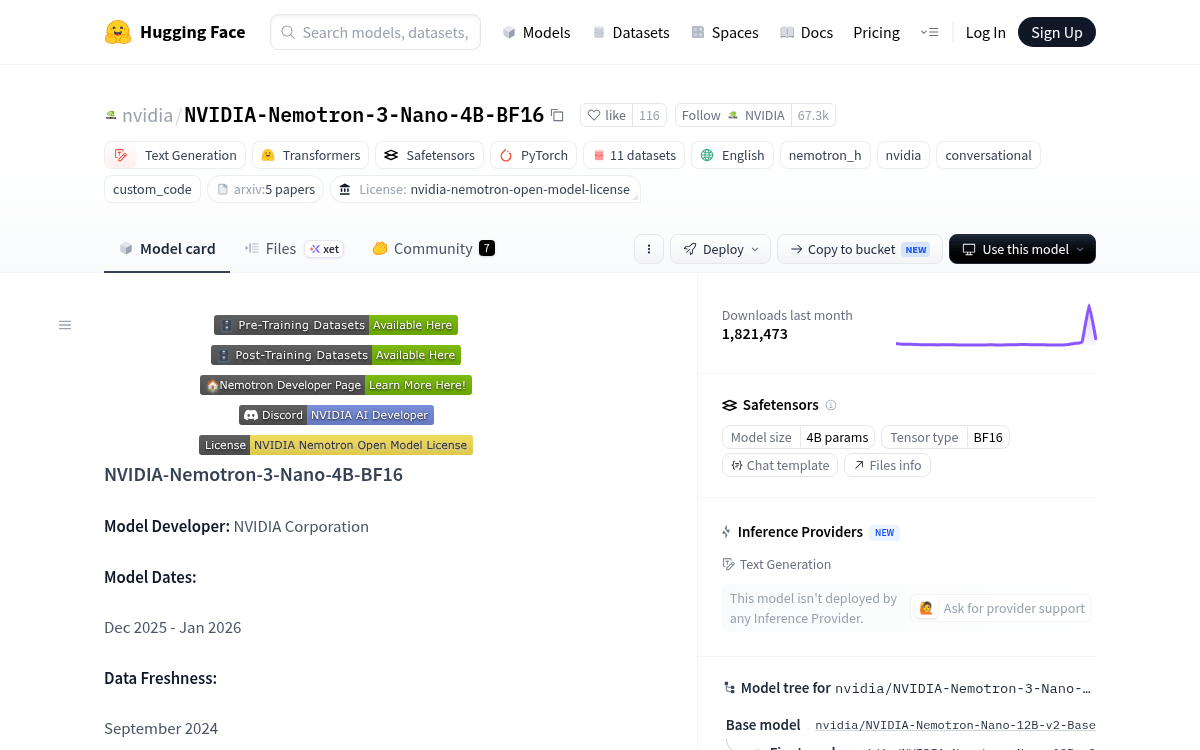
NVIDIA has released Nemotron-3-Nano-4B-BF16, a small language model built for agentic work at the edge. The architecture combines Mamba-2 and MLP layers with just four attention layers, compressed from the 9B parent NVIDIA-Nemotron-Nano-9B-v2 using the Nemotron Elastic framework. The result is a 4B-parameter model with a 262K context window that runs on a single consumer GPU and handles reasoning, tool calls, and long documents.
A hybrid built for agents
Most small models today are pure transformers. Nemotron-3-Nano leans on Mamba-2, a state-space layer that scales linearly with sequence length rather than quadratically like attention. With only four attention layers in the stack, 262K-token contexts become practical on modest hardware. The model is designed for both reasoning and non-reasoning tasks, generating a reasoning trace before producing a final response, with that behavior toggled via system prompt. Set enable_thinking=False in the chat template for direct answers, at a small accuracy cost on hard prompts.
Intended deployment targets
NVIDIA positions the model for Jetson Thor, GeForce RTX, and DGX Spark platforms, with use cases including AI gaming NPCs, local voice assistants, and IoT automation. The goal is local inference on hardware developers already own, with planning, tool calls, and structured output treated as core capabilities rather than fine-tune add-ons.
Benchmark numbers
Reasoning-on scores are where a 4B typically struggles most, and the numbers here are notably competitive:
| Benchmark | Reasoning-On | Reasoning-Off |
|---|---|---|
| AIME25 | 78.5 | - |
| MATH500 | 95.4 | - |
| GPQA | 53.2 | - |
| LiveCodeBench | 51.8 | - |
| BFCL v3 (tool calls) | 61.1 | 61.1 |
| IFEval-Instruction | 92.0 | 88.0 |
| RULER (128k) | - | 91.1 |
| Tau2-Retail | 39.8 | 34.8 |
RULER at 91.1 over 128K is the headline for anyone doing long-context retrieval or agent state tracking. AIME25 at 78.5 reaches territory that recent 4B dense models generally cannot without much longer reasoning traces.
Training and compression pipeline
Rather than pretraining a 4B from scratch, NVIDIA compressed a 9B hybrid model using the Nemotron Elastic framework, which distills multiple capability-preserving variants from a single parent across a corpus of over 10 trillion tokens. The post-training data spans English and multilingual text across code, legal, math, science, and finance, with synthetic reasoning traces from DeepSeek R1/R1-0528, Qwen3-235B-A22B, Nemotron 4 340B, and several Qwen2.5 variants. The 4B is, in practical terms, an aggressive distillation of the current generation of large open reasoning models into a compact footprint.
Running it
The model works with standard serving stacks. For vLLM, you need version 0.15.1 or newer plus a custom reasoning parser from the repo:
pip install -U "vllm>=0.15.1"
wget https://huggingface.co/nvidia/NVIDIA-Nemotron-3-Nano-4B-BF16/resolve/main/nano_v3_reasoning_parser.py
vllm serve nvidia/NVIDIA-Nemotron-3-Nano-4B-BF16 \
  --max-model-len 262144 \
  --mamba_ssm_cache_dtype float32 \
  --enable-auto-tool-choice \
  --tool-call-parser qwen3_coder \
  --reasoning-parser-plugin nano_v3_reasoning_parser.py \
  --reasoning-parser nano_v3
SGLang, TRT-LLM, and plain Transformers are also supported, with quantized builds already available for llama.cpp, Ollama, and LM Studio. Recommended sampling parameters are temperature=1.0, top_p=0.95 for reasoning and temperature=0.6, top_p=0.95 for tool calling.
Strengths and ceilings
- Long context on a budget. RULER at 91.1 over 128K competes with much larger transformers, with cheaper inference courtesy of Mamba-2.
- Math and instruction following. MATH500 at 95.4 and IFEval-Instruction at 92 are strong for the size class.
- Tool calling. BFCL v3 at 61.1 is solid, though Tau2 scores across Airline, Retail, and Telecom reveal limits in multi-turn business workflows.
- Game-agent tasks. Orak at 22.9 is modest; acting as an NPC across Mario, Darkest Dungeon, and Stardew Valley remains hard for compact models.
- English only. Despite multilingual pretraining, the model is officially released for English and code.
Why the architecture choice matters
Pure attention burns quadratic memory as context grows, which is exactly what breaks when an agent starts stacking tool outputs, retrieved documents, and multi-step reasoning traces. Replacing most attention layers with Mamba-2 keeps memory linear in sequence length while the residual attention layers preserve the pattern-matching strength that makes transformers competitive at reasoning. Paired with the Nemotron Elastic compression method, the approach suggests a different production workflow: pretrain one capable hybrid parent, then carve out size-specific children rather than running full pretraining for each footprint. For anyone shipping agents to laptops, Jetson boards, or RTX workstations, the 4B tier becomes an intended deployment target rather than a forced compromise.