
NVIDIA's Cosmos-Reason2 Doubles Accuracy on Self-Driving Safety Benchmarks at 2B Parameters
NVIDIA released a 2B open reasoning vision language model for robots and video agents that outperforms its Qwen3-VL base across physical AI benchmarks.
 Pro
Takeaways
- NVIDIA released Cosmos-Reason2-2B, an open 2B reasoning VLM for robotics and physical AI.
- Post-trained from Qwen3-VL-2B-Instruct with a 256K context, up 16x from Reason 1.
- Adds 2D/3D point localization, bounding boxes, timestamp precision, and trajectory output.
- Beats its Qwen3-VL base on nearly every physical AI benchmark, including self-driving.
- Commercial use allowed under the NVIDIA Open Model License; needs 24 GB GPU, BF16.
- Salesforce, Uber, Encord, Hitachi, and Milestone are already integrating the Cosmos Reason family.
NVIDIA quietly dropped a compact but ambitious model into the open-weight ecosystem: Cosmos-Reason2-2B, a small vision language model tuned for reasoning about the physical world. It is the smallest member of a family that also includes 8B and 32B variants, aimed at robotics, autonomous vehicles, and video analytics rather than general chat.
Feed it a video plus a text prompt and it produces a chain-of-thought followed by an answer grounded in what it sees, drawing on prior knowledge, physics, and common sense to decide what is happening and what to do next.
Under the hood
The model is a post-trained fork of Qwen3-VL-2B-Instruct, keeping the same Vision Transformer plus dense LLM architecture but retraining it on physical reasoning data. The release adds sharper spatio-temporal understanding, more precise timestamps, object detection with 2D/3D point localization and bounding box coordinates alongside reasoning explanations, and long-context understanding up to 256K input tokens.
That context window jump matters. Cosmos Reason 1 topped out at 16K input tokens, so this is a 16x expansion, which counts for a lot when you are feeding in minutes of video at 4 frames per second.
How it stacks up on physical reasoning
NVIDIA evaluated Cosmos-Reason2 head-to-head against its Qwen3-VL base across general vision, robotics, self-driving, and smart-space categories. The 2B variant beats Qwen3-VL-2B-Instruct on nearly every metric, sometimes by wide margins:
- General overall: 62.21 vs 59.60
- Robotics overall: 45.52 vs 42.07
- Self-driving overall: 57.37 vs 42.73
- Smart spaces (Warehouse AI): 64.14 vs 36.63
The self-driving and smart-spaces gaps are the most striking. On the AV Collision benchmark the 2B model scores 74.33 versus 36.33 for stock Qwen3-VL, essentially doubling accuracy on safety-critical scenarios. NVIDIA reports Cosmos Reason 2 tops the Physical AI Bench and Physical Reasoning leaderboards as the #1 open model for visual understanding.

Running it locally
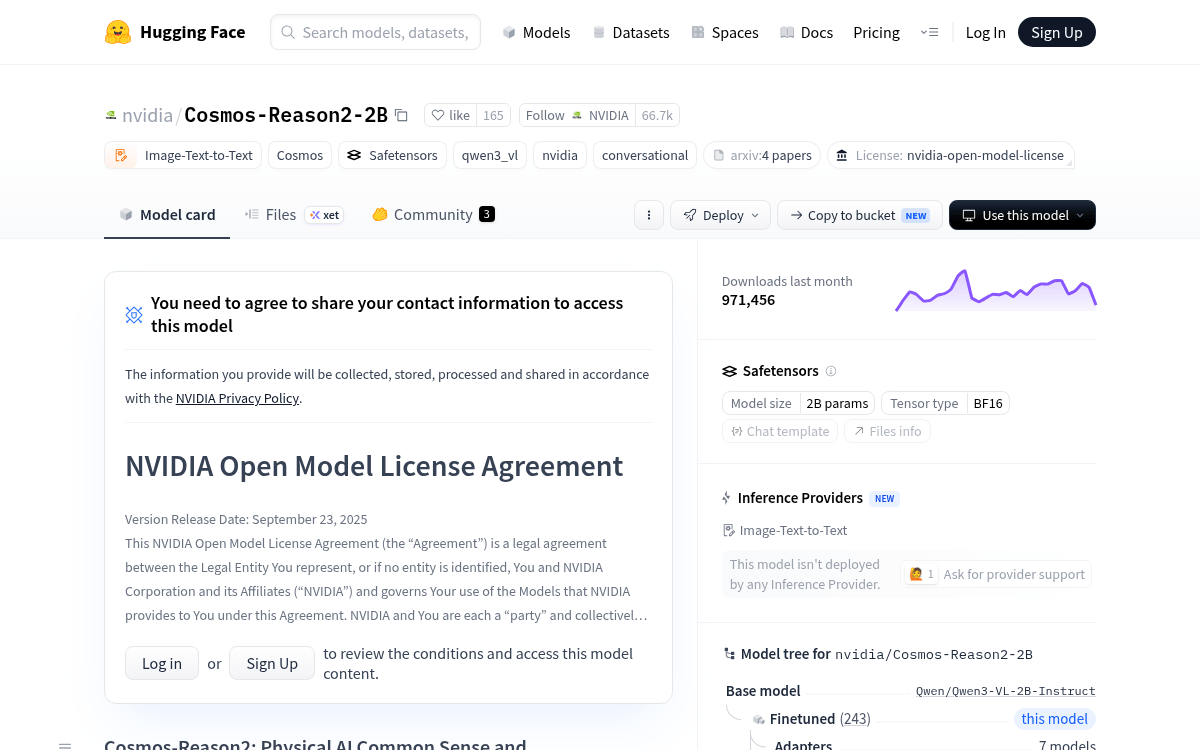
You need a Hugging Face account and have to accept NVIDIA's Open Model License, but once through the gate the weights load through the standard Transformers Qwen3-VL class. The recommended setup is fps=4 for input video and max_tokens=4096 to avoid truncated responses, tested on H100 and A100. Minimum requirement is 24 GB of GPU memory, and NVIDIA has only validated BF16 inference on Blackwell and Hopper hardware running Linux.
import transformers, torch
model = transformers.Qwen3VLForConditionalGeneration.from_pretrained(
    "nvidia/Cosmos-Reason2-2B",
    dtype=torch.float16,
    device_map="auto",
    attn_implementation="sdpa",
)
processor = transformers.AutoProcessor.from_pretrained("nvidia/Cosmos-Reason2-2B")
To get the chain-of-thought behavior, append a system prompt instructing the model to wrap reasoning in <think> tags and the final answer in <answer> tags. Skip that and you get shorter, less structured responses.
Where it earns its keep
NVIDIA points at three workloads, each already mapped to a real deployment:
- Video analytics agents for extracting insights from large volumes of recorded or live footage. Salesforce is analyzing video from Cobalt robots with Agentforce and the video search and summarization blueprint, using Cosmos Reason as the VLM.
- Data curation and annotation for physical AI training datasets. Uber is exploring Cosmos Reason 2 for autonomous vehicle training captions, with a co-authored fine-tuning recipe showing BLEU scores improving 10.6%, MCQ VQA gaining 0.67 points, and LingoQA increasing 13.8% after domain adaptation.
- Robot planning as the deliberative brain inside a vision-language-action stack. Encord provides native support for Cosmos Reason 2 in its Data Agent library for robotics and other physical AI use cases.
Where it breaks
The model card is unusually candid about failure modes. Cosmos-Reason2 may misread video or text in challenging cases involving complex scene composition and temporal dynamics, including fast camera movements, overlapping human-object interactions, low lighting with high motion blur, and multiple people performing different actions simultaneously. Anyone building safety-critical systems on top of it should treat those as hard limits.
NVIDIA also flags a life-safety warning: because the model is designed for robot planning and can serve as a VLA model, its outputs directly influence physical actuation, and planning errors carry inherent risks including physical collisions, unsafe object manipulation, or unintended interactions with humans and property.
Why 2B matters here
Most reasoning VLMs in the physical AI space are much larger. Cosmos-Reason2-2B lands at roughly 2.4 billion parameters, which makes it feasible for on-device or edge deployment on a single mid-range GPU while still beating a stronger general-purpose base model on the tasks that matter for robotics. The NVIDIA announcement also confirms Hitachi, Milestone, and VAST Data are integrating the Cosmos Reason family into production pipelines for robotics, autonomous driving, and smart-city video analytics.
The license is commercially usable and NVIDIA explicitly does not claim ownership of outputs, though you have to redistribute the license text and attribute derivatives to Cosmos. For teams building embodied agents who have been leaning on closed APIs or oversized general VLMs, this is a legitimate option that trades a bit of general knowledge for meaningfully better physical grounding.