
NVIDIA's BigVGAN v2 Quietly Became the Voice Behind 2M AI Audio Downloads
NVIDIA's universal neural vocoder turns mel spectrograms into 44 kHz audio across speech, music, and sound effects with a fused CUDA kernel for faster inference.
 Pro
Takeaways
- NVIDIA's BigVGAN v2 universal neural vocoder passes 2 million downloads on Hugging Face.
- Fused CUDA kernel delivers 1.5 to 3x faster inference on a single A100.
- Checkpoints cover 22, 24, and 44 kHz sample rates with up to 512x upsampling.
- Trained on speech, environmental sounds, and instruments for true universality.
- Quality is reported comparable to Descript Audio Codec at 44 kHz.
- Open source under MIT via the NVIDIA/BigVGAN repo.
NVIDIA has quietly cemented BigVGAN v2 as the default neural vocoder for a big chunk of the open-source audio stack. The 22 kHz checkpoint alone has crossed two million downloads on Hugging Face, and it now powers voice-cloning projects like Seed-VC along with dozens of other Spaces. If you have wondered why so many recent TTS and voice-conversion demos suddenly sound cleaner, this model is a large part of the answer.
A vocoder is the last stage in most speech synthesis pipelines. It takes a compact acoustic representation, usually a mel spectrogram, and turns it into a waveform you can play. Earlier vocoders were typically trained on one speaker or one dataset and fell apart the moment you fed them singing, drums, or a language they had not seen. BigVGAN aims to be universal: one set of weights that handles clean speech, noisy field recordings, instruments, and multilingual audio without retraining.
What v2 actually changes
The v2 release is less about a new architecture and more about pushing the same generator much harder. NVIDIA highlights four concrete upgrades:
- A custom fused CUDA kernel that delivers 1.5 to 3x speedup on a single A100 for the upsampling plus activation path.
- An improved training setup using a multi-scale sub-band CQT discriminator and a multi-scale mel spectrogram loss.
- Larger training data covering diverse audio types, including speech in multiple languages, environmental sounds, and instruments.
- Pretrained checkpoints supporting up to 44 kHz sampling rate and 512x upsampling ratio.
The 44 kHz number matters because it covers the highest sound frequency humans can hear, so there is no perceptual headroom left to chase. NVIDIA reports that the 44 kHz model reaches audio quality comparable to Descript Audio Codec, the current reference point for high-fidelity neural audio.
Inside the generator
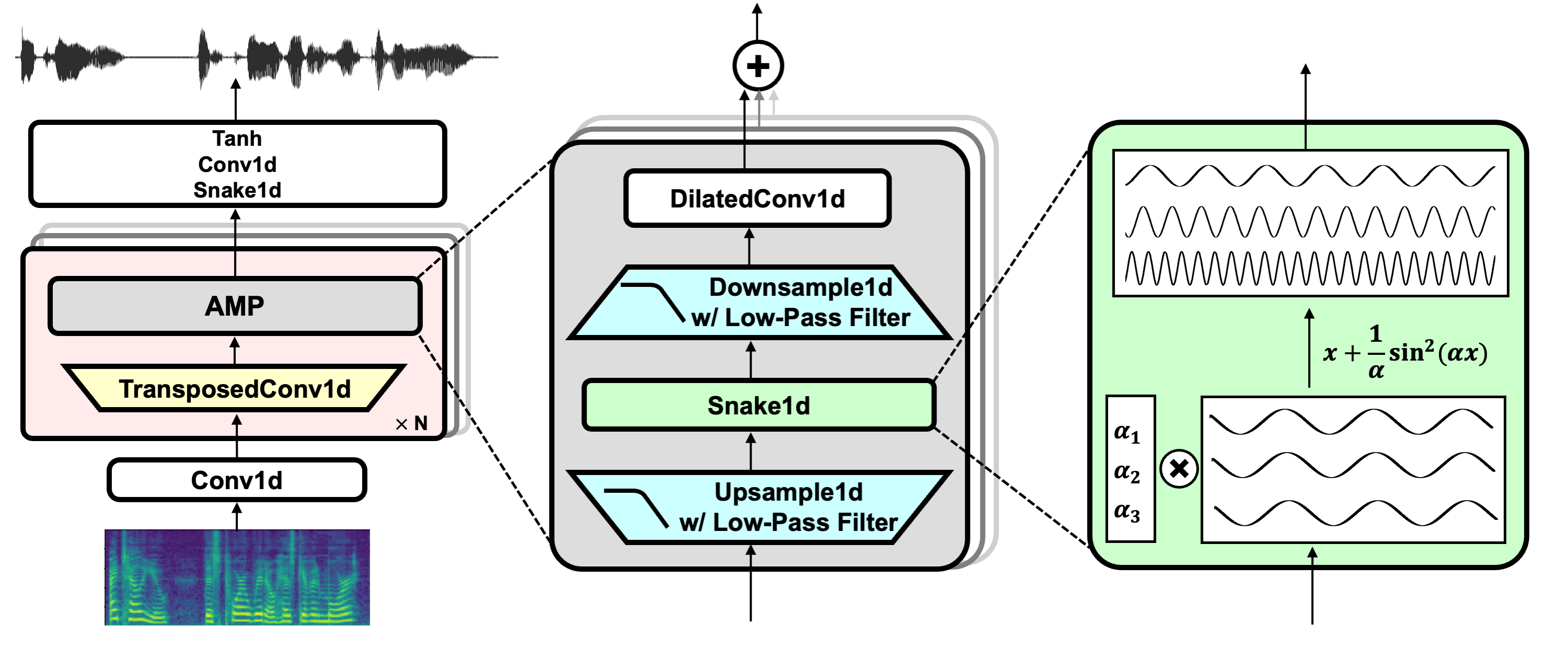
Under the hood the model is fully convolutional, with several upsampling blocks built from transposed convolutions followed by dilated residual layers. The interesting piece is a module called anti-aliased multi-periodicity composition, or AMP. Audio is periodic by nature, so AMP sums features from multiple residual branches, each tuned to a different periodicity, and applies a Snake activation to give the network a periodic inductive bias. Low-pass filters around the upsampling steps prevent aliasing, which is where a lot of older GAN vocoders produced that faint metallic buzz.
The checkpoint lineup
NVIDIA published a family of v2 weights so you can pick the one that matches your pipeline instead of resampling everything. Every checkpoint was trained for 5M steps, and this is the final release of the BigVGAN v2 weights.
| Checkpoint | Sample rate | Mel bands | Upsampling | Params |
|---|---|---|---|---|
| bigvgan_v2_44khz_128band_512x | 44 kHz | 128 | 512x | 122M |
| bigvgan_v2_44khz_128band_256x | 44 kHz | 128 | 256x | 112M |
| bigvgan_v2_24khz_100band_256x | 24 kHz | 100 | 256x | 112M |
| bigvgan_v2_22khz_80band_256x | 22 kHz | 80 | 256x | 112M |
All of them share the same MIT license and were trained on the same large-scale compilation, so the choice is mostly about matching your acoustic model's output config.
Running it
Inference is a three-line affair once you have the BigVGAN repo installed. You load the weights straight from the Hub, feed in a mel spectrogram, and get back a float waveform:
import bigvgan, torch
from meldataset import get_mel_spectrogram
model = bigvgan.BigVGAN.from_pretrained(
    'nvidia/bigvgan_v2_22khz_80band_256x', use_cuda_kernel=True)
model.remove_weight_norm()
model = model.eval().cuda()
mel = get_mel_spectrogram(wav, model.h).cuda()
with torch.inference_mode():
    audio = model(mel)
The use_cuda_kernel=True flag unlocks the fused activation kernel. On first use it builds the kernel with nvcc and ninja, then caches it to alias_free_activation/cuda/build so subsequent runs load it automatically. The codebase has been tested with CUDA 12.1. Skip the flag and everything still works in pure PyTorch, just slower.
Why it matters for pipelines
Most of the current TTS wave, whether diffusion-based, autoregressive, or flow-matching, ends by predicting a mel spectrogram. The vocoder decides whether the final audio sounds like a professional recording or a compressed voicemail. By training one model that handles clean speech, noisy environments, singing, and instruments together, NVIDIA has effectively removed the vocoder as a variable when comparing TTS or voice-conversion systems. For anyone building a speech or music pipeline, dropping in one of these checkpoints is close to a free quality upgrade.