
Norway's National Library AI Lab Hits 1M Downloads With Open Norwegian Speech Model
A billion parameter Norwegian speech recognition model from the National Library of Norway crosses one million downloads with an updated v2 checkpoint.
 Pro
Takeaways
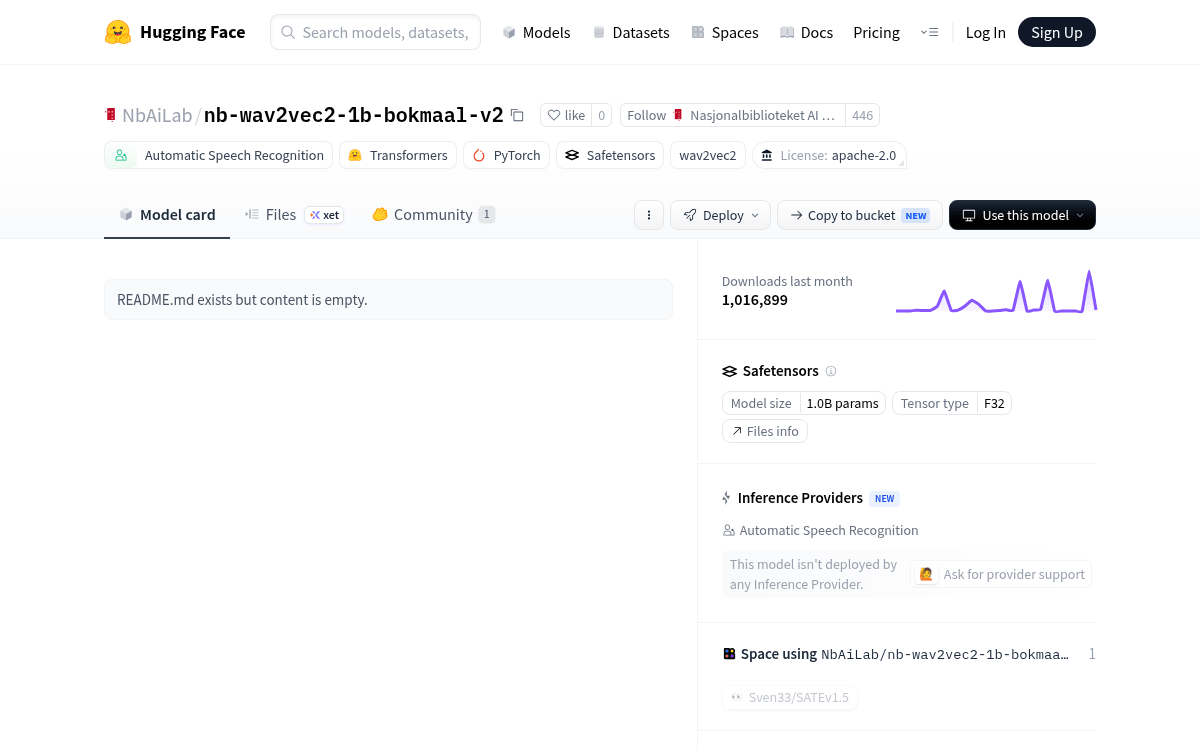
- NbAiLab released nb-wav2vec2-1b-bokmaal-v2, a 1B parameter Norwegian Bokmål ASR model, now past 1M downloads.
- Fine-tuned from Meta's XLS-R 1B on the Norwegian Parliamentary Speech Corpus, Apache 2.0 licensed.
- The v1 baseline hit 6.33% WER on NPSC with a 5-gram KenLM, 7.38% without.
- The NbAiLab team cut Norwegian ASR state of the art from 17.10% to 7.60% WER.
- CTC model with no built-in punctuation or timestamps, weaker on dialects and noisy audio.
- Fine-tuning is cheap enough to run on a single average GPU in under a day.
Norwegian gets skipped by most mainstream speech recognition stacks, and when it is supported, accuracy typically trails English by a wide margin. The nb-wav2vec2-1b-bokmaal-v2 model from the National Library of Norway AI Lab fills that gap for Bokmål, the dominant written standard, and has now crossed one million downloads on Hugging Face.
The v2 checkpoint refreshes the lab's billion-parameter wav2vec2 fine-tune of Meta's XLS-R feature extractor. It ships as a standard AutoModelForCTC under Apache 2.0, with 1.0B parameters stored in Safetensors format. The original v1 reported a 6.33% word error rate on the Norwegian Parliamentary Speech Corpus test set with a 5-gram KenLM language model, and 7.38% without one.
Loading and running the model
The Transformers pipeline entry point works the same as any other CTC model:
from transformers import pipeline
pipe = pipeline(
    "automatic-speech-recognition",
    model="NbAiLab/nb-wav2vec2-1b-bokmaal-v2",
)
text = pipe("my_audio.wav")["text"]
Audio must be sampled at 16 kHz. The v2 repo does not bundle a language model, but attaching a 5-gram KenLM the same way the v1 did will recover a couple of WER points. You can build one from your own corpus by extracting text from the Norwegian Colossal Corpus, or copy the 5-gram model from the sibling repo. Hugging Face publishes a guide on adding a 5-gram language model to an ASR model if you need a walkthrough.
Why this model exists
Norway has two official written standards, Bokmål and Nynorsk, and both are severely underrepresented in commercial ASR systems. The NbAiLab team pushed the state of the art on the Norwegian Parliamentary Speech Corpus from a 17.10% word error rate down to 7.60% overall, with per-standard results of 5.81% for Bokmål and 11.54% for Nynorsk. The team also converted the parliamentary corpus into the NbAiLab/NPSC Hugging Face dataset, released all training code, and documented the work in the Boosting Norwegian ASR paper at NoDaLiDa.
Strengths and limits
- Strong on formal Bokmål. Training data skews heavily toward parliamentary recordings: clean, articulate speech in a neutral register.
- Bokmål only. The sibling nb-wav2vec2-1b-nynorsk handles Nynorsk.
- CTC output, not seq2seq. Unlike Whisper, there is no built-in punctuation, casing, or timestamp prediction. Output is lowercase; everything else you add yourself.
- Weak on dialects and noise. Norwegian is dialect-rich, and the parliamentary training distribution skews formal, so accuracy drops on regional speech, spontaneous conversation, and low-SNR recordings.
Retraining on modest hardware
The wav2vec2 lineage is tractable on a single GPU. Following the team's published recipe, domain adaptation to call center audio, medical dictation, or media captioning should run in under a day on average hardware, which makes v2 a realistic starting point rather than a fixed black box.
The model runs under Apache 2.0, self-hosted on a GPU or via transformers on CPU for short clips. There is no managed inference provider on Hugging Face, so deployment is fully on your own infrastructure. For teams building Norwegian voice interfaces, dictation tools, or transcription pipelines, it remains one of the few open, high-accuracy options that does not require routing audio through a closed API.