
Northwestern's DNABERT-2 Beats Billion-Parameter Rivals With 21x Fewer Parameters
A compact 117M-parameter genome foundation model swaps k-mer tokenization for Byte Pair Encoding, matching top benchmarks with 21x fewer parameters.
 Pro
Takeaways
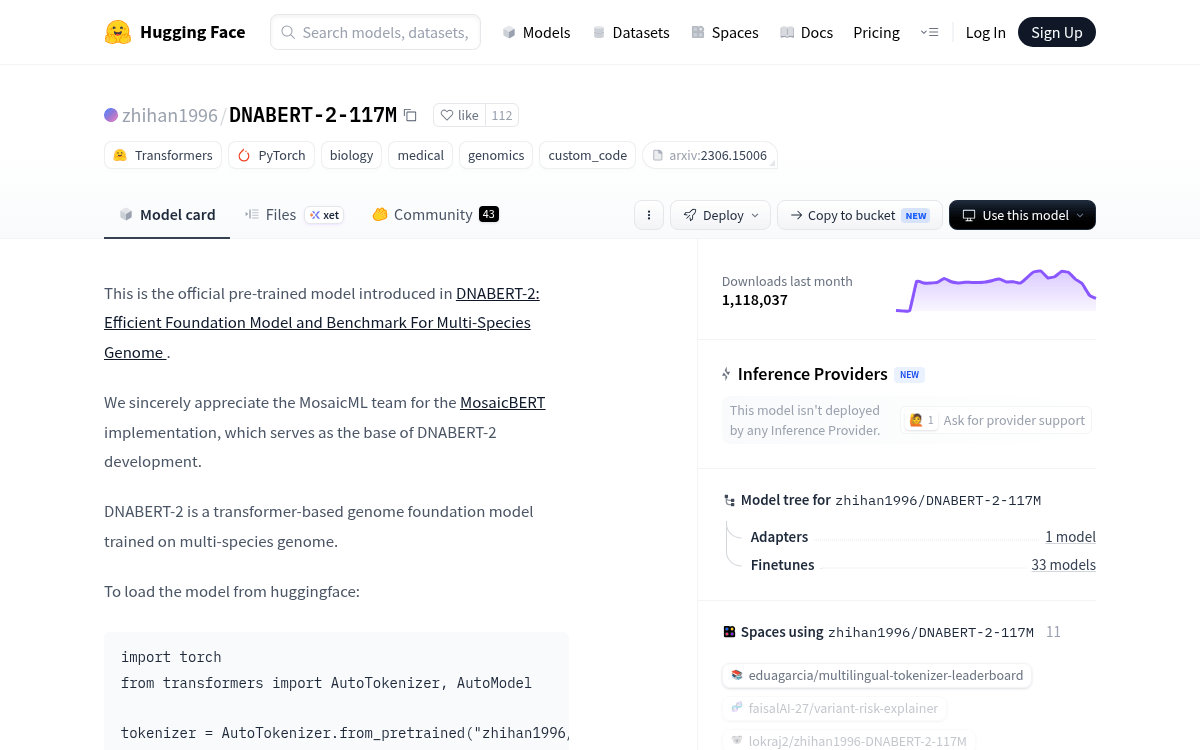
- DNABERT-2-117M is a compact genome foundation model with 1.1M+ downloads on Hugging Face.
- Replaces k-mer tokenization with Byte Pair Encoding for longer effective context and higher efficiency.
- Matches state-of-the-art with 21x fewer parameters and 56x less GPU pretraining time.
- Trained on multi-species genomes, particularly strong on non-human genomic tasks.
- Ships with the GUE benchmark covering 28 genome classification datasets.
- Published at ICLR 2024; code at MAGICS-LAB/DNABERT_2.
Genomics has been having its own transformer moment, and one of the workhorses driving it just crossed 1.1 million downloads on Hugging Face. DNABERT-2-117M is a compact encoder-only model built to read DNA sequences the way BERT reads English, and it has become a default starting point for anyone fine-tuning on genomic tasks.
The model comes from a team at Northwestern and Stony Brook, with the accompanying paper accepted at ICLR 2024. Its most interesting design decision sits in the tokenizer, not the architecture.
Killing the k-mer
Earlier genome models like the original DNABERT and Nucleotide Transformer tokenized DNA using k-mers: fixed-length permutations of A, T, C, and G. Simple to implement, but the authors argue the approach breaks down at scale, introducing computation and sample inefficiencies that block progress toward larger genomic foundation models.
Their fix is borrowed from NLP. Byte Pair Encoding (BPE) replaces k-mer tokenization by iteratively merging the most frequent co-occurring genome segments in the training corpus until a target vocabulary size is reached. Frequent motifs collapse into single tokens, sequences compress into far fewer tokens, and the model can attend to longer stretches of DNA without expanding its context window.
Small model, big benchmark wins
The efficiency numbers are the headline. On the Genome Understanding Evaluation (GUE) benchmark, DNABERT-2 matches state-of-the-art performance with roughly 56x less GPU time: about 14 days on 8 NVIDIA RTX 2080Ti GPUs versus 17 days on 128 NVIDIA A100 GPUs. It also uses 21 times fewer parameters than the top competing model.
The team also built GUE themselves, citing the absence of a standardized benchmark as an obstacle to fair comparison across genomic models. The benchmark covers 28 datasets spanning classification tasks across human and non-human genomes. DNABERT-2 and NT-2500M-multi lead most tasks, with the performance gap over other baselines widest on non-human genome analysis.
What you can plug it into
DNABERT-2 is an embedding backbone. Feed it a DNA sequence and get back a 768-dimensional representation per token, which you can pool or fine-tune for downstream classification. Common use cases include:
- Promoter and enhancer detection
- Transcription factor binding site prediction
- DNA methylation and chromatin state analysis
- Variant effect prediction
- Splice site classification and COVID variant identification
Loading it requires the trust_remote_code flag due to the custom tokenizer and modeling code:
from transformers import AutoTokenizer, AutoModel
import torch
tok = AutoTokenizer.from_pretrained("zhihan1996/DNABERT-2-117M", trust_remote_code=True)
model = AutoModel.from_pretrained("zhihan1996/DNABERT-2-117M", trust_remote_code=True)
dna = "ACGTAGCATCGGATCTATCTATCGACACTTGGTTATCGATCTACGAGCATCTCGTTAGC"
ids = tok(dna, return_tensors="pt")["input_ids"]
hidden = model(ids)[0]                       # [1, seq_len, 768]
embedding = torch.mean(hidden[0], dim=0)     # 768-d sequence vector
Limitations worth knowing
- Encoder-only architecture means no sequence generation. For generative tasks, HyenaDNA or Evo are the current reference points.
- Context length, while improved by BPE, remains bounded compared to long-range state-space models built for whole-chromosome inputs.
- The
trust_remote_code=Truerequirement blocks use in some production environments. - Performance advantages over Nucleotide Transformer variants are strongest on non-human tasks; on some human-only benchmarks the gap narrows considerably.
Why it keeps trending
With 33 public fine-tunes and adoption across biosentinel, variant-risk, and antimicrobial-resistance projects on the official repo, the uptake reflects a practical constraint: most genomics labs do not have 128 A100s available. A 117M-parameter model that fits on a single consumer GPU, ships a standardized benchmark, and matches billion-parameter competitors on downstream tasks is the pragmatic default for building sequence classifiers over DNA.
The broader pattern generalizes beyond biology. Swapping k-mers for BPE gave the authors more headroom than scaling parameters would have, a finding worth tracking as foundation models move into protein, RNA, and single-cell modalities where tokenization choices remain unsettled.