
Nomic's nomic-embed-text-v1 Beats OpenAI Embeddings With 4M Downloads
Nomic Embed ships an 8192-token open-weights text encoder that beats OpenAI's Ada-002 and text-embedding-3-small on MTEB and LoCo benchmarks.
 Pro
Takeaways
- Open-weights 8192-token embedder beating OpenAI Ada-002 and text-embedding-3-small on MTEB and LoCo
- Apache 2.0 with full training code, weights, and 235M curated text-pair dataset released
- 137M parameter encoder, small enough to run in-browser via Transformers.js and ONNX
- Requires task prefixes (search_document, search_query, clustering, classification) for correct behavior
- Multimodal via nomic-embed-vision-v1 aligned to the same embedding space
- Technical report accepted to TMLR; trainable in one week on 8xH100
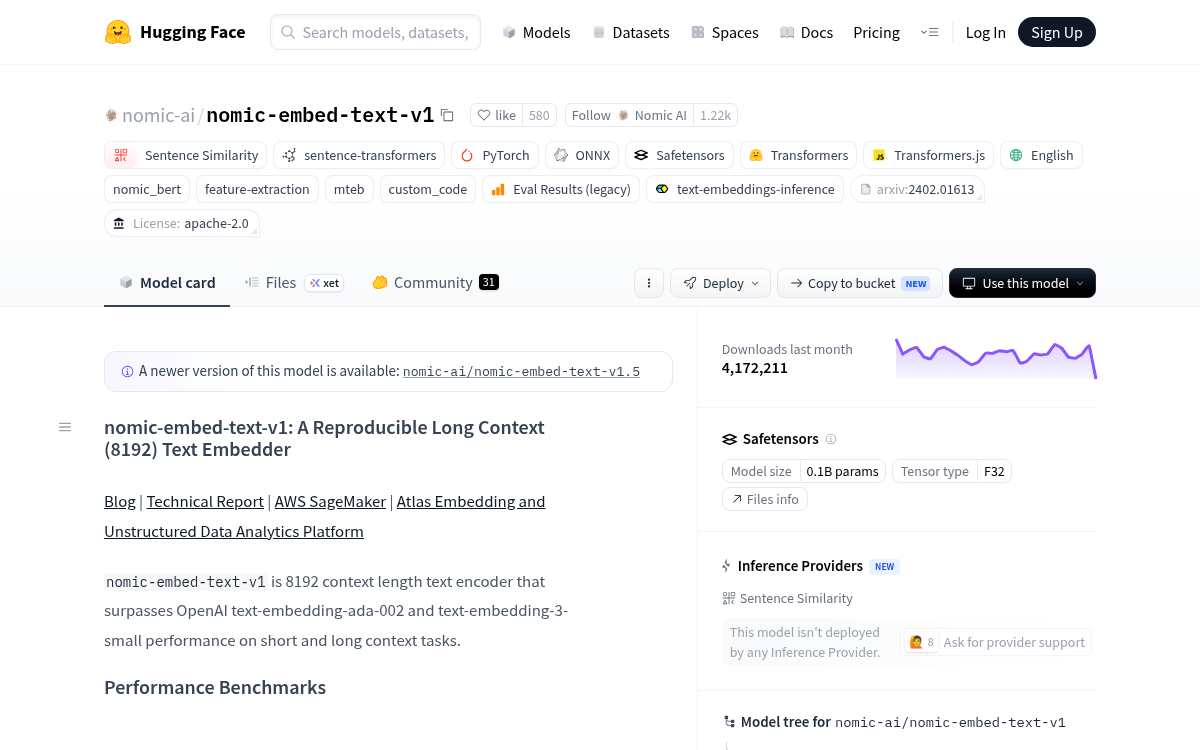
Text embeddings power most modern retrieval systems, yet the strongest models have historically been closed APIs. nomic-embed-text-v1 takes a different route, publishing weights, training code, and the full curated dataset under Apache 2.0 while matching or beating OpenAI's hosted embedding models on standard benchmarks. It has quietly become one of the most downloaded embedding models on Hugging Face, with over 4 million downloads and 4,000+ likes on the model card.
What you actually get
The technical report describes nomic-embed-text-v1 as the first fully reproducible, open-source, open-weights, open-data, 8192 context length English text embedding model that outperforms OpenAI Ada-002 and text-embedding-3-small on the short-context MTEB benchmark and the long-context LoCo benchmark. The paper was later accepted to TMLR.
Under the hood sits a compact 137M-parameter encoder based on a long-context BERT variant (nomic-bert-2048). It is the only 100M-parameter class open-source model that beats both text-embedding-ada-002 and text-embedding-3-small on short and long-context tasks.
Reading the benchmarks
On the three headline benchmarks, the tradeoffs are clear:
| Model | SeqLen | MTEB | LoCo | Jina LC |
|---|---|---|---|---|
| nomic-embed-text-v1 | 8192 | 62.39 | 85.53 | 54.16 |
| jina-embeddings-v2-base-en | 8192 | 60.39 | 85.45 | 51.90 |
| text-embedding-3-small | 8191 | 62.26 | 82.40 | 58.20 |
| text-embedding-ada-002 | 8191 | 60.99 | 52.70 | 55.25 |
Nomic leads on MTEB (short context) and LoCo (long context) but trails OpenAI's text-embedding-3-small on the Jina Long Context benchmark. For long-document retrieval in the Ada-002 style, the open model wins comfortably. For queries that look like the Jina LC distribution, the gap flips.
Task prefixes are mandatory
One quirk trips up first-time users: every input must carry a task instruction prefix telling the model what job it is doing. In a RAG setup, documents get embedded as search_document: and user queries as search_query:. The four supported prefixes are:
search_documentfor texts stored in a retrieval indexsearch_queryfor user questions hitting that indexclusteringfor grouping, topic discovery, or dedupclassificationfor feature vectors feeding a downstream classifier
Forgetting the prefix silently degrades retrieval quality, so it is the first thing to check when results look off.
Minimal usage
from sentence_transformers import SentenceTransformer
model = SentenceTransformer("nomic-ai/nomic-embed-text-v1", trust_remote_code=True)
docs = ["search_document: TSNE is a dimensionality reduction algorithm"]
queries = ["search_query: Who created t-SNE?"]
doc_emb = model.encode(docs)
q_emb = model.encode(queries)
The model also runs in the browser via Transformers.js and ships ONNX weights, which makes it viable for on-device retrieval where sending text to a hosted API is off the table.
Inside the training recipe
The pipeline is multi-stage contrastive learning on top of a long-context BERT (nomic-bert-2048). An unsupervised stage trains on weakly related pairs like StackExchange question-answer pairs, Amazon review title-body pairs, and news summaries. A supervised finetuning stage then uses higher-quality labeled data such as search queries paired with their answers, with hard-negative mining doing most of the heavy lifting.
The scale is more approachable than you might expect. Full training runs in one week on an 8xH100 node across masked language modeling and contrastive pretraining stages. The team also released a training data loader with 235 million curated text pairs that allows full replication of the model.
Why fully open matters
Most "open" embedding models release weights but keep the training data private, which means you cannot audit contamination, extend the corpus, or reproduce the numbers. The Nomic Embed paper and the contrastors repository release both the code and the curated pair dataset, so a research group with a mid-sized cluster can rerun the pipeline and swap in their own domain data.
A multimodal companion, nomic-embed-vision-v1, is aligned to the same embedding space, so text vectors from v1 can be compared directly against image vectors from the vision model. Useful if you already have a text index and want to add image search without re-embedding everything.
Where it fits
The obvious slot is RAG over long documents, where 8192 tokens per chunk cuts down on chunk-boundary artifacts and lets you index whole sections rather than sliced paragraphs. It is also a strong default for clustering large corpora, deduping semantic near-duplicates, and building classifier features on top of a frozen encoder. The main gaps are non-English text and use cases that need Matryoshka-style truncatable embeddings, both of which are addressed by the newer nomic-embed-text-v1.5 release that Hugging Face now points to as the successor.