
NLP Town's ModernBert Sentiment Model Cuts Errors 40% but Drops Multilingual Support
NLP Town shipped a ModernBert-based upgrade to its widely-used sentiment classifier, cutting product review errors by 40 percent with 10x more training data.
 Pro
Takeaways
- NLP Town released a ModernBert-based sentiment classifier with 40% fewer errors on product reviews.
- Original multilingual BERT model has surpassed 42 million downloads on Hugging Face.
- New version trained on 10x more data, optimized for English only, drops the other five languages.
- Uses ModernBert backbone with Flash Attention and Rotary Positional Embeddings for longer context and faster inference.
- Priced at $999 commercial license via Gumroad; original multilingual model remains free under MIT.
- Live demo available on Hugging Face Spaces for side-by-side comparison.
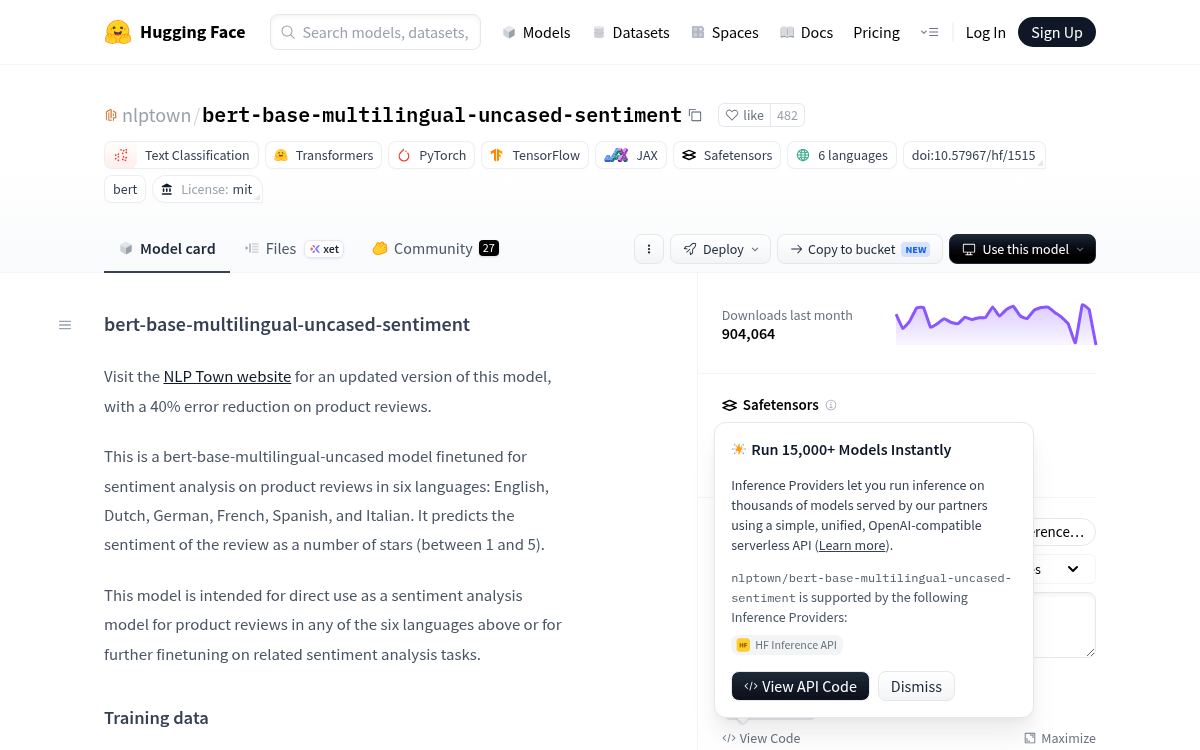
The team behind one of Hugging Face's most-downloaded sentiment models has quietly rolled out a next-generation version, and the numbers are worth attention. NLP Town, a Belgium-based NLP consultancy, released a paid ModernBert-based sentiment classifier that cuts errors on product reviews by 40 percent compared to their long-running open-source baseline. The original multilingual BERT model has been downloaded more than 42 million times, so any meaningful accuracy bump matters for a large chunk of production pipelines already running this classifier.
What actually shipped
The new model is a drop-in replacement for the classic star-rating classifier, rebuilt on a modern encoder backbone. It runs on ModernBert, is optimized for English, trains on roughly 10x more data, and cuts errors by 40 percent on product reviews. The trade-off is the key story: the original covered English, Dutch, German, French, Spanish, and Italian, while the upgrade drops the other languages to squeeze more accuracy out of English review data.
The output format stays familiar. Feed in a review, get back a star rating from 1 to 5, matching the original checkpoint's interface. If you have a pipeline built around the old model, swapping in the new one should not require rewriting your downstream logic.
Why ModernBert matters here
ModernBert, released by Answer.AI in late 2024, is a rebuild of the classic BERT encoder with modern training techniques. It addresses BERT's inefficiency and limited context handling, and uses Flash Attention and Rotary Positional Embeddings for faster processing and longer text support. For sentiment analysis on product reviews specifically, two things matter:
- The extended context window handles long-form reviews (think Amazon paragraphs, not tweets) without truncation.
- Flash Attention makes inference substantially cheaper per token, which counts when scoring millions of reviews.
Combined with a training corpus roughly ten times larger than the original, the architecture upgrade explains how NLP Town got a 40 percent error cut without changing the task definition.
The pricing twist
The old multilingual checkpoint remains free and MIT-licensed on Hugging Face. The new ModernBert version is sold as a commercial product on Gumroad for $999, with the model files delivered for direct use in Hugging Face transformers. You can test it live on the Hugging Face Space before buying, which lets you compare both models side by side on your own text.
Loading the free multilingual version still looks like this:
from transformers import AutoTokenizer, AutoModelForSequenceClassification
model_id = "nlptown/bert-base-multilingual-uncased-sentiment"
tokenizer = AutoTokenizer.from_pretrained(model_id)
model = AutoModelForSequenceClassification.from_pretrained(model_id)
Sharp edges and honest limits
The strength is narrow and well-defined: English product reviews with a 5-point rating output. That fits e-commerce companies, review platforms, and anyone aggregating customer sentiment, detecting trends, or surfacing particularly positive or negative feedback.
The trade-offs are equally clear:
- English-only. If you need Dutch, German, French, Spanish, or Italian, stay on the free multilingual checkpoint.
- Product-review domain. The training data skews to consumer reviews, so financial news, medical text, or social media sarcasm will need domain-specific alternatives like FinBERT or a fine-tuned variant.
- Ordinal output. You get a star rating, not aspect-based sentiment or emotion labels.
The encoder comeback
This release fits a broader pattern of teams revisiting classic encoder tasks with ModernBert. Similar upgrades have shipped recently, including ModernFinBERT, trained on a mix of real and synthetic data with LLM-based label correction applied to public datasets, which reports up to 48 percent accuracy gains over existing models like FinBERT. Multilingual variants have appeared too, such as clapAI's ModernBERT-large-multilingual-sentiment, which covers 16+ languages including Vietnamese, Chinese, Portuguese, Russian, Japanese, Korean, and Arabic.
Small, task-specific encoders still have plenty of runway. For high-volume classification workloads where you would otherwise pay per-token to a general-purpose LLM, a 150-million parameter ModernBert model running on a single GPU can be dramatically cheaper and often more accurate on its trained domain. The NLP Town release is a concrete data point: a 40 percent error reduction on a task that many teams still ship to production, delivered by an encoder small enough to run on commodity hardware.