
Neural Magic Shrinks SmolLM to Under 1GB Without Losing Accuracy
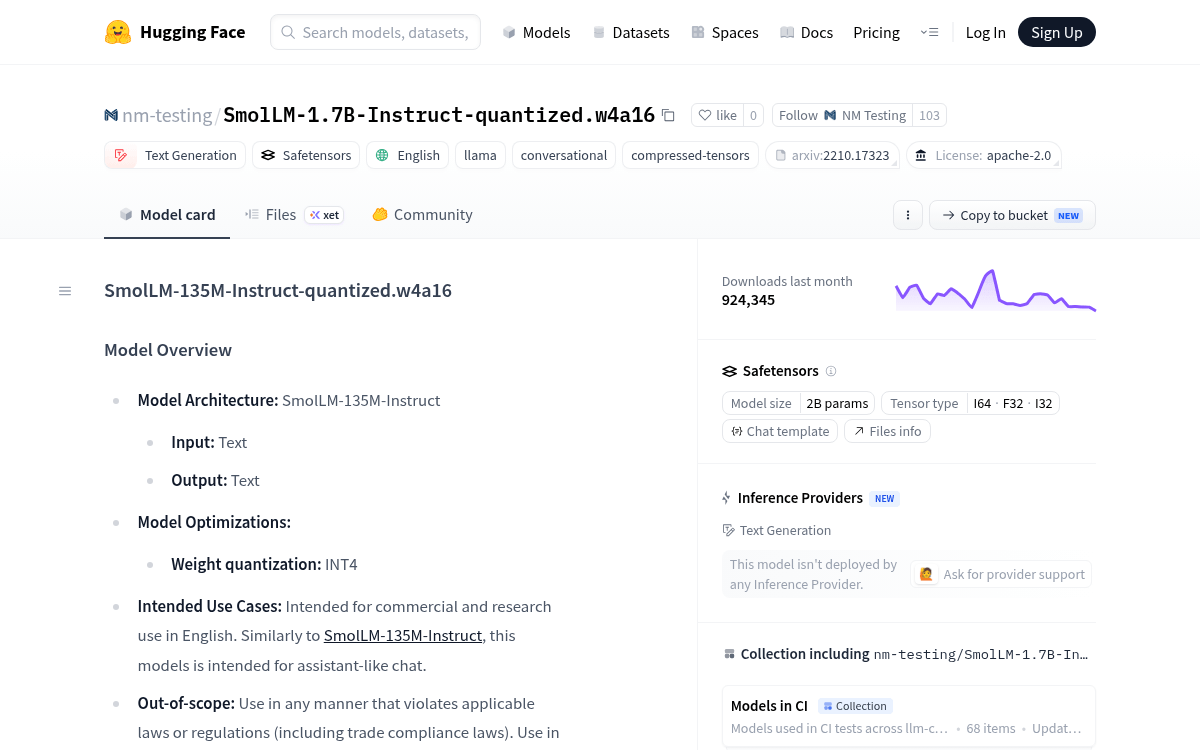
Neural Magic's 4-bit GPTQ quantization shrinks SmolLM-1.7B-Instruct by roughly 75% while preserving benchmark accuracy, and it has crossed 924K downloads.
 Pro
Takeaways
- Neural Magic released a w4a16 GPTQ quantization of SmolLM-1.7B-Instruct with 924K+ downloads.
- 4-bit weights and 16-bit activations shrink disk and GPU memory footprint by roughly 75%.
- Compression uses the llm-compressor library with group size 64 and 512 calibration samples.
- Accuracy recovery averages 101% versus the FP16 baseline on OpenLLM Leaderboard v1 tasks.
- Apache-2.0 licensed, loads through standard Transformers, and runs natively in vLLM.
- Best for edge assistants, high-throughput pipelines, speculative decoding drafts, and local prototyping.
A tiny instruction-tuned language model just got tinier. Neural Magic has published a w4a16 quantized build of SmolLM-1.7B-Instruct that compresses the weights to 4-bit integers while keeping activations at 16-bit precision. The checkpoint has quietly racked up more than 924,000 downloads on Hugging Face, making it one of the more heavily used small-model quantizations in circulation.
The base model comes from Hugging Face's SmolLM family, a series available in three sizes (135M, 360M, and 1.7B parameters) built on Cosmo-Corpus. That training set combines Cosmopedia v2 (28B tokens of synthetic textbooks and stories generated by Mixtral), Python-Edu (4B tokens of educational Python samples from The Stack), and FineWeb-Edu (220B tokens of deduplicated educational web samples). The Instruct variant was tuned on a permissive subset of WebInstructSub combined with StarCoder2-Self-OSS-Instruct, followed by one epoch of Direct Preference Optimization using HelpSteer for the 1.7B checkpoint.
Decoding w4a16
The naming scheme is Neural Magic shorthand: 4-bit weights, 16-bit activations. Quantizing SmolLM-Instruct's weights to INT4 cuts the bits per parameter from 16 down to 4 and shrinks disk and GPU memory footprint by roughly 75%. Only the weights inside transformer linear layers are touched, and symmetric group-wise quantization is applied, where a linear scaling per group maps INT4 values to their floating point equivalents.
The compression algorithm is GPTQ, a post-training method that quantizes weights layer by layer while using a small calibration set to minimize the error introduced at each step. The recipe uses a 10% dampening factor, a group size of 64, and 512 calibration sequences drawn from Neural Magic's LLM Compression Calibration dataset. The tooling is Neural Magic's open-source llm-compressor library, and the compression run is essentially a one-shot pass with GPTQModifier targeting linear layers and ignoring the lm_head.
Accuracy holds up
The model card reports OpenLLM Leaderboard v1 numbers for the smaller SmolLM-135M variant of the same recipe, and the pattern is what you would expect from a well-behaved GPTQ run. The quantized 135M version actually edges out the FP16 baseline on average.
| Benchmark | SmolLM-Instruct (FP16) | w4a16 quantized | Recovery |
|---|---|---|---|
| MMLU (5-shot) | 26.22 | 25.20 | 96.12% |
| ARC Challenge (25-shot) | 29.95 | 30.03 | 100.29% |
| GSM-8K (5-shot) | 1.29 | 1.97 | 152.91% |
| HellaSwag (10-shot) | 41.41 | 40.81 | 98.55% |
| Winogrande (5-shot) | 50.04 | 53.59 | 107.10% |
| TruthfulQA (0-shot) | 40.38 | 39.87 | 98.74% |
| Average | 31.55 | 31.91 | 101.16% |
The GSM-8K jump is more statistical noise than a real math breakthrough, since both scores are essentially zero. MMLU, HellaSwag, and TruthfulQA all sit within a couple of points of the unquantized baseline, which is the usual bar for a successful 4-bit compression.
Running it
The model ships in the compressed-tensors format, which is natively supported by vLLM and by the Transformers integration bundled with llm-compressor. Loading is a normal from_pretrained call, no custom kernels required on the user side:
from transformers import AutoModelForCausalLM, AutoTokenizer
model_id = "nm-testing/SmolLM-1.7B-Instruct-quantized.w4a16"
tok = AutoTokenizer.from_pretrained(model_id)
model = AutoModelForCausalLM.from_pretrained(model_id, device_map="auto")
msgs = [{"role": "user", "content": "Write a haiku about quantization."}]
inputs = tok.apply_chat_template(msgs, return_tensors="pt").to(model.device)
print(tok.decode(model.generate(inputs, max_new_tokens=64)[0]))
Licensing is Apache-2.0, so commercial use is fair game.
Where this actually fits
SmolLM-1.7B was never going to compete with a 70B model on hard reasoning, and its 4-bit descendant won't either. What you get is a chat-capable model that fits comfortably in under a gigabyte of GPU memory for weights, leaving room for large batch sizes or long-context KV caches on modest hardware. Practical spots where this shines:
- On-device or edge assistants where every hundred megabytes of RAM matters
- High-throughput classification, tagging, or reformatting pipelines behind vLLM
- Draft models for speculative decoding in front of a larger target model
- CI test fixtures for compression tooling, which is how Neural Magic itself uses it
- Local prototyping when you want a real instruction-tuned model without the memory hit
Weak spots include multilingual work, long-form reasoning, code generation beyond simple Python, and anything factually load-bearing. SmolLM2 documentation notes the models primarily understand English and that generated content may not always be factually accurate, logically consistent, or free from bias, so they should be treated as assistive tools and important information should be verified. The same caveats apply here, arguably more so given the extra quantization noise.
The broader signal is that 4-bit GPTQ has become boring in the best sense. A recipe that used to require careful hand-tuning is now a handful of lines of llm-compressor config, produces predictable single-digit-percent accuracy drops, and slots into vLLM without ceremony. For anyone shipping a small model to production, that maturity is the real story.