
Naver's HyperCLOVA X SEED Beats Qwen and Gemma on Korean at 1.5B
Naver's HyperCLOVA X team released a 1.5B Korean-focused instruction model that beats Qwen2.5 and Gemma 3 on Korean benchmarks.
 Pro
Takeaways
- Naver's HyperCLOVAX-SEED-Text-Instruct-1.5B is an open-weight 1.5B Korean-focused instruction model with a 16k context window.
- Beats Qwen2.5-1.5B-instruct and Gemma-3-1B-it on all four major Korean benchmarks (KMMLU, HAE-RAE, CLiCK, KoBEST).
- Trained in four stages: two pretraining passes, rejection sampling fine-tuning, then supervised fine-tuning.
- Long-context reinforcement was applied from pretraining through SFT to stabilize the 16k window.
- Runs via Transformers, vLLM, SGLang, or as a community GGUF build for llama.cpp and Ollama.
- Part of a SEED family including 0.5B and 3B variants aimed at edge and cost-sensitive deployment.
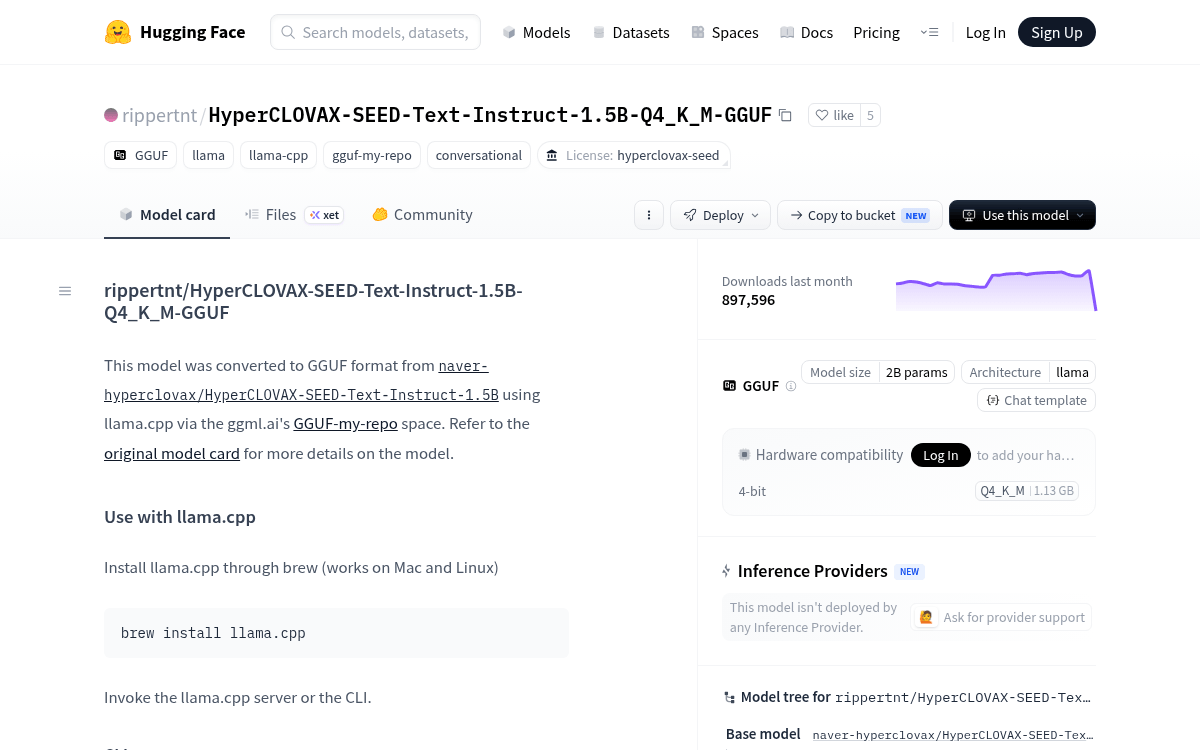
Naver has quietly become one of the more interesting players in small language models with its HyperCLOVA X SEED lineup, and the 1.5B instruction-tuned variant shows why. A compact dense transformer built to punch above its weight on Korean tasks while handling English competently, it has spawned community quantizations like the Q4_K_M GGUF build that has now cleared 890k downloads on Hugging Face.
A Korean specialist that outscores Qwen and Gemma
HyperCLOVA X SEED is Naver's lightweight open-source family with a strong focus on Korean, and the 1.5B model sits between 0.5B and 3B siblings. The pitch is simple. If you need a small model that actually understands Korean linguistic and cultural context, the usual western options leave a lot of accuracy on the table.
Numbers on the official model card back that up. Across KMMLU, HAE-RAE, CLiCK, and KoBEST, the four standard Korean evaluation suites, the instruct model consistently beats similarly sized alternatives:
| Model | KMMLU | HAE-RAE | CLiCK | KoBEST |
|---|---|---|---|---|
| HyperCLOVAX-SEED-Instruct-1.5B | 0.3933 | 0.5674 | 0.4947 | 0.6490 |
| Qwen2.5-1.5B-instruct | 0.3696 | 0.5160 | 0.4772 | 0.5968 |
| gemma-3-1b-it | 0.3075 | 0.3648 | 0.3724 | 0.5869 |
The gap on HAE-RAE, which probes Korean cultural knowledge, is the most telling. Gemma 3 at 1B trails by roughly 20 points, Qwen2.5 by 5. For Korean-centric applications, that separates a model that guesses plausibly from one that answers correctly.
What is under the hood
The architecture is deliberately conservative. According to the model card, it is a dense transformer with 1.5B parameters, text-in and text-out, and a 16k token context window. Training data was cut off prior to August 2024.
The training recipe runs in four stages:
- Pretraining Stage 1 on a large volume of documents to build broad coverage
- Pretraining Stage 2 that concentrates on higher-quality curated data
- Rejection sampling Fine-Tuning (RFT), where the model generates candidates and only the best ones feed further training, sharpening reasoning and multi-domain knowledge
- Supervised Fine-Tuning (SFT) to lock in instruction-following behavior
Naver also called out a weakness common to small models, which tend to fall apart on long inputs. Long-context reinforcement was baked in from pretraining through SFT so the 16k window is actually usable rather than nominal.
The sibling 0.5B model gives a rough sense of how cheap this line is to train. A single training run for the 0.5B cost roughly 4.358K A100 GPU hours, or about USD 6,537, which Naver claims is 39 times cheaper than training Qwen2.5-0.5B-instruct. The 1.5B is obviously more expensive, but the same lightweight training philosophy applies.
Getting it running
The model is free to download under Naver's HyperCLOVA X SEED license, though the repo gates access behind a contact-info agreement. Once you accept, standard Hugging Face tooling works. A minimal call looks like this:
from transformers import AutoTokenizer, AutoModelForCausalLM
model_id = "naver-hyperclovax/HyperCLOVAX-SEED-Text-Instruct-1.5B"
tok = AutoTokenizer.from_pretrained(model_id)
model = AutoModelForCausalLM.from_pretrained(model_id, device_map="auto")
chat = [{"role": "user", "content": "Who are you?"}]
inputs = tok.apply_chat_template(chat, add_generation_prompt=True, return_tensors="pt").to(model.device)
print(tok.decode(model.generate(inputs, max_new_tokens=64)[0]))
vLLM, SGLang, and Docker Model Runner are all supported out of the box, and the weights are small enough to run comfortably on a single consumer GPU. Community GGUF conversions push it further: the Q4_K_M quantization runs on CPU or modest hardware through llama.cpp, Ollama, or LM Studio. Ollama builds report a 3.2GB footprint with a 128K context window, though that number reflects the underlying llama config rather than what the base model was trained to handle stably.
Where it fits, and where it doesn't
The obvious sweet spot is Korean-language products where latency and hosting cost matter more than frontier capability. Naver describes the instruct line as a versatile instruction-following model, good at Korean translation and complex instructions such as JSON output, which lines up with chatbots, structured data extraction, on-device summarization, and RAG pipelines over Korean corpora.
Practical limits worth noting:
- English performance is fine but not the point. For English-only workloads, Qwen or Gemma variants remain competitive.
- The base model actually outscores the instruct model on the raw Korean benchmarks, suggesting some alignment tax was paid during SFT.
- At 1.5B, do not expect reliable code generation or multi-step math against 7B+ competitors.
- Knowledge cutoff is pre-August 2024, so anything requiring recent information needs RAG.
There is a broader industry read here too. Regional foundation models used to be a marketing exercise, with numbers that quietly trailed the big open-weight releases. The SEED lineup, alongside similar efforts from Alibaba and Mistral, shows that focused pretraining data plus a disciplined post-training pipeline can beat larger generalist models on the language and culture they were built for. For anything Korean-facing on a tight compute budget, this is now the small model to benchmark against first.