
Nari Labs' Dia-1.6B Beats ElevenLabs at Multi-Speaker Dialogue on One GPU
Nari Labs open-sourced a 1.6B parameter dialogue model that generates realistic multi-speaker audio with laughs, coughs, and emotional tone from plain text scripts.
 Pro
Takeaways
- Nari Labs released Dia-1.6B, an open-weights TTS model for multi-speaker dialogue under Apache 2.0.
- Uses
[S1]/[S2]tags and inline cues like(laughs),(coughs)for nonverbal sounds. - Supports zero-shot voice cloning via reference audio prompts, no fine-tuning required.
- Runs on ~10GB VRAM, generates ~40 tokens/s on an NVIDIA A4000, real-time on enterprise GPUs.
- Built by two undergrads on Google TPU Research Cloud, inspired by SoundStorm and Parakeet architectures.
- English only, no CPU support yet, quantization and multilingual on the GitHub roadmap.
A two-person team just dropped a text-to-speech model that generates full multi-speaker conversations, complete with laughter and throat-clearing, directly from a script. Dia-1.6B from Nari Labs is Apache-2.0 licensed, runs on a single consumer GPU, and its samples hold up against ElevenLabs and Sesame CSM.
Dialogue, not sentences
Most open TTS work has focused on reading a single sentence in a single voice. Dia works differently, generating realistic multi-speaker exchanges from a transcript, accepting an audio clip to condition emotion and tone, and producing nonverbal sounds like laughter, coughing, and throat-clearing inline with the speech.
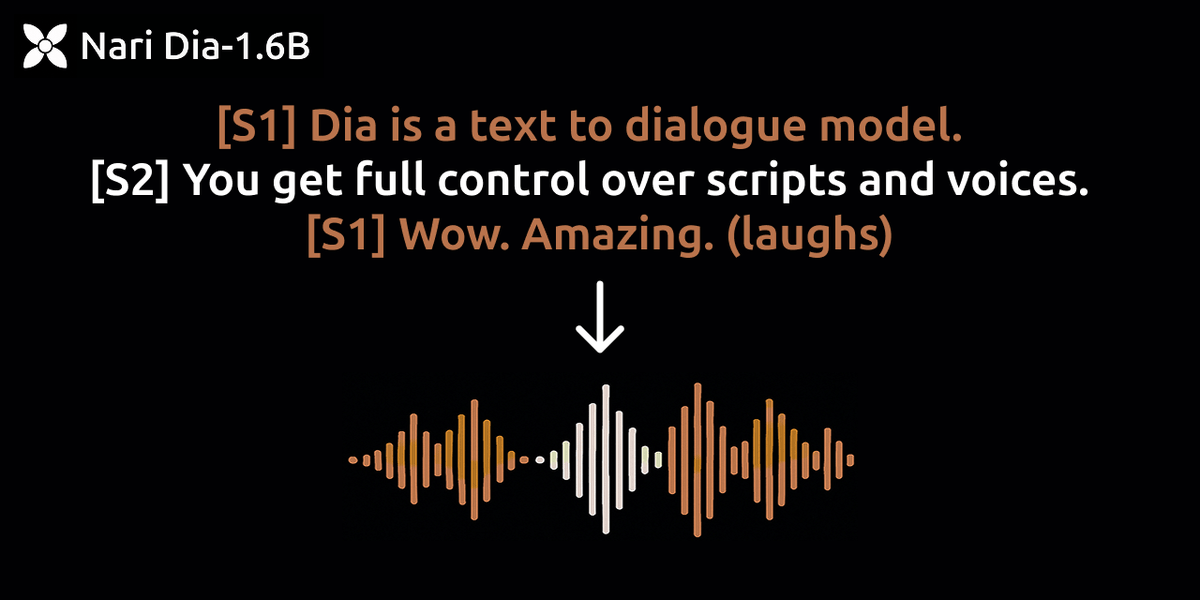
The script format is simple. Speakers are marked with [S1] and [S2] tags, with parenthesized cues dropped inline. The recognized nonverbal tags include:
(laughs),(chuckle),(sighs),(gasps)(coughs),(clears throat),(sneezes),(sniffs)(sings),(humming),(mumbles),(whistles)(claps),(applause),(screams),(groans),(burps),(beep)
Competing systems fumble these cues. Dia interprets tags like (laughs) and reproduces them as actual laughter, whereas ElevenLabs and Sesame CSM-1B require manual replacements such as writing "haha" in the transcript.
Ten lines of Python to a conversation
Loading and running the model is about as friction-free as open-weights TTS gets:
import soundfile as sf
from dia.model import Dia
model = Dia.from_pretrained("nari-labs/Dia-1.6B")
text = "[S1] Dia is an open weights text to dialogue model. [S2] You get full control over scripts and voices. [S1] Wow. Amazing. (laughs) [S2] Try it now on Git hub or Hugging Face."
output = model.generate(text)
sf.write("simple.mp3", output, 44100)
If you would rather not touch code, the team ships a Gradio app you can launch with uv run app.py after cloning the repo, plus a hosted ZeroGPU Space on Hugging Face.
What it will and will not run on
Dia has been tested only on GPUs with PyTorch 2.0+ and CUDA 12.6. CPU support is not yet available, and the first run takes longer because the Descript Audio Codec has to be downloaded as well. The memory footprint is modest by 2026 standards but not laptop-friendly:
| Spec | Value |
|---|---|
| Parameters | 1.6B |
| VRAM (full precision) | ~10 GB |
| Sample rate | 44.1 kHz |
| Throughput on A4000 | ~40 tokens/s (86 tokens = 1s audio) |
| Language | English only |
| License | Apache 2.0 |
That works out to roughly half real-time on a mid-range workstation card, with real-time generation on enterprise GPUs. torch.compile speeds things up on supported hardware, and the team has quantization on the roadmap for tighter memory budgets.
Voice control without fine-tuning
Because the model was not trained on a specific speaker, every run produces a different voice unless you pin things down. There are two ways to lock a voice:
- Fix the random seed for deterministic voice selection.
- Provide an audio prompt plus its transcript, and the model will continue in that speaker's voice, which amounts to zero-shot cloning.
The audio-conditioning path is also how you steer emotion. Feed in a reference clip and the model's delivery and intonation follow the mood of the sample. No fine-tuning, no LoRA, no dataset assembly.
The architecture behind it
Dia is not a diffusion model. It draws on architectures inspired by SoundStorm and Parakeet, tuned specifically for dialogue synthesis, with 1.6 billion parameters and attention designed to hold context across long conversations. Nari Labs credits three main influences: the SoundStorm paper on parallel audio generation, Jordan Darefsky's Parakeet blog, and the Descript Audio Codec that handles neural audio tokenization on the output side.
Compute came from an unusual source for an indie project. The team credits the Google TPU Research Cloud program for training resources and Hugging Face for the ZeroGPU grant that keeps the public demo running.
How the samples compare
Nari published a side-by-side comparison page pitting Dia against ElevenLabs Studio and Sesame CSM-1B. The qualitative pattern is consistent: both competitors fail to render laughter tags as actual speech sounds, ElevenLabs Studio produces clean but slightly stiff output, and Dia shows more natural conversational rhythm than Sesame CSM-1B.
These early benchmarks are informal and no official numbers have been released. No MOS score, no WER on a standard test set, no latency comparison against production APIs.
Rough edges to know about
- English only at launch, with no immediate multilingual plans.
- No CPU inference path yet, and no quantized weights in the base release.
- Voice identity drifts run-to-run unless you seed or prompt.
- Nonverbal tags outside the recognized set produce unpredictable output.
- The Hugging Face Space can be flaky under load, with users reporting generation errors that sometimes require changing the input text or audio prompt to recover.
Where it actually fits
The obvious targets are applications where single-speaker TTS falls flat. Nari points at podcasts, audiobooks, game characters, and interactive applications where natural dialogue matters. Concretely:
- Podcast-style narration in the vein of NotebookLM, which is what Nari originally set out to recreate.
- NPC and character dialogue for games where hiring voice actors for every line is not feasible.
- Audiobook production with multi-character scenes.
- Prototyping conversational agents that need emotional range without an ElevenLabs bill.
- Accessibility tools and dubbing pipelines where offline, self-hosted inference is a hard requirement.
The license is the other big deal. Apache 2.0 with open weights means you can run it in production, fine-tune it, and ship it in a commercial product without a per-character API cost. The ecosystem has already responded: the model page lists 26 finetunes, 14 adapters, and 6 community quantizations built on top of the base checkpoint.
Why this release is worth paying attention to
The headline is a capable TTS model. The subtext is a shift in what a two-person team can ship. Dia runs on consumer-grade hardware with 10 GB of VRAM, produces dialogue that competes with proprietary products like ElevenLabs and NotebookLM, comes from two undergrads with no funding, and has been trending on Hugging Face ahead of models from companies spending millions on research and training.
For anyone building voice interfaces, the calculus changes. A controllable, multi-speaker TTS is now something you can pull from Hugging Face and run behind your own firewall. The remaining gap to commercial services is polish, language coverage, and voice consistency, rather than raw capability.