
Nanbeige LLM Lab's Nanbeige4.1-3B Beats 30B Rivals With 600 Tool Calls
Nanbeige LLM Lab released a 3B open-source model that matches 32B rivals on reasoning and is the first small generalist with native deep-search agent behavior.
 Pro
Takeaways
- Nanbeige4.1-3B is an open-source 3B model that beats Qwen3-32B on most reasoning, code, and alignment tests.
- First small generalist to natively sustain deep-search workflows with up to 600 tool-call turns.
- Scores 75 on xBench-DeepSearch-2505, rivaling 200B+ foundation models with tool access.
- Trained with SFT plus RL using point-wise, pair-wise, and complexity-aware rewards.
- Apache 2.0 license, 256K context, works with transformers, vLLM, and SGLang out of the box.
- Full technical report and weights available for self-hosting.
A new 3B parameter model from Nanbeige LLM Lab is punching well above its weight class. Nanbeige4.1-3B is an open-source small language model that competes with 30B-class rivals on code, math, and alignment benchmarks, and according to its authors, it is the first small generalist model to natively handle deep-search agent workflows spanning hundreds of tool calls.
The model is built on Nanbeige4-3B-Base and iterates on the earlier Nanbeige4-3B-Thinking-2511 reasoning checkpoint, refined with supervised fine-tuning and reinforcement learning. It ships under an Apache 2.0 license, so the weights are available for self-hosting and commercial use.
A 3B model that hangs with the 30Bs
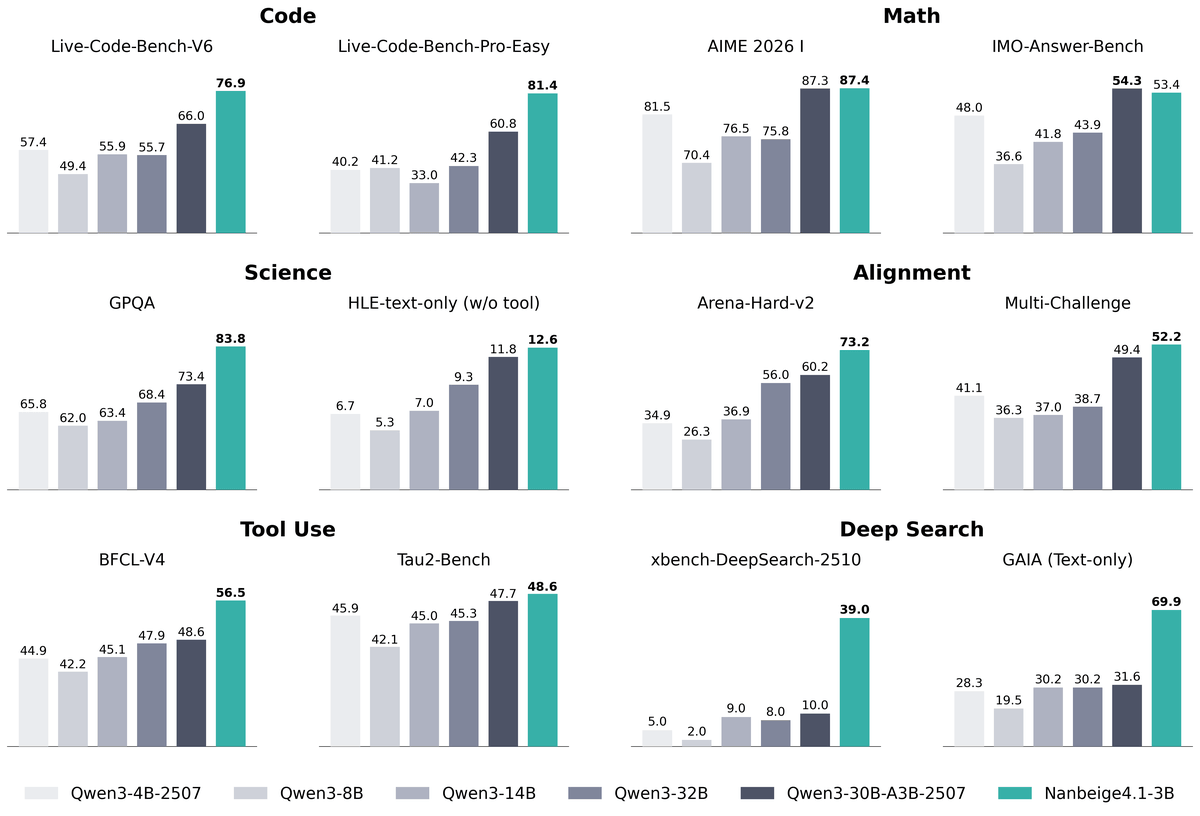
Despite its parameter count, Nanbeige4.1-3B consistently surpasses 30B to 32B class models like Qwen3-30B-A3B-2507 and Qwen3-32B on the majority of the reported benchmarks, including coding, alignment, and tool-use tasks. Here is how it compares on a subset:
| Benchmark | Qwen3-4B-2507 | Qwen3-32B | Qwen3-30B-A3B-2507 | Nanbeige4.1-3B |
|---|---|---|---|---|
| Live-Code-Bench-V6 | 57.4 | 55.7 | 66.0 | 76.9 |
| Live-Code-Bench-Pro-Medium | 5.3 | 3.5 | 3.5 | 28.1 |
| AIME 2026 I | 81.46 | 75.83 | 87.30 | 87.40 |
| GPQA | 65.8 | 68.4 | 73.4 | 83.8 |
| Arena-Hard-v2 | 34.9 | 56.0 | 60.2 | 73.2 |
| BFCL-V4 (tool use) | 44.87 | 47.90 | 48.6 | 56.50 |
The jumps on Live-Code-Bench-Pro-Medium (from around 3 to 28) and Arena-Hard-v2 (from 56 to 73) are where the model pulls away. It lags on IMO-Answer-Bench, where Qwen3-30B-A3B-2507 edges it out 54.34 to 53.38.
Six hundred tool calls without falling over
The more interesting result is agent behavior. Most small models fall apart after a handful of tool calls, and Qwen3-4B and Qwen3-8B fail to sustain meaningful exploration beyond a few turns. Nanbeige4.1-3B reliably executes up to 600 tool-call turns for complex deep-search tasks, a range typically reserved for models with significantly higher parameter counts.
On xBench-DeepSearch-2505 it scored 75, ahead of specialized 8B search agents like MiroThinker-v1.0-8B (61) and matching or beating some 200B+ foundation models such as GLM-4.6-357B (70) and Minimax-M2-230B (72). On GAIA (text-only) it hit 69.90, versus around 28 for Qwen3-4B-2507 with tools.
How it was built
The paper describes a training recipe tailored to each capability rather than one giant SFT sweep. For reasoning and preference alignment, the authors combine point-wise and pair-wise reward modeling. For code generation, they design complexity-aware rewards in reinforcement learning, optimizing both correctness and efficiency. For deep search, they perform complex data synthesis and incorporate turn-level supervision during training.
A few implementation details worth noting:
- Point-wise and pair-wise reward modeling aims to keep responses human-aligned while mitigating common SLM issues such as repetition and redundant thinking.
- Turn-level supervision during RL is what appears to keep the model stable across hundreds of tool calls, rather than collapsing into loops.
- The context window is 256,000 tokens, enough to hold coherence over long reasoning chains and multi-turn interactions.
Running it locally
The model ships in standard safetensors format and works out of the box with transformers, vLLM, SGLang, and Docker Model Runner. Recommended sampling settings are temperature 0.6, top-p 0.95, and up to 131072 max new tokens. A minimal chat example:
from transformers import AutoModelForCausalLM, AutoTokenizer
tok = AutoTokenizer.from_pretrained('Nanbeige/Nanbeige4.1-3B', trust_remote_code=True)
model = AutoModelForCausalLM.from_pretrained(
    'Nanbeige/Nanbeige4.1-3B', torch_dtype='auto', device_map='auto', trust_remote_code=True
)
messages = [{'role': 'user', 'content': 'Which number is bigger, 9.11 or 9.8?'}]
prompt = tok.apply_chat_template(messages, add_generation_prompt=True, tokenize=False)
ids = tok(prompt, return_tensors='pt').input_ids.to('cuda')
out = model.generate(ids, eos_token_id=166101)
print(tok.decode(out[0][len(ids[0]):], skip_special_tokens=True))
Deep-search workflows require a separate setup. You swap in tokenizer_config_search.json, use the miroflow-framework for orchestration, wire up an E2B sandbox for Python execution, and provide Serper for Google search plus Jina for scraping. Qwen3-14B-thinking handles summarization, and temperature is bumped to 1.0.
Where it fits in your stack
The obvious fit is when you want agentic behavior on hardware that cannot host a 30B-class model. Concretely:
- Local coding assistants that need to solve harder than surface-level problems, where a 4B model would usually give up.
- Autonomous research and browsing agents that chain many search, scrape, and summarize calls without a frontier API bill.
- Math and science reasoning at the edge, where GPQA scores in the low 80s open up tutoring or verifier use cases previously reserved for much larger models.
- Alignment-sensitive chat applications, given the strong Arena-Hard-v2 and Multi-Challenge results.
Weaknesses are the usual ones for a 3B model. IMO-style olympiad answering still trails larger mixture-of-experts systems, and Humanity's Last Exam scores (12.60 without tools, 22.29 with tools) confirm this is no frontier reasoner in absolute terms. The team also flags standard safety caveats, noting that outputs can still contain bias or harmful content given the model's size and probabilistic nature.
What the recipe tells us
The authors present Nanbeige4.1-3B as a unified generalist model that combines agentic behavior, code generation, and general reasoning at 3B parameters, and they describe it as the first open-source small language model to achieve that versatility in a single checkpoint. They open-source it to support research into efficient, agent-capable language models, hoping the release contributes to the community's understanding of how to jointly train reasoning, coding, and long-horizon behaviors under strict capacity constraints.
The broader signal for the field is that recipe, rather than parameter count alone, is starting to matter more for agent behavior. Careful reward design and turn-level supervision appear to unlock capabilities in a 3B model that raw scaling did not deliver in 30B siblings, a useful data point for anyone budgeting compute for the next round of small-model training.