
Multilingual-E5-Large Quietly Beats BM25 Hybrids Across 100 Languages
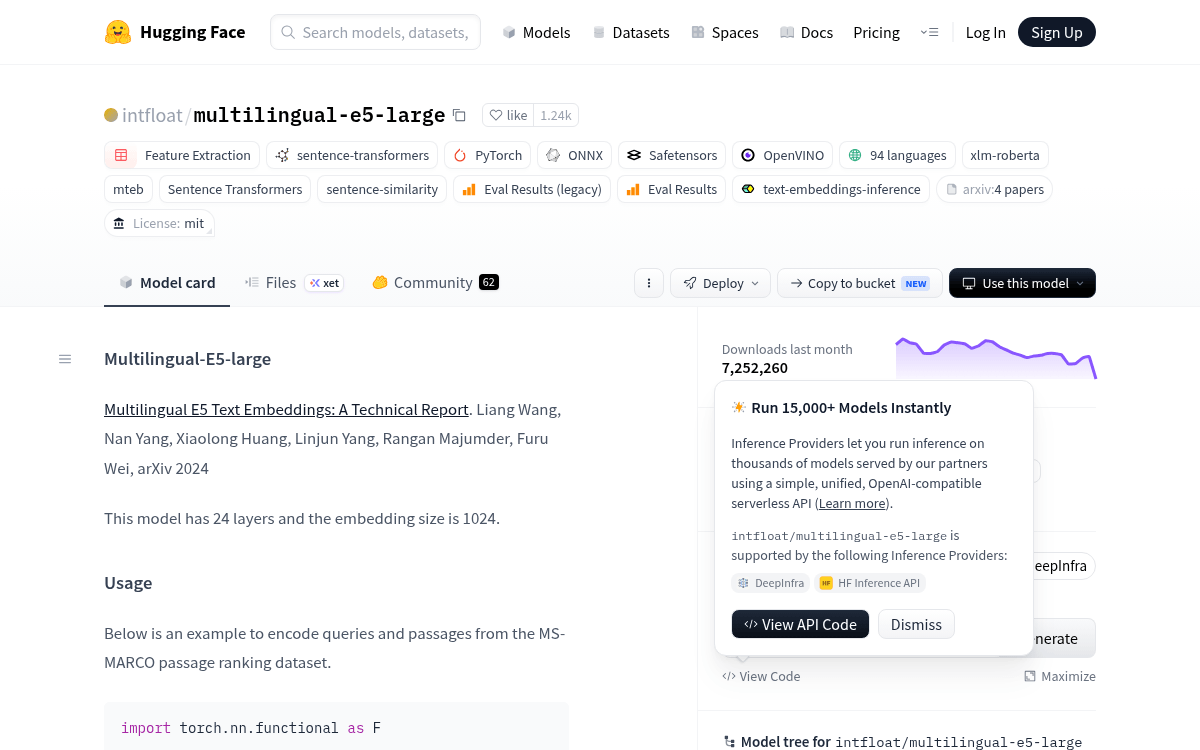
The intfloat multilingual-e5-large embedding model is racking up 7M+ monthly downloads, cementing its spot as the go-to open dense retriever across 94 languages.
 Pro
Takeaways
- intfloat/multilingual-e5-large hits 7.2M+ monthly downloads, dominating open multilingual embeddings on Hugging Face
- 24 layer XLM-RoBERTa-large backbone, 1024-dim embeddings, supports around 100 languages
- Trained in two stages: weakly supervised contrastive pretraining then supervised fine tuning on MS MARCO, NQ, MIRACL and more
- Averages 70.5 MRR@10 on Mr. TyDi versus 33.3 for BM25 across 11 languages
- Requires "query: " and "passage: " prefixes on inputs or accuracy degrades
- MIT licensed with PyTorch, ONNX, Safetensors and OpenVINO weights, capped at 512 tokens per input
A single open source embedding model keeps quietly winning the multilingual retrieval fight. The intfloat/multilingual-e5-large checkpoint on Hugging Face now pulls more than 7.2 million downloads a month and has crossed 4,500 likes, making it one of the most heavily used sentence embedding models on the Hub. It is MIT licensed, runs locally, and covers a large slice of the world's written languages.
The model was published by the intfloat account and is described in a technical report by Liang Wang, Nan Yang, Xiaolong Huang, Linjun Yang, Rangan Majumder and Furu Wei. As a dense text encoder, it turns a query or a document into a single fixed-size vector you can compare with cosine similarity for retrieval, clustering or classification.
What is actually inside
The architecture has 24 layers and an embedding size of 1024, initialized from xlm-roberta-large and continually trained on a mixture of multilingual datasets. That works out to roughly 560M parameters and coverage of 100 languages inherited from xlm-roberta, though low-resource languages may see quality drop off.
Training happened in two stages. Stage one is weakly supervised contrastive pre-training on billions of naturally paired texts scraped from the open web:
- Filtered mC4 title and page content pairs, around 1B
- NLLB translation pairs, around 2.4B
- CC News title and news content, around 400M, plus Wikipedia section title and passage pairs, around 150M
- Filtered Reddit comment and response pairs, around 800M
- S2ORC title and abstract plus citation pairs, around 100M, Stackexchange QA around 50M, and xP3 prompt and response pairs around 80M
Stage two is supervised fine tuning on labeled retrieval datasets: MS MARCO, NQ, Trivia QA, NLI from SimCSE, ELI5, DuReader Retrieval in Chinese, KILT Fever and HotpotQA, SQuAD, Quora, Mr. TyDi across 11 languages and MIRACL across 16 languages. The contrastive objective uses a low temperature of 0.01 in the InfoNCE loss, which is why cosine similarity scores tend to bunch between 0.7 and 1.0. Only the relative ordering matters for retrieval, so this is expected behavior rather than a bug.
Where it earns its keep
On Mr. TyDi, a multilingual retrieval benchmark, the large model averages 70.5 MRR@10 across 11 languages, versus 33.3 for BM25 and 41.7 for a BM25 plus mDPR hybrid. It also beats its smaller siblings, multilingual-e5-small at 64.4 and multilingual-e5-base at 65.9. Per language numbers show it handling Arabic, Bengali, Japanese, Korean, Russian, Swahili, Telugu and Thai roughly as well as English, which is unusual for a single unified model.
Prefixes, or else
The tokenizer expects a prefix on every input. Use "query: " and "passage: " for asymmetric tasks like open QA retrieval, and use "query: " for symmetric tasks such as semantic similarity, bitext mining and paraphrase retrieval, or when using embeddings as features for classification or clustering. Skipping the prefix quietly tanks accuracy.
The simplest way to run it is through sentence-transformers:
from sentence_transformers import SentenceTransformer
model = SentenceTransformer("intfloat/multilingual-e5-large")
texts = [
    "query: when was artificial intelligence founded",
    "passage: AI was founded as an academic discipline in 1956.",
    "passage: Alan Turing war ein britischer Mathematiker.",
]
embeddings = model.encode(texts, normalize_embeddings=True)
scores = (embeddings[:1] @ embeddings[1:].T) * 100
print(scores)
The checkpoint ships as PyTorch, ONNX, Safetensors and OpenVINO, so you can run it on CPU with ONNX Runtime, on Intel hardware with OpenVINO, or serve it through text-embeddings-inference for higher throughput. Because weights are open under MIT, self hosting behind a private network is straightforward.
The rough edges
Real limits to keep in mind:
- Long texts get truncated to at most 512 tokens, so chunking is on you for anything book length.
- Low-resource languages inherit XLM-RoBERTa's uneven coverage, so quality drops off outside the top few dozen languages.
- The 1024-dimensional vectors are heavier to store and search than the 384-dim small variant, which matters when indexing tens of millions of chunks.
- Prefix discipline is mandatory. Pipelines that forget the
query:orpassage:tag will silently regress.
Why it still matters
Closed API embeddings from the big labs are convenient but expensive at scale, and they usually cannot be shipped into air gapped or regulated environments. A 560M parameter multilingual encoder that runs on a single GPU, handles nearly a hundred languages, and posts double digit gains over BM25 hybrids on Mr. TyDi is the kind of default that is hard to dislodge. For anyone building RAG over a multilingual corpus or a semantic search layer for an international product, this remains the safe pick to benchmark everything else against.