
Moritz Laurer's mDeBERTa Quietly Beats LLMs at Multilingual Text Classification
A compact multilingual NLI model keeps racking up downloads because it handles zero-shot classification across 100 languages without fine-tuning.
 Pro
Takeaways
- Moritz Laurer's mDeBERTa NLI model nears 900K monthly downloads on Hugging Face.
- Handles zero-shot classification in 100 languages via NLI, no labeled data needed.
- Built on Microsoft's mDeBERTa-v3-base, fine-tuned on 2.7M hypothesis-premise pairs across 27 languages.
- XNLI accuracy ranges 0.74 to 0.87 across languages; 0.87 on English MultiNLI.
- Cross-lingual training lets you write English labels for non-English text.
- MIT license, 300M params, runs at 900-1900 texts/sec on a single A100.
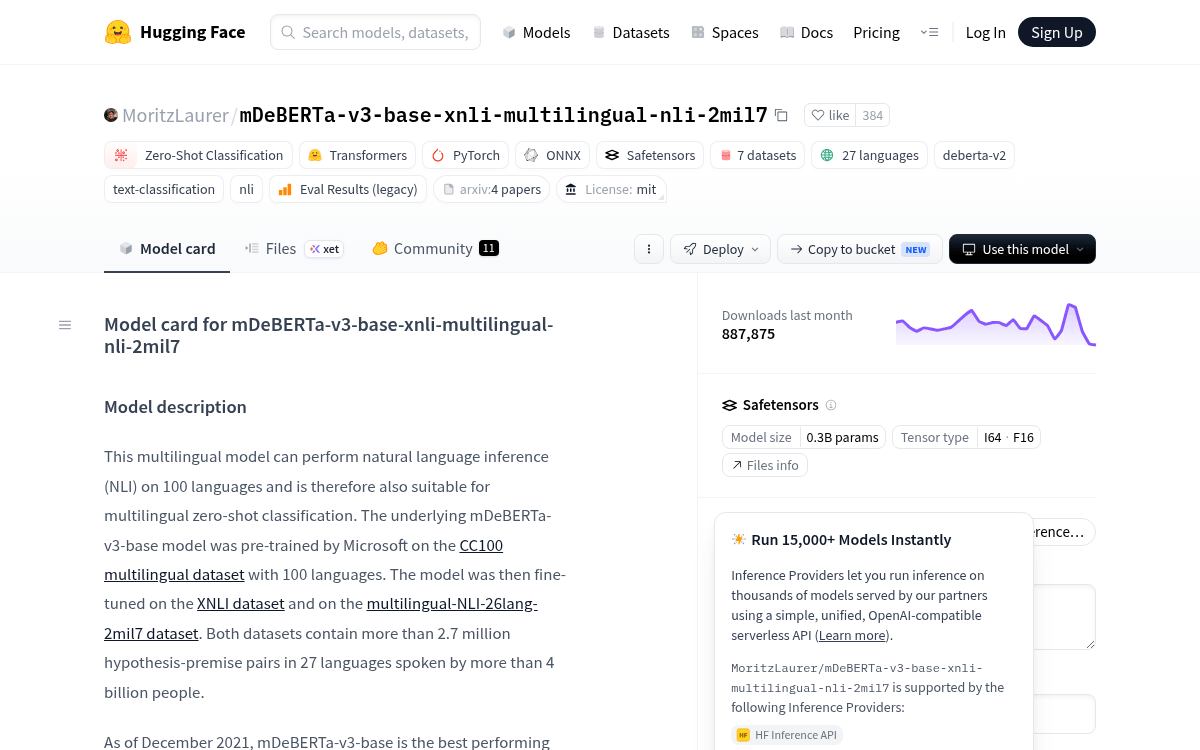
Among the top-trending models on Hugging Face right now sits an unusual entry: a 300M-parameter encoder from Moritz Laurer that has quietly become the default workhorse for multilingual zero-shot text classification. The model, mDeBERTa-v3-base-xnli-multilingual-nli-2mil7, pulls close to 900,000 monthly downloads for a straightforward reason: it classifies text across dozens of languages without a single labeled training example on your end.
That makes it worth understanding why this small encoder still beats reaching for a giant generative model when you need to route support tickets in Hindi, tag news articles in Swahili, or filter user feedback in Vietnamese.
The NLI trick powering zero-shot classification
The model is a natural language inference (NLI) classifier. Given a premise and a hypothesis, it outputs one of three labels: entailment, neutral, or contradiction. That sounds narrow, but NLI is the mechanism behind zero-shot classification in the Transformers pipeline. Candidate labels get rewritten as hypotheses like This text is about politics, and the model scores how well each one is entailed by the input text. Because the backbone supports 100 languages, the same mechanism works across them all.
Using it in practice looks like this:
from transformers import pipeline
classifier = pipeline(
    "zero-shot-classification",
    model="MoritzLaurer/mDeBERTa-v3-base-xnli-multilingual-nli-2mil7",
)
sequence = "Angela Merkel ist eine Politikerin in Deutschland"
labels = ["politics", "economy", "entertainment", "environment"]
print(classifier(sequence, labels, multi_label=False))
How Laurer built it
The backbone is Microsoft's mDeBERTa-v3-base, pre-trained on the CC100 multilingual corpus across 100 languages. Laurer then fine-tuned it on two NLI corpora totaling more than 2.7 million hypothesis-premise pairs in 27 languages spoken by over 4 billion people. The custom multilingual-NLI-26lang-2mil7 dataset is a translated stitching of five well-known English NLI benchmarks (MultiNLI, Fever-NLI, ANLI, LingNLI, and WANLI) rendered into 26 languages via open-source machine translation.
One useful design decision: for each language, a random 10% of pairs uses an English hypothesis paired with a non-English premise. That mixed-language training lets you write candidate labels in English while classifying text in Arabic or Japanese, which saves teams from translating their entire label taxonomy. Training ran for 3 epochs with a learning rate of 2e-05, batch size 32, gradient accumulation of 2, warmup ratio 0.06, and weight decay of 0.01 using the standard Hugging Face Trainer.
Accuracy across languages
The eval results are refreshingly honest. On the XNLI test set across 15 languages, accuracy runs from roughly 74% to 87%. English tops out at 0.871, German at 0.824, Chinese at 0.803, with lower-resource languages like Urdu (0.744) and Swahili (0.746) trailing. Laurer explicitly flags inflated claims elsewhere: models on the hub that report around 90% on non-English languages have most likely made a testing error, since recent literature caps average XNLI performance a few points above 80%.
Throughput on an A100 runs between 900 and 1,900 texts per second depending on language, orders of magnitude beyond what any LLM API call can offer at comparable cost.
Strengths, weaknesses, and quirks
- Strong at: topic classification, intent detection, content moderation triage, and any task where labels can be phrased as short hypotheses.
- Weak at: adversarial reasoning, with scores of 0.537 on ANLI and 0.497 on ANLI-r3, both benchmarks designed to fool models.
- Training data caveat: machine-translated NLI pairs reduce data quality for strict inference tasks, though grammar errors matter less for zero-shot classification where topical relevance is the main signal.
- Language coverage: fine-tuned on 27 languages, with cross-lingual transfer to the other 73 mDeBERTa languages at reduced accuracy.
- Infrastructure note: mDeBERTa does not support FP16, so plan for bf16 or fp32 inference.
Where the economics land against LLMs
Running a 300M-parameter encoder locally on a single GPU costs essentially nothing compared to per-token API pricing across millions of documents. Batched inference chews through thousands of texts per second, a throughput no hosted LLM can match at similar cost. For regulated workflows in finance, healthcare, or the public sector, a fixed-weight classifier with published eval numbers is also easier to audit than a probabilistic LLM call.
The model ships MIT-licensed in PyTorch, ONNX, and Safetensors formats and deploys cleanly to SageMaker and Azure endpoints. If your pipeline currently routes multilingual text through a general-purpose LLM just to get a category label, swapping in this encoder is one of the easier wins available, and the download counter suggests plenty of teams have already made that call.