
Moondream 2 Gets 40% Faster and Smarter Without Growing Beyond 2B
Moondream 2's latest release adds grounded visual reasoning, sharper detection, and a 20-40% speedup while keeping the model small enough to run anywhere.
 Pro
Takeaways
- Moondream 2's 2025-06-21 release adds grounded step-by-step visual reasoning via a new
reasoning=Trueflag. - Object detection sharpened with RL on higher-quality bounding boxes, reducing clumping and improving fine-grained labels.
- Text generation is 20 to 40 percent faster thanks to a new superword tokenizer.
- UI localization on ScreenSpot jumps from 60.3 to 80.4 F1@0.5, useful for screen agents.
- RL fine-tuning now covers 55 vision-language tasks, expanding toward 120 in the next update.
- Apache 2.0, 2B params, runs on CUDA, MPS, vLLM, SGLang, Ollama, and llama.cpp.
A tiny vision language model just got a serious upgrade. Moondream 2, the 2B-parameter open source VLM that has quietly become one of the most downloaded image-text models on Hugging Face, has shipped a new revision that adds grounded reasoning, tighter object detection, and meaningfully faster generation, without growing in size.
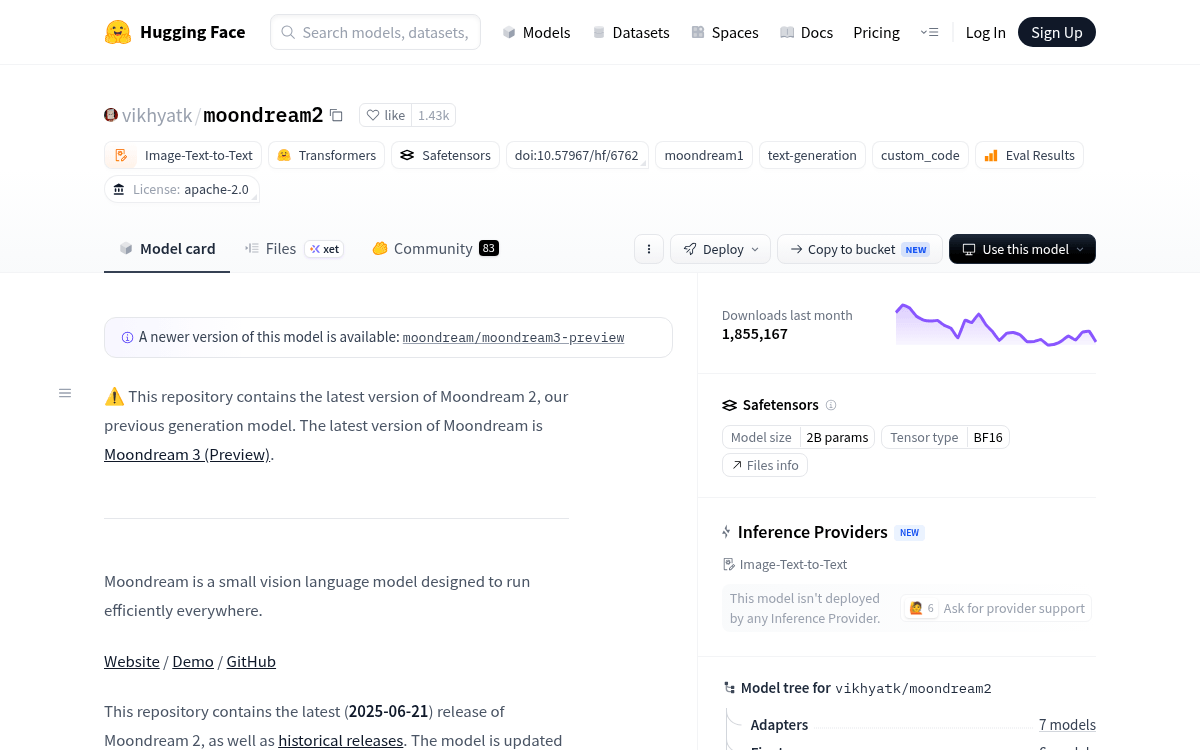
The model card now points to the 2025-06-21 revision as the latest Moondream 2 checkpoint, alongside a preview of the next generation, Moondream 3. For teams already running Moondream 2 in production, the upgrade is a drop-in revision bump.
What actually changed
The release notes describe five focused improvements rather than a full architectural rewrite:
- Grounded reasoning. A new step-by-step reasoning mode that anchors reasoning to spatial positions within the image before answering, leading to more precise visual interpretation (e.g., chart median calculations, accurate counting). You opt in with
reasoning=Trueon thequeryskill to trade latency for accuracy. - Sharper object detection. Uses reinforcement learning on higher-quality bounding-box annotations to reduce object clumping and improve fine-grained detections (e.g., distinguishing blue bottle vs. bottle).
- Faster text generation. 20 to 40 percent faster response generation via a new superword tokenizer and lightweight tokenizer transfer hypernetwork, which reduces the number of tokens emitted without loss in accuracy.
- Better UI understanding. Boosts ScreenSpot (UI element localization) performance from an F1@0.5 of 60.3 to 80.4, a huge jump for anyone building screen agents.
- RL fine-tuning at scale. RL fine-tuning applied across 55 vision-language tasks to reinforce grounded reasoning and detection capabilities, with a roadmap to expand to about 120 tasks in the next update.
Grounded reasoning, in plain terms
Grounded reasoning means the model first locates the relevant regions in the image, then reasons over those locations before producing an answer. That is why counting and chart reading, historically weak spots for small VLMs, improve here. Rather than hallucinating a number, the model traces where in the image the countable objects sit and then tallies them. The tradeoff is speed, so it is an explicit flag you toggle per query.
How to run it
The model is Apache 2.0 licensed, roughly 2B parameters, and ships in BF16 safetensors weighing under 4GB. It runs on a single consumer GPU, Apple Silicon via MPS, or CPU with quantized builds through llama.cpp, Ollama, and LM Studio.
from transformers import AutoModelForCausalLM
from PIL import Image
model = AutoModelForCausalLM.from_pretrained(
    "vikhyatk/moondream2",
    revision="2025-06-21",
    trust_remote_code=True,
    device_map={"": "cuda"},
)
img = Image.open("chart.png")
print(model.query(img, "What is the median value?", reasoning=True)["answer"])
print(model.detect(img, "blue bottle")["objects"])
print(model.point(img, "person")["points"])
The four built-in skills, caption, query, detect, and point, cover most practical vision tasks without requiring prompt engineering against a general chat model. Serving is supported through vLLM and SGLang with OpenAI-compatible endpoints.
Where it fits, and where it does not
Moondream 2 has always been positioned against giants like GPT-4V and Claude by trading raw capability for deployability. Where many multimodal language models have struggled with zero-shot detection, including OpenAI o3-mini, SmolVLM 2.0, and Claude 3 Opus, Moondream was designed with detection in mind. That focus, combined with the new RL-tuned bounding boxes, makes it a strong pick for pipelines that need structured outputs rather than long-form descriptions.
Practical use cases where the 2025-06-21 revision now shines:
- Screen agents and RPA, thanks to the ScreenSpot jump to 80.4 F1@0.5.
- Document and chart QA, where grounded reasoning cuts hallucinated numbers.
- On-device or edge inference for cameras, robots, and mobile apps.
- Batch labeling and dataset bootstrapping, where detection and pointing produce usable coordinates cheaply.
- OCR and layout extraction, building on the prior release's document-layout detection.
The weak spots have not vanished. The model can generate inaccurate statements and struggles with intricate or nuanced instructions. It is also not free from societal biases, so users should exercise caution and critical thinking when relying on its outputs. Abstract reasoning and long multi-turn conversations remain the domain of larger frontier VLMs.
Small model, stubborn gains
The interesting story here is not any single benchmark number. A 2B model, updated iteratively through targeted RL on dozens of tasks, is closing gaps that used to require 30B-plus multimodal models. The release notes hint at scaling that RL recipe from 55 to roughly 120 tasks in the next drop, which suggests the improvement curve has not flattened yet. For anyone who needs a VLM that runs on their own hardware, produces structured outputs, and can be pinned to a specific revision for reproducibility, Moondream 2 remains one of the most pragmatic options available, and the newest checkpoint makes that argument stronger than before.