
Mixedbread's mxbai-embed-large-v1 Beats OpenAI's Embedding API With 3M Downloads
Mixedbread's open embedding model crosses 3 million downloads, beating OpenAI's text-embedding-3-large on MTEB while shipping under Apache 2.0.
 Pro
Takeaways
- mxbai-embed-large-v1 scores 64.68 on MTEB, beating OpenAI text-embedding-3-large (64.58) at 335M params.
- Apache 2.0 license, 3M+ downloads on Hugging Face, fully self-hostable.
- Supports Matryoshka truncation (1024 down to 64 dims) and binary quantization for major storage savings.
- Trained on 700M pairs with contrastive learning, fine-tuned on 30M triplets with AnglE loss.
- Works with sentence-transformers, Transformers.js, Ollama, llama.cpp, and TEI out of the box.
- English only, 512 token context, requires special query prompt for retrieval tasks.
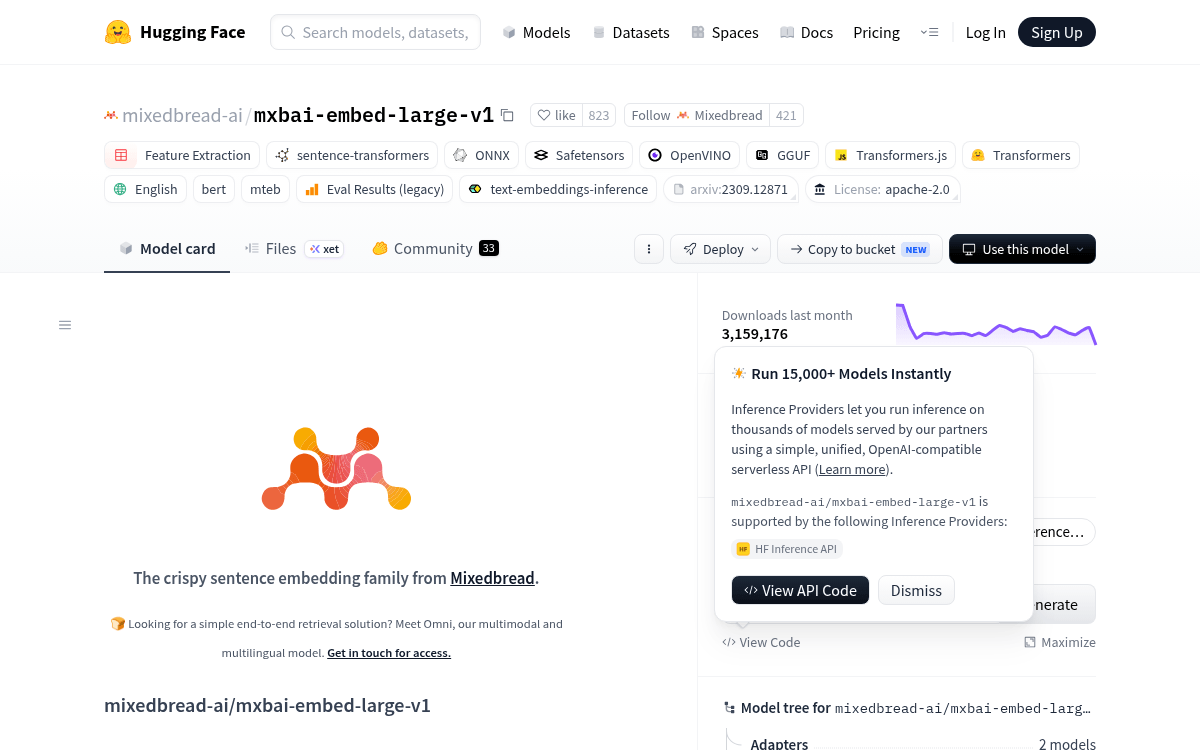
An open source English embedding model from Mixedbread has quietly become one of the most downloaded retrieval models on Hugging Face, racking up more than 3 million pulls and 800+ likes. mxbai-embed-large-v1 is a 335M parameter BERT-large sentence encoder that outperforms OpenAI's flagship embedding API on the standard benchmark while remaining fully self-hostable under Apache 2.0.
If you are building semantic search or RAG in English, this model gives you commercial-grade retrieval quality without sending queries to a third party or paying per-token fees.
How it stacks up on MTEB
The model was evaluated on the Massive Text Embedding Benchmark, a 56-dataset suite that measures embedding models across seven tasks: classification, clustering, pair classification, re-ranking, retrieval, STS (semantic textual similarity), and summarization. mxbai-embed-large-v1 posts an average score of 64.68, edging out OpenAI's text-embedding-3-large (64.58) and Cohere embed-english-v3.0 (64.47).
A few numbers worth calling out from the reported results:
- PairClassification: 87.20 (best in class among the compared models)
- STS: 85.00, well above OpenAI's 81.73
- Retrieval: 54.39, roughly on par with OpenAI's 55.44
- Classification: 75.64, competitive with proprietary APIs
Mixedbread notes that it outperforms commercial models like OpenAI's text-embedding-3-large and matches the performance of models 20x its size like echo-mistral-7b, and it was trained with no overlap of the MTEB data, which matters because embedding leaderboards have historically been prone to test-set contamination.
Matryoshka meets binary quantization
The model's real practical trick is that its 1024-dimensional output is not fixed. It was trained with Matryoshka Representation Learning, so you can truncate the vector to 512, 256, or even 64 dimensions without retraining and lose relatively little quality. You can also quantize each dimension from float32 down to int8 or a single bit.
Combined, those two techniques can shrink your vector database dramatically. One community writeup estimates binary quantization support allows for 32x storage savings and 40x faster retrieval on local hardware. In sentence-transformers, dimension truncation is a one-liner:
from sentence_transformers import SentenceTransformer
from sentence_transformers.quantization import quantize_embeddings
model = SentenceTransformer("mixedbread-ai/mxbai-embed-large-v1", truncate_dim=512)
emb = model.encode(["A man is eating bread"])
binary_emb = quantize_embeddings(emb, precision="ubinary")
Inside the training recipe
The pipeline runs in two contrastive stages. The model was trained on a vast dataset of over 700 million pairs using contrastive training, then fine-tuned on more than 30 million high-quality triplets using the AnglE loss function. AnglE, introduced in arXiv:2309.12871, adds an angle-based objective on top of the usual cosine similarity, which helps the model separate semantically close but distinct sentences that plain cosine tends to collapse together.
The base architecture is standard BERT-large with CLS token pooling as the default, though mean pooling also works. For retrieval, queries need a specific instruction prefix: Represent this sentence for searching relevant passages:. Document embeddings use no prompt. This asymmetric setup is common in modern retrievers, and the sentence-transformers API handles it automatically via prompt_name="query".
Where it shines, where it stumbles
Strengths cluster around English text retrieval, semantic similarity, and classification for chunks that fit inside BERT's context window. It plugs directly into Ollama, llama.cpp, LM Studio, Transformers.js, and text-embeddings-inference, so you can run it on a laptop, a browser, or a GPU server without code changes.
The limits are also clear:
- English only. Multilingual workloads need a different model.
- 512 token context, inherited from BERT. Long documents need chunking.
- Bi-encoder architecture. For maximum precision on the top results, Mixedbread recommends pairing it with one of their rerankers, since the NQ retrieval benchmark takes ~2.68M inferences with a bi-encoder but 9,251,360,000 inferences with a cross-encoder, which is why cross-encoders are typically used to rerank a query against a few documents.
When to reach for it
This is a strong default for anyone building English RAG, semantic search over docs or code comments, deduplication pipelines, or clustering workloads where you want proprietary-grade quality without a per-call bill. The combination of Matryoshka truncation and binary quantization makes it especially attractive when vector database storage is the dominant cost. You can hit it through Mixedbread's hosted API, or pull the weights and run ollama run hf.co/mixedbread-ai/mxbai-embed-large-v1 and be embedding within a minute.
For non-English or long-document use cases, look elsewhere. For the most common retrieval setup in production, an Apache 2.0 model that beats OpenAI's flagship on the standard benchmark is hard to argue with.