
MIT's AST Turns Spectrograms Into Images, Hits 1.3M Downloads
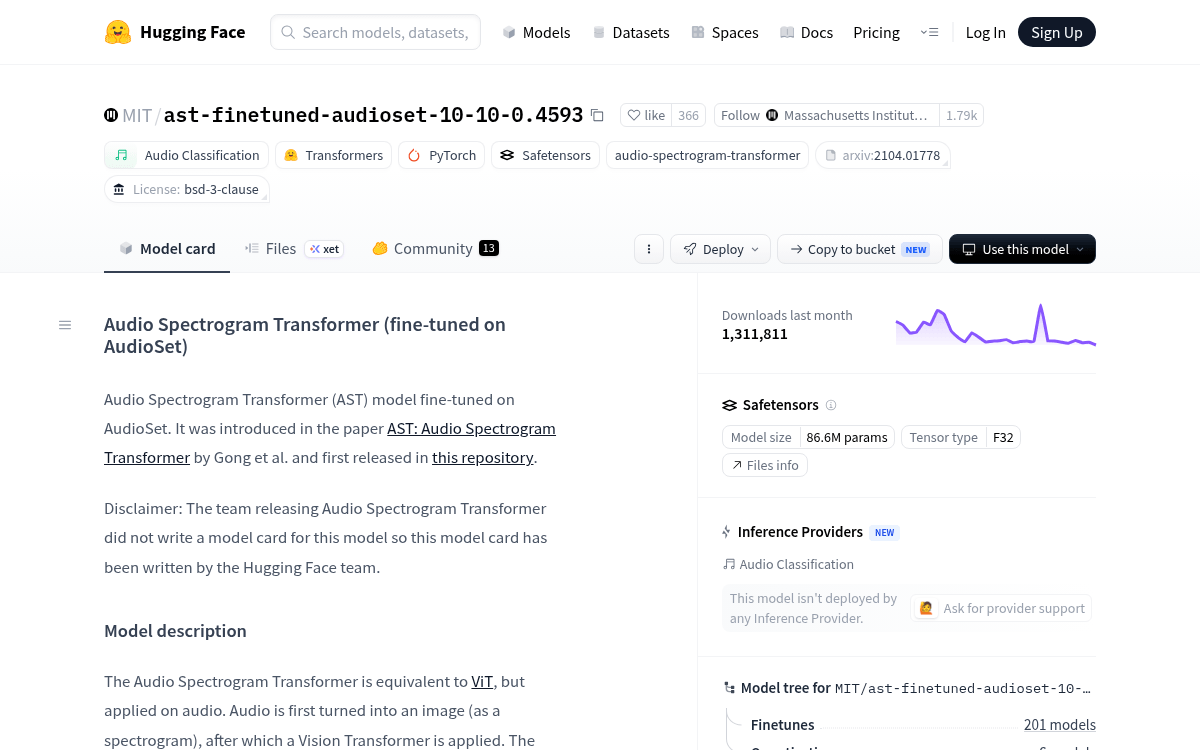
MIT's Audio Spectrogram Transformer keeps drawing huge traffic on Hugging Face, with over 1.3 million monthly downloads and 200+ community finetunes built on top.
 Pro
Takeaways
- MIT's Audio Spectrogram Transformer hits 1.31M downloads and 201 community finetunes on Hugging Face.
- First convolution-free audio classifier, treating spectrograms as images passed through a ViT-style encoder.
- Reaches 0.485 mAP on AudioSet, 95.6% on ESC-50, 98.1% on Speech Commands V2 per the original paper.
- Uses cross-modal transfer from ImageNet-pretrained DeiT weights via cut-and-interpolate positional embeddings.
- 86.6M params, BSD-3 license, safetensors format, one-line load through
transformerspipelines. - Ideal starting point for audio tagging, sound event detection, and embedding extraction across variable-length clips.
A convolution-free audio classifier from MIT continues to dominate as one of the most-downloaded audio models on Hugging Face. The checkpoint MIT/ast-finetuned-audioset-10-10-0.4593 is an 86.6M-parameter Audio Spectrogram Transformer fine-tuned on Google's AudioSet, and it has quietly become the default backbone for a lot of production audio tagging pipelines. It sits at 1,311,811 downloads with 201 community finetunes and 6 quantized variants tracked on the Hub.
Turning sound into an image, then running a ViT
The core idea, from Gong, Chung and Glass at MIT CSAIL, is deceptively simple. AST was the first convolution-free, purely attention-based model for audio classification. Rather than stacking CNN layers over a spectrogram like PANNs or PSLA did, it treats the spectrogram itself as an image and runs a Vision Transformer over it.
The raw waveform gets turned into a log-Mel spectrogram, sliced into overlapping 16x16 patches, linearly projected into 768-dim embeddings, and passed through a 12-layer, 12-head Transformer encoder. A [CLS] token collects the audio representation and a linear head predicts the 527 AudioSet classes.
Because it is a plain Transformer, it inherits one very useful property: variable-length inputs come for free, so the same architecture handles 1-second clips from Speech Commands and 10-second clips from AudioSet without retuning. CNN-based models typically require architecture changes to hit optimal performance on different input lengths.
The trick that made it actually work: ImageNet weights
Transformers are notoriously data-hungry, and audio datasets are small compared to ImageNet. The authors solved this with cross-modal transfer learning from a DeiT vision model. That means averaging the RGB patch-embedding weights into a single channel for spectrograms, and cut-and-bilinear-interpolating the 2D positional embeddings from a 24x24 image grid into a 12x100 audio grid. The ablation is stark: on the balanced AudioSet split, mAP jumps from 0.148 without pretraining to 0.347 with ImageNet pretraining, and on the full split from 0.366 to 0.459.
Where it shines
AST was state of the art on three canonical audio benchmarks at release: 0.485 mAP on AudioSet, 95.6% accuracy on ESC-50, and 98.1% accuracy on Speech Commands V2. In practice that translates into a general-purpose audio tagger covering 527 classes including speech, music genres, animal sounds, vehicles, alarms, and environmental noises.
Training is also faster than the previous CNN-attention hybrids. On full AudioSet the authors report only 5 epochs versus 30 for the PSLA hybrid baseline, using a batch size of 12 with Adam and binary cross-entropy. Typical use-cases where this checkpoint shows up in the wild:
- Sound event detection and audio tagging for surveillance, wildlife monitoring, and smart-home devices
- Content moderation and metadata extraction on video platforms
- Voice activity detection front-ends (the model powers several VAD demo Spaces)
- Feature extractor for downstream finetuning on niche datasets like cough detection, machine fault sounds, or music tagging
- Embeddings for audio retrieval and clustering
Where it falls short
AST is a classifier, not a speech recognizer or an audio generator. It outputs multi-label probabilities over the AudioSet ontology and nothing else. It also inherits AudioSet's biases: rare classes are underrepresented, and clip-level labels are weak, so fine-grained temporal localization is limited. The overlap-6 patching that gives the best 0.459 mAP produces 1,212 patches per 10-second clip, which quadratically increases attention cost, so inference is heavier than a comparable CNN like PANN CNN14.
Using it in three lines
The Hugging Face integration is straightforward through the standard pipeline API:
from transformers import pipeline
pipe = pipeline("audio-classification", model="MIT/ast-finetuned-audioset-10-10-0.4593")
print(pipe("dog_bark.wav", top_k=5))
For more control, load the feature extractor and model directly with AutoFeatureExtractor and AutoModelForAudioClassification. The model is BSD-3-clause licensed, ships in safetensors, and weighs 86.6M parameters in F32 (roughly 344MB on disk).
Why it still trends years later
The lasting contribution of AST was the architectural collapse it enabled: the same ViT that classifies cats can classify coughs if you feed it a spectrogram and reuse its positional embeddings. That insight is why this specific checkpoint remains the go-to base for hundreds of downstream projects, from streaming AST demos to voice-tools Spaces to the MTEB audio leaderboard. For a strong off-the-shelf audio embedding, or a starting point for finetuning on a custom sound dataset, this is still the sensible default.