
Microsoft's WavLM-Large Replaces Five Speech Models With One Shared Encoder
Microsoft's WavLM-Large is a self-supervised speech encoder built to handle recognition, speaker ID, diarization and more from one backbone.
 Pro
Takeaways
- Microsoft's WavLM-Large is a self-supervised speech encoder for full-stack downstream tasks.
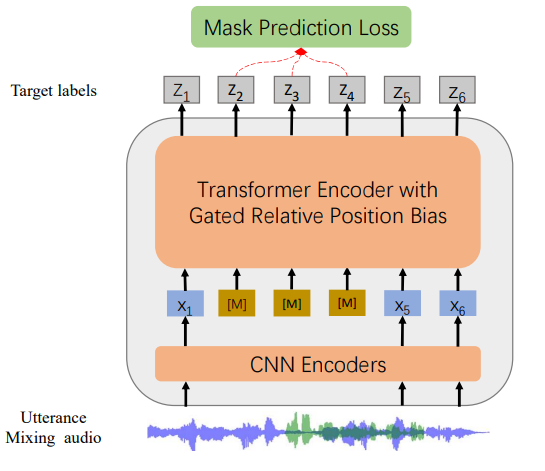
- Built on HuBERT with gated relative position bias and joint masked prediction plus denoising.
- Pretrained on 94k hours of English audio from Libri-Light, GigaSpeech, and VoxPopuli.
- Utterance mixing during pretraining boosts speaker separation, diarization, and verification.
- Reaches state-of-the-art on the SUPERB benchmark across recognition and speaker tasks.
- Available via Hugging Face Transformers and microsoft/unilm on GitHub.
Speech models tend to be specialists. One is tuned for transcription, another for speaker verification, another for diarization, and swapping between them means juggling separate feature extractors with incompatible assumptions. Microsoft's WavLM-Large is a self-supervised encoder designed to serve as the shared backbone underneath all of them, and the model card on Hugging Face lays out exactly how to plug it into your pipeline.
One encoder, full-stack speech
WavLM outputs frame-level features from raw 16 kHz waveforms. Self-supervised pretraining has worked well for speech recognition, but audio carries speaker identity, paralinguistics, and spoken content simultaneously, which makes learning a single universal representation difficult. Built on the HuBERT framework, WavLM emphasizes both spoken content modeling and speaker identity preservation, so the same checkpoint can be fine-tuned into an ASR head, a speaker verification head, a diarization system, or an emotion classifier without swapping the acoustic backbone.
What's actually new inside
Two training choices separate WavLM from earlier self-supervised models like wav2vec 2.0 and HuBERT. First, WavLM jointly learns masked speech prediction and denoising during pretraining, preserving content modeling from masked prediction while gaining non-ASR capability from denoising. Second, it uses gated relative position bias in the Transformer to better capture sequence ordering. The training set also scales from 60k to 94k hours.
The denoising objective goes beyond noise injection. WavLM uses a data augmentation method that simulates overlapping speech, which is why the same encoder transfers well to speaker separation and diarization, not only clean transcription.
Training data and format
The Large checkpoint was pretrained on roughly 94k hours of English audio from three public corpora:
- 60,000 hours of Libri-Light
- 10,000 hours of GigaSpeech
- 24,000 hours of VoxPopuli
All audio is 16 kHz, and the model expects that sample rate. It is English-only and pretrained on audio alone, so no tokenizer ships with it. Transcription requires attaching a tokenizer and fine-tuning on labeled text data.
Loading it from Transformers
The checkpoint works as a drop-in AutoModel in Hugging Face Transformers:
from transformers import AutoProcessor, AutoModel
processor = AutoProcessor.from_pretrained("microsoft/wavlm-large")
model = AutoModel.from_pretrained("microsoft/wavlm-large", device_map="auto")
From there, attach a task-specific head. For ASR fine-tuning, Microsoft points to the standard Transformers speech recognition example; for classification tasks like keyword spotting or emotion recognition, the audio-classification example applies. Source code and original PyTorch weights live in the microsoft/unilm repository.
Strengths and known limits
WavLM Large reaches state-of-the-art on the SUPERB benchmark, which spans recognition, speaker ID, emotion, and paralinguistic tasks. Several limitations are worth noting before committing to it:
- English only. Pretraining data is English, so cross-lingual transfer is limited.
- No tokenizer. Transcription requires fine-tuning on labeled text data.
- Embeddings only. The model produces frame-level features, not text or audio, so a task head is always required.
- Uneven speech enhancement gains. Independent work found substantial WER improvement from WavLM features, while speech quality metric gains were more modest.
Where it fits in a real pipeline
WavLM-Large is a strong default when you need one encoder across several speech tasks, or when you want representations that hold up for speaker-aware problems like verification, diarization, and separation alongside ASR. Recent work continues to build on it, including a speech emotion recognition system that freezes WavLM as the feature extractor and stacks BiLSTM plus attention on top. For monolingual English speech with pretrained features that transfer beyond transcription, it remains one of the stronger starting points available under a permissive research license.