
Microsoft's WavLM Base Plus Handles Speaker ID, Noise, and Transcription in One Model
Microsoft's WavLM Base Plus is a self-supervised speech foundation model on Hugging Face built for full-stack downstream audio tasks.
 Pro
Takeaways
- Microsoft's WavLM Base Plus is a self-supervised English speech encoder hosted on Hugging Face.
- Extends HuBERT with joint masked speech prediction and denoising for full-stack audio tasks.
- Uses gated relative position bias in the Transformer to improve recognition performance.
- Pre-trained on 94,000 hours of English audio from Libri-Light, GigaSpeech, and VoxPopuli.
- WavLM Large achieves state-of-the-art results on the SUPERB benchmark.
- Best for speaker verification, diarization, classification, and noise-robust ASR fine-tuning.
Speech AI has a quiet workhorse problem. Most teams reach for Whisper or wav2vec2 when they need to turn audio into features, but Microsoft Research's WavLM Base Plus covers a wider range of jobs than transcription alone, and its model card on Hugging Face lays out exactly how to plug it into speaker verification, diarization, and classification pipelines. The design choices in the underlying paper explain why it keeps showing up as a backbone in audio systems.
A backbone built for more than transcription
WavLM is a self-supervised speech encoder from Microsoft. Self-supervised learning has worked well for speech recognition, but less exploration has gone into other audio tasks, and speech signals carry multi-faceted information including speaker identity, paralinguistics, and spoken content, which makes learning universal representations difficult. Microsoft's answer was to design a single pre-trained model that could feed every layer of an audio stack, from ASR to speaker ID.
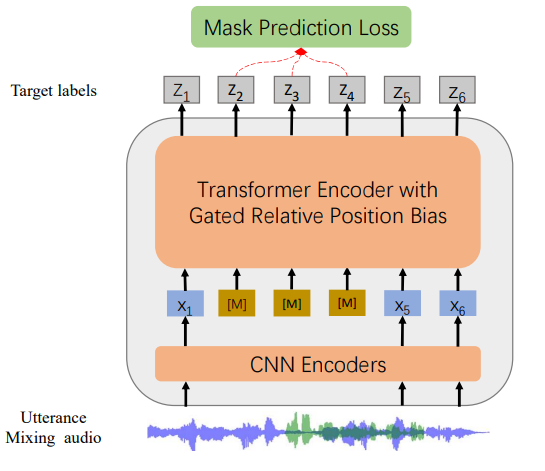
The encoder is built on the HuBERT framework, with an emphasis on both spoken content modeling and speaker identity preservation, and equips the Transformer with gated relative position bias to sharpen recognition. In practice, the model tracks relative positions between audio frames in a way that helps it disambiguate phonemes without losing track of who is speaking.
Predict masked speech, but with noise mixed in
The main pre-training objective is what separates WavLM from earlier self-supervised speech models. It jointly learns masked speech prediction and denoising, keeping the content modeling capability of masked prediction while lifting performance on non-ASR tasks through denoising.
Concretely, WavLM extends HuBERT to denoising masked speech modeling, where the target is to predict pseudo-labels of simulated noisy speech on masked regions. Training audio is corrupted by adding background noise or speech from other utterances on top of the original signal, and the model has to reconstruct the clean content anyway. That utterance-mixing step is why WavLM tends to hold up in messy real-world audio, and why it preserves speaker identity rather than smearing it out.
94,000 hours of English audio
The Base Plus checkpoint is the mid-sized variant, trained on a much larger pool than the vanilla base model. According to the model card, it was pre-trained on:
- 60,000 hours of Libri-Light, a large unlabeled audiobook corpus
- 10,000 hours of GigaSpeech, a multi-domain transcribed corpus
- 24,000 hours of VoxPopuli, a multilingual parliamentary speech dataset
That comes to roughly 94,000 hours. The paper scales training from 60k hours to 94k hours, and the Large variant reaches state-of-the-art results on the SUPERB benchmark with meaningful gains across speech processing tasks. Audio is expected at 16kHz, and Base Plus is English-only, so multilingual pipelines will need a different backbone.
What you actually get from the checkpoint
WavLM Base Plus is a feature extractor, not a ready-to-use ASR system. The model card is explicit that there is no tokenizer bundled with it because pre-training used audio alone, so speech recognition requires creating a tokenizer and fine-tuning on labeled text. Loading it looks like any other Hugging Face model:
from transformers import AutoProcessor, AutoModel
processor = AutoProcessor.from_pretrained("microsoft/wavlm-base-plus")
model = AutoModel.from_pretrained("microsoft/wavlm-base-plus", device_map="auto")
The model card points at official fine-tuning examples for speech recognition and audio classification in the transformers repo, and lists speaker verification and diarization as supported downstream tasks. On Hugging Face, there are already 36 fine-tuned derivatives and 2 quantized variants built on this checkpoint, a decent signal that the backbone transfers cleanly.
When to reach for it
Consider WavLM Base Plus when you need a speech encoder that produces frame-level embeddings for tasks beyond transcription. Typical use cases include:
- Speaker verification and diarization, where the denoising objective helps separate overlapping voices
- Audio classification such as emotion, intent, or keyword spotting
- ASR fine-tuning on domains where noise robustness matters more than raw benchmark WER
- Feature extraction as input to downstream models that expect fixed-size embeddings per frame
The limits are real. It only handles English, it expects 16kHz audio, and it will not match modern encoder-decoder ASR systems like Whisper out of the box because it has no decoder and no text supervision. It is also a Base-sized model, so if you have the compute, the Large checkpoint is the one that carries the SUPERB numbers cited in the paper.
One encoder, many heads
The interesting piece of WavLM sits below the leaderboard. A single self-supervised objective, framed as denoising masked prediction with mixed-in interfering speakers, produces representations that transfer across content, speaker identity, and paralinguistic tasks. That is the argument for using it as a foundation layer. For anyone building audio pipelines who has been defaulting to wav2vec2 or HuBERT, WavLM is the closer sibling that was designed with the full stack in mind.