
Microsoft's VibeVoice-1.5B Generates 90-Minute Four-Speaker Podcasts in One Pass
Microsoft's open-source TTS model generates up to 90 minutes of multi-speaker podcast audio using a Qwen2.5 backbone and a diffusion head.
 Pro
Takeaways
- Microsoft released VibeVoice-1.5B, an open-source MIT-licensed TTS model for long-form podcasts.
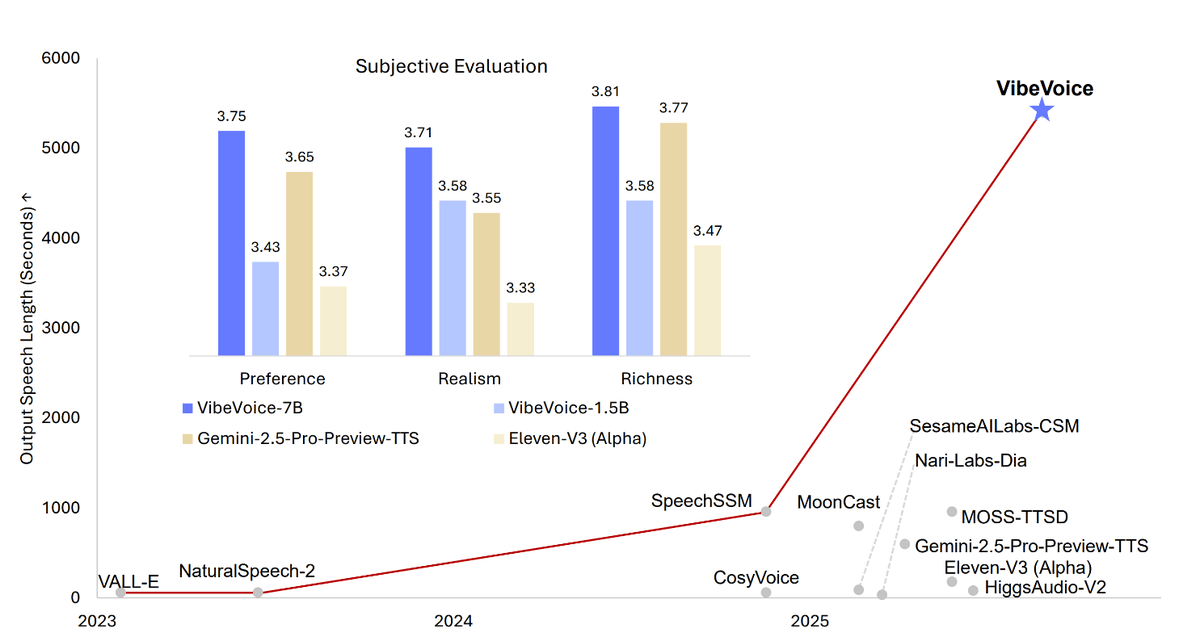
- Generates up to 90 minutes of continuous audio with up to 4 distinct speakers.
- Uses continuous acoustic and semantic tokenizers at an ultra-low 7.5 Hz frame rate, 3200x downsampling.
- Combines Qwen2.5-1.5B LLM backbone with a lightweight 123M-parameter diffusion head.
- English and Chinese only; no overlapping speech, background music, or Foley sounds.
- Research use only, with automatic AI disclaimers and imperceptible watermarks embedded in output.
Microsoft Research quietly dropped one of the more interesting speech models of the year on Hugging Face, aimed squarely at the thing every AI-generated podcast tool has struggled with: keeping four voices consistent across a full episode without them drifting, flattening out, or stepping on each other. VibeVoice-1.5B is an open-source, MIT-licensed text-to-speech model that can synthesize up to 90 minutes of continuous audio with as many as four distinct speakers in a single generation.
The model has already been downloaded roughly 124,000 times and is powering close to a hundred Hugging Face Spaces, from custom-voice podcast generators to conference simulators. It sits inside a small family: a 1.5B main model, a 7B Large variant with a 32K context window, and a 0.5B streaming version aimed at real-time use.
Why long-form TTS breaks down
Most TTS systems are tuned for short clips of a single voice. Push them past a couple of minutes with multiple speakers and voices start bleeding into each other, prosody flattens, and the audio loses the sense of a continuous conversation. VibeVoice targets exactly those failure modes, scalability, speaker consistency, and natural turn-taking, for podcast-style dialogue generated from a script.
VibeVoice-1.5B synthesizes up to 90 minutes of speech with up to four distinct speakers in a single session, far past the one or two speaker ceiling of traditional TTS models. That single-session detail matters: the whole conversation is generated in one continuous pass, which is why turn-taking sounds coherent instead of stitched.
Tokenizing audio at 7.5 Hz
The core architectural bet is aggressive compression of the audio stream. VibeVoice uses continuous acoustic and semantic speech tokenizers operating at an ultra-low frame rate of 7.5 Hz. For context, most neural codecs run at 50 to 75 Hz. Dropping to 7.5 Hz means roughly 10x fewer tokens per second of audio, which is what makes 90-minute sequences tractable for a transformer.
That compression comes from a pair of tokenizers running on 24 kHz input, giving a 3200x downsampling ratio. The acoustic tokenizer is a sigma-VAE variant with a mirror-symmetric encoder and decoder, each around 340M parameters, split across seven stages of modified Transformer blocks. The semantic tokenizer mirrors that encoder but is trained on an automatic speech recognition proxy task, so its outputs are aligned to what the text actually means rather than just how it sounds.
Next-token diffusion instead of autoregressive audio
The generation loop stitches together an LLM and a diffusion decoder in a pattern the paper calls next-token diffusion. The LLM handles text context and dialogue flow, while a specialized diffusion head produces the high-fidelity acoustic details.
The LLM here is Qwen2.5-1.5B, chosen for its context length and reasoning over dialogue structure. It reads the script, tracks who is speaking, and produces hidden states that get fed into a lightweight diffusion head (four layers, roughly 123M parameters) that predicts the acoustic VAE features using a DDPM process with classifier-free guidance and DPM-Solver at inference.
The practical effect: the LLM handles the story of the conversation (turn-taking, pacing, who says what next) while the diffusion head handles the physics of the voice (timbre, prosody, small acoustic details). Both pretrained tokenizers are frozen during the main training run, so only the LLM and diffusion head get updated.
Curriculum training up to 64K tokens
Getting a transformer to handle 90 minutes of conditioned audio meant scaling context gradually. Microsoft used a length curriculum that starts small and grows: 4K, then 16K, then 32K, then 64K tokens. Staged expansion is now standard for long-context language models, but applying it to interleaved text and audio tokens is a big part of why the model holds a speaker identity together across an hour of dialogue.
The model lineup and what each variant is meant for:
| Model | Context | Max generation | Best for |
|---|---|---|---|
| VibeVoice-0.5B-Streaming | Streaming | Real-time | Low-latency interactive TTS |
| VibeVoice-1.5B | 64K | ~90 min | Long-form podcasts, audiobooks |
| VibeVoice-Large (7B) | 32K | ~45 min | Highest-fidelity dialogue |
Getting it running
The simplest path is the Transformers pipeline, though most real usage goes through the community demo scripts because they handle multi-speaker prompts cleanly.
from transformers import pipeline
pipe = pipeline("text-to-speech", model="microsoft/VibeVoice-1.5B")
audio = pipe("Speaker 1: Welcome back to the show.\nSpeaker 2: Glad to be here.")
For serious multi-speaker generation, the demo repos use a script with named speakers and reference voice clips:
python demo/inference_from_file.py \
  --model_path microsoft/VibeVoice-1.5B \
  --txt_path demo/text_examples/2p_music.txt \
  --speaker_names Alice Frank
Voice cloning works by dropping short WAV or MP3 reference clips into a voices folder. Set the number of speakers on the left, pick or add voices by dropping short WAV/MP3 clips into VibeVoice-Fork/demo/voices, and adjust the CFG slider (1.30-1.35 recommended) for best results. The surrounding ecosystem now includes 4-bit quantization to run the language model component in 4-bit mode to significantly reduce VRAM usage, ComfyUI nodes, and LoRA fine-tuning support.
What it can and cannot do
The demos show off some genuinely impressive behaviors: spontaneous emotion and singing, podcast-style audio with background music, cross-lingual dialogue (Mandarin-English), and extended multi-speaker conversations. Cross-lingual mixing inside a single conversation is unusual for open TTS models.
The limitations are equally worth knowing before you build anything on top of it:
- Limited to English and Chinese.
- Supports turn-taking but does not model overlapping speech between speakers.
- Does not generate background sounds, Foley, or music. Audio output is strictly speech.
- Not optimized for low-latency, interactive, or live-streaming scenarios. That is the target for the 7B variant.
- Inherits any bias or errors from the Qwen2.5-1.5B base model.
Watermarks, disclaimers, and the licensing catch
Microsoft is being unusually cautious about how this gets used. Every generation ships with an audible spoken disclaimer that the segment was generated by AI, plus an imperceptible watermark for provenance verification. Inference requests are hashed and logged for abuse pattern detection.
Despite the MIT license, the model is explicitly marked for research use only, and commercial deployment is not recommended by the developers without further testing. Voice impersonation without consent, disinformation, and live deepfake voice conversion are all called out as prohibited. If you are planning a product, you are on your own for the legal and ethical due diligence.
Why this release matters
Three shifts are worth tracking here. The ultra-low 7.5 Hz frame rate is a serious argument that continuous tokenization at extreme compression can beat discrete audio tokens for long-form generation without sacrificing fidelity. Plugging a small general-purpose LLM into a diffusion head, rather than training a bespoke audio transformer, gives you dialogue reasoning almost for free, which is what makes the multi-speaker turn-taking feel natural. And this is now the strongest open baseline for AI-generated podcasts, competing directly with closed products like NotebookLM's audio overviews but with weights you can inspect and fine-tune.
The technical report and the original Microsoft repository are the canonical references, though community forks have proliferated after the main repo went through periods of turbulence. For anyone building tools around synthetic dialogue, audiobook generation, or long-form voice research, this is the model to benchmark against.