
Microsoft's TRELLIS Turns a Single Photo Into 3D Assets With 2.5M Downloads
Microsoft's open source image-to-3D model hits 2.5M downloads by turning a single picture into meshes, Gaussians, or radiance fields.
 Pro
Takeaways
- Microsoft's TRELLIS-image-large passed 2.5M downloads as the leading open image-to-3D model.
- Uses Structured LATent (SLAT) representation to decode one latent into meshes, Gaussians, or radiance fields.
- Two-stage rectified flow transformer, up to 2B parameters, trained on 500K 3D objects.
- MIT licensed with local editing support and official demo on GitHub.
- Adopted by NVIDIA AI Blueprints, powering 100+ community Spaces for sketch-to-3D and text-to-3D.
- Successor TRELLIS.2 adds 4B parameters, PBR textures, and 1536 cubed output resolution.
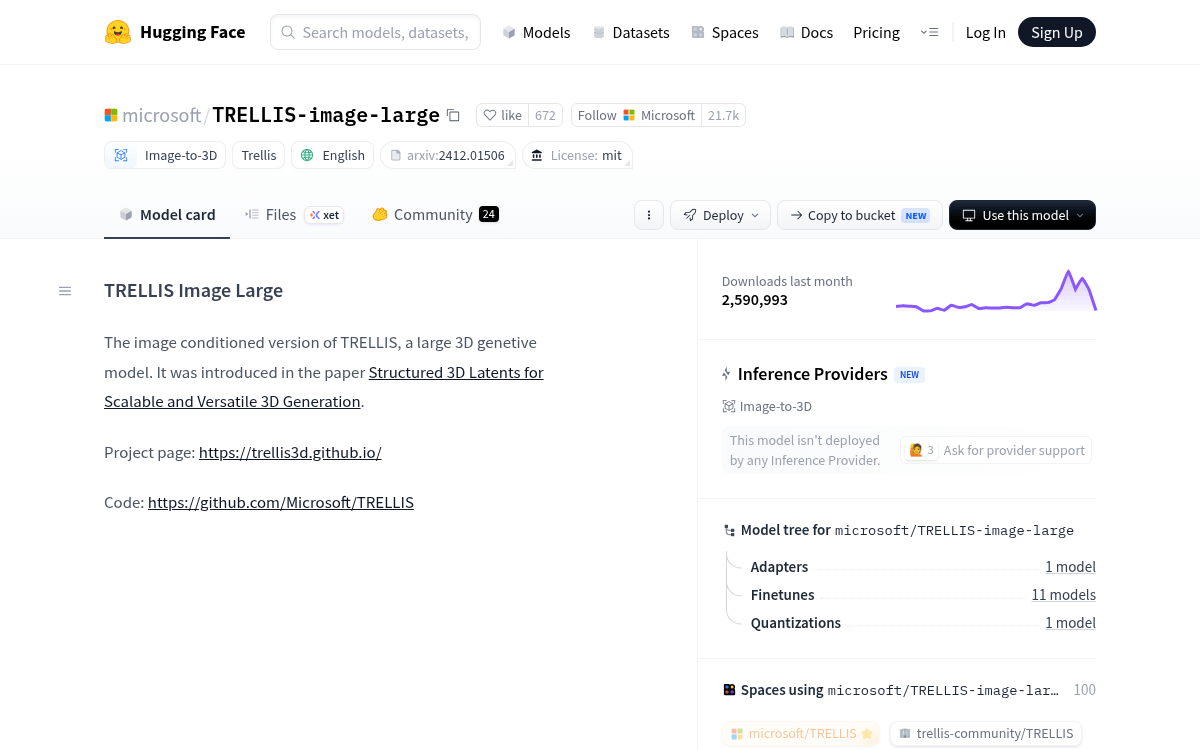
Microsoft's TRELLIS-image-large has quietly become one of the most downloaded 3D generation models on Hugging Face, with over 2.5 million pulls and 672 likes on the model card. It takes a single image and produces a fully formed 3D asset, and unlike most predecessors it lets you choose the output format after generation rather than baking it into training.
One latent, three output formats
The trick behind TRELLIS is a representation called Structured LATents, or SLAT. SLAT marries sparse structures with rich visual features: it places local latents on the active voxels that intersect an object's surface, then encodes each one by fusing image features from densely rendered views of the asset. In plain terms, the model keeps only the voxels that actually touch the object's shell, then attaches a rich feature vector to each one.
By decoupling latent structure from decoder choice, TRELLIS lets you pick the representation that fits your pipeline: 3D Gaussians for real-time rendering, meshes for physical simulation, or radiance fields for neural rendering, all without retraining. Previous image-to-3D models generally locked you into whatever format they were trained to produce.
How it actually generates
Generation runs in two rectified-flow transformer stages. A Sparse Structure flow transformer first estimates a 64-cubed voxel grid to identify the sparse structure representing the global shape. A second SLAT flow transformer then predicts the local latent vectors for those voxels, producing detailed geometry and texture. The generated SLAT is finally decoded into a mesh, NeRF, or 3DGS. Rectified flow is a diffusion cousin that learns straighter probability paths, which typically means fewer sampling steps and faster inference.
On the training side, the method combines the sparsely-populated 3D grid with dense multiview features extracted from a strong vision foundation model. The rectified flow transformers scale to 2 billion parameters, trained on a dataset of 500K diverse 3D objects.
What you get with the image-large checkpoint
- Input: a single reference image.
- Output: meshes, 3D Gaussian splats, or radiance fields decoded from the same latent.
- License: MIT, so commercial use is on the table.
- Editing: TRELLIS can manipulate targeted local regions of a given 3D asset according to text or image prompts.
- Code and demo: official repo at github.com/Microsoft/TRELLIS with a Hugging Face Space for browser testing.
A minimal call through the reference pipeline looks like this:
from trellis.pipelines import TrellisImageTo3DPipeline
from PIL import Image
pipe = TrellisImageTo3DPipeline.from_pretrained("microsoft/TRELLIS-image-large")
pipe.cuda()
image = Image.open("chair.png")
out = pipe.run(image)
mesh = out["mesh"][0]
gaussians = out["gaussian"][0]
Where it shines, where it stumbles
Authors and community spaces both point to geometry fidelity and texture detail on solid, object-scale inputs as the model's strengths. Reported results surpass existing methods at similar scales, and the flexible output format selection plus local 3D editing are capabilities earlier models did not offer. It has found a particular following in game props, product visualization, and AR asset pipelines, where a clean mesh needs to drop cleanly into Blender or Unity.
Weak points are the usual image-to-3D issues: thin structures, transparent materials, and full scenes rather than single objects. The base model also outputs vertex-colored or baked textures rather than physically based materials, which is why Microsoft has since shipped TRELLIS.2, a 4B-parameter image-to-3D model producing up to 1536-cubed PBR textured assets, built on native 3D VAEs with 16x spatial compression.
Why the download counter keeps climbing
Two things explain the traction. NVIDIA AI Blueprints adopted the system in September 2025, giving it a validated production path on RTX and datacenter GPUs. The community has also forked it aggressively, with sketch-to-3D, Flux-conditioned, and text-to-3D variants all built on top of the image-large weights.
For anyone building content pipelines, digital twins, or synthetic data generators, TRELLIS is now the default open baseline to beat. The underlying paper, Structured 3D Latents for Scalable 3D Generation, was accepted as a CVPR spotlight, and the follow-up work suggests Microsoft plans to keep pushing native 3D VAE resolution and PBR quality rather than reverting to closed releases.