
Microsoft's Table Transformer Hits 1M Downloads Parsing PDF Tables
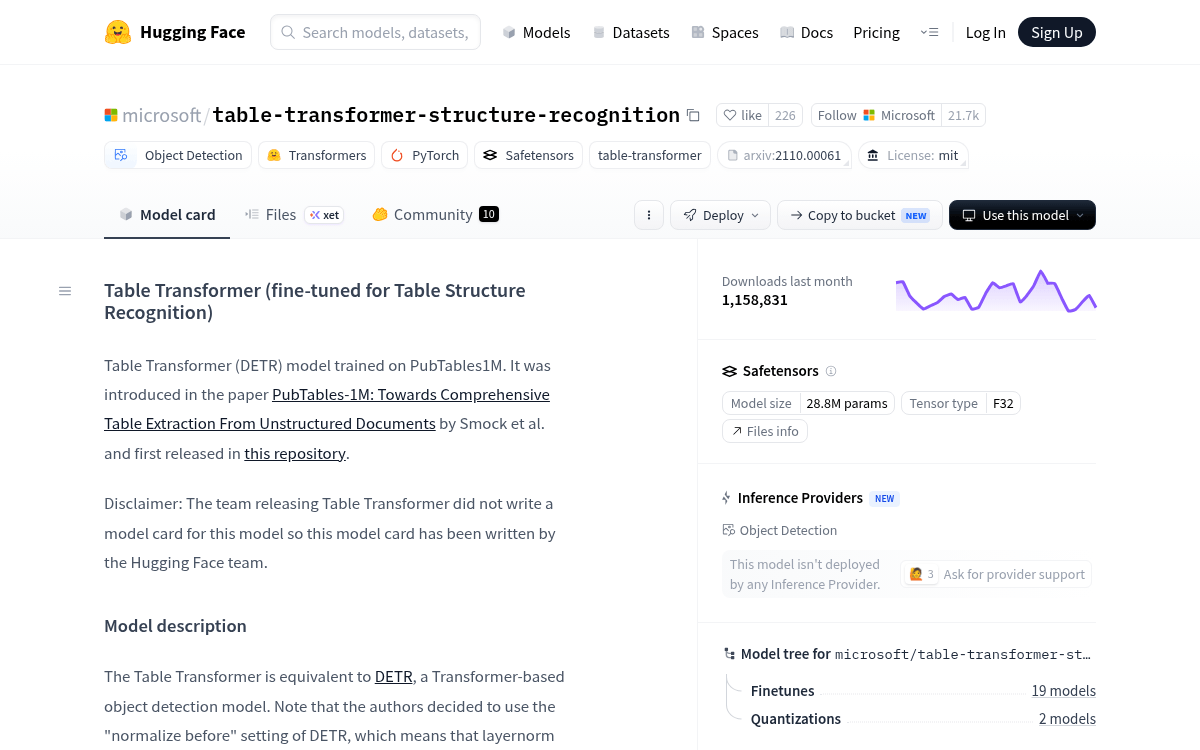
Microsoft's compact 28.8M parameter DETR-based model turns tables in PDFs and scanned images into structured rows, columns, and cells with minimal setup.
 Pro
Takeaways
- Microsoft's Table Transformer extracts rows, columns, and cells from table images using a DETR-based object detector.
- Trained on the PubTables-1M dataset of 947,642 fully annotated tables from scientific documents.
- Compact 28.8M parameter model, MIT licensed, runs on CPU or a single consumer GPU.
- Integrated into Hugging Face Transformers via
AutoModelForObjectDetectionfor two-line loading. - Requires a separate OCR or PDF text step to populate cell contents alongside detected geometry.
- Introduced in the PubTables-1M paper at CVPR 2022 with canonicalization to fix oversegmentation.
Extracting tables from PDFs and scanned documents remains one of the most stubborn problems in document AI. Layouts vary wildly, merged cells break naive parsers, and OCR alone gives you a bag of words with no grid. Microsoft's Table Transformer (TATR) is a compact object detection model built specifically to solve the structural piece, and it continues to trend on Hugging Face with over a million downloads.
TATR treats table parsing as a plain object detection task. Feed it a cropped image of a table and it returns bounding boxes for rows, columns, spanning cells, column headers, and projected row headers. Combine those boxes with text from OCR or a PDF text layer and you can reconstruct the table as HTML, CSV, or a dataframe.
DETR under the hood, trained on a million tables
Architecturally, TATR is equivalent to DETR, a transformer-based object detector, with the authors using the "normalize before" setting so layernorm is applied before self- and cross-attention. DETR (DEtection TRansformer) skips the region proposals and anchor boxes of older detectors, predicting a fixed set of boxes end-to-end through a transformer encoder-decoder.
The training data is the real differentiator. Microsoft trained two models on 947,642 fully annotated tables from the PubTables-1M dataset, one for table detection and one for structure recognition. Annotations include bounding boxes in both image and PDF coordinates for all rows, columns, and cells (including blank ones), along with column headers and projected row headers.
A key contribution of the underlying paper was cleaning up messy ground truth. The authors targeted a significant source of inconsistency in prior datasets called oversegmentation, using a novel canonicalization procedure. Those fixes produced measurable gains in training performance and a more reliable estimate of model quality at evaluation time.
Running it in a few lines
The checkpoint is MIT licensed and integrated directly into Hugging Face Transformers. At 28.8M parameters, the model runs comfortably on a single consumer GPU or even CPU for batch jobs.
from transformers import AutoImageProcessor, AutoModelForObjectDetection
from PIL import Image
import torch
processor = AutoImageProcessor.from_pretrained("microsoft/table-transformer-structure-recognition")
model = AutoModelForObjectDetection.from_pretrained("microsoft/table-transformer-structure-recognition")
image = Image.open("table_crop.png").convert("RGB")
inputs = processor(images=image, return_tensors="pt")
with torch.no_grad():
    outputs = model(**inputs)
target_sizes = torch.tensor([image.size[::-1]])
results = processor.post_process_object_detection(outputs, threshold=0.7, target_sizes=target_sizes)[0]
One important quirk: this checkpoint expects an image already cropped to a single table. The typical pipeline is a two-stage setup where a companion detection model (table-transformer-detection) locates tables on a full page, then the structure model parses each crop.
Where it shines, where it stumbles
TATR performs well on the clean, printed tables found in scientific papers, financial filings, and technical reports. It handles column headers, spanning cells, and blank cells because those were explicitly labeled in PubTables-1M. It also fits into serverless inference or batch document pipelines without GPU sprawl.
The main caveats:
- Inference code built on TATR needs text extraction (from OCR or directly from PDF) as a separate input to include text in the HTML or CSV output. The model gives you geometry, not content.
- Pre-trained weights are only available for TATR trained on PubTables-1M, which is dominated by scientific literature. Handwritten tables, invoices with heavy visual styling, or rotated scans often need fine-tuning.
- An updated v1.1 checkpoint was introduced in a follow-up paper on aligning benchmark datasets for table structure recognition, and is often worth trying when the base model underperforms on your documents.
Where it fits in a real pipeline
The practical sweet spot is document intelligence workflows where you need reliable structure without paying per-page fees to a commercial API. Common patterns include:
- Parsing tables out of research papers or regulatory filings into structured data for downstream analytics or RAG systems.
- Extracting financial tables from 10-Ks and earnings PDFs, then feeding cells into spreadsheets or databases.
- Pre-processing tables for LLMs, which tend to hallucinate less when handed a clean HTML table than a raw OCR dump.
- Bootstrapping a domain-specific extractor by fine-tuning on a few hundred annotated tables from your own corpus.
The broader Table Transformer effort also ships the official repository for the PubTables-1M dataset and the GriTS evaluation metric, worth knowing if you plan to benchmark alternatives fairly. GriTS scores predicted table grids against ground truth in a way that penalizes structural errors more meaningfully than plain IoU.
For teams building document AI, TATR remains one of the few open-weight, permissively licensed models that treats table structure as a first-class problem rather than an afterthought bolted onto a general layout parser.