
Microsoft's Phi-3-Mini Beats 8B Models on Math With Just 3.8B Parameters
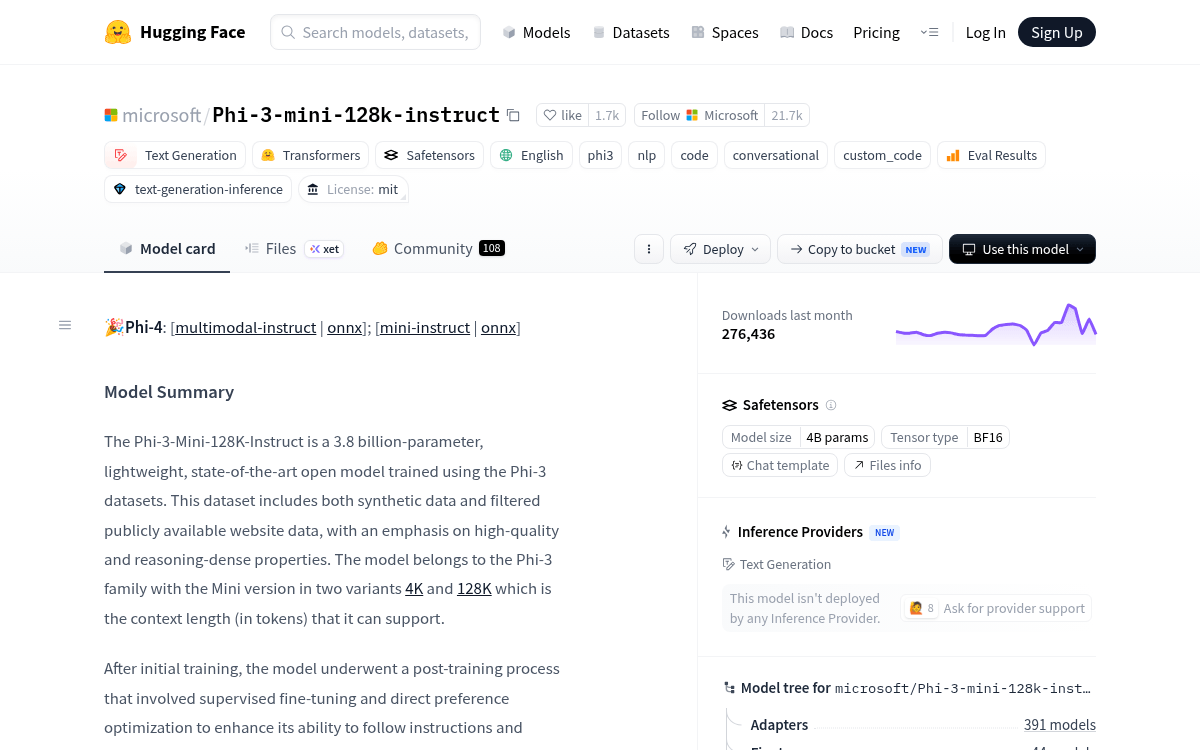
Microsoft's Phi-3-mini-128k-instruct remains one of Hugging Face's most-downloaded small models, packing a 128K context into a 3.8B parameter footprint.
 Pro
Takeaways
- Microsoft's Phi-3-mini-128k-instruct is a 3.8B parameter open model with a 128K token context window.
- Trained on 4.9T tokens using 512 H100 GPUs over 10 days, aligned with SFT and DPO.
- Post-training refresh lifted JSON structured output from 1.9 to 60.1 and RULER long-context average from 68.8 to 84.6.
- Beats Llama-3-8B-Instruct on GSM8K math (85.3 vs 77.4) despite half the parameter count.
- Weak on world knowledge benchmarks like TriviaQA, so retrieval augmentation is recommended for factual apps.
- Ships with vLLM, SGLang, Docker Model Runner, and ONNX runtimes including int4 quantizations for edge deployment.
Small language models keep proving that raw parameter count is not the only path to useful reasoning, and Microsoft's Phi-3-mini-128k-instruct is one of the more durable examples on Hugging Face. The checkpoint has crossed 1.7K likes and roughly 276K monthly downloads, and it still shows up as a default option in local runtimes like vLLM, SGLang, and Docker Model Runner. The profile is unusual enough to warrant another look: a 3.8B parameter dense transformer that claims a 128K context window without a mixture-of-experts trick or an external retrieval crutch.
The shape of the model
Phi-3-Mini-128K-Instruct is a 3.8 billion-parameter open model trained on the Phi-3 datasets, which combine synthetic data with filtered public web content, weighted toward high-quality, reasoning-dense material. Architecturally it is a dense decoder-only Transformer fine-tuned with Supervised Fine-Tuning (SFT) and Direct Preference Optimization (DPO) to align it with human preferences and safety guidelines.
The training bill is modest by frontier standards but hardly small. Microsoft reports a 128K context length, 512 H100-80G GPUs, 10 days of training, and 4.9T tokens, with an October 2023 knowledge cutoff. The data recipe is deliberately curated rather than scraped wide, and the team is explicit that they filter public documents to the right level of knowledge so that small models spend capacity on reasoning rather than memorized trivia.
What the June refresh actually changed
The current weights are not the original April release. The model card documents a post-training refresh that used additional data to lift long-context understanding, instruction following, and structured output, alongside better multi-turn conversation quality, explicit support for the system tag, and stronger reasoning.
The deltas on structured output and long context matter most for anyone building agentic pipelines:
- JSON structure output jumped from 1.9 to 60.1 on Microsoft's internal benchmark, which is the difference between unusable and shippable for tool-calling.
- RULER long-context retrieval at the full 128K window climbed from 43.3 to 65.6, with the overall RULER average moving from 68.8 to 84.6.
- RepoQA, which measures long-context code understanding, went from a 32.4 average to 77, with Python scores rising from 27 to 85.
Those numbers matter because 128K windows on small models often collapse in the last quarter of the context. The updated RULER curve suggests the model actually holds attention past 64K rather than degrading into noise.
Punching above its weight, except on trivia
Against peers in the 7B to 8x7B range, the 3.8B Phi-3-mini outperforms on reasoning and math while lagging on world-knowledge benchmarks. Selected numbers from the model card:
| Benchmark | Phi-3-Mini-128K | Llama-3-8B-Ins | Mixtral-8x7B | GPT-3.5-Turbo |
|---|---|---|---|---|
| MMLU (5-shot) | 69.7 | 66.5 | 70.5 | 71.4 |
| GSM8K CoT (8-shot) | 85.3 | 77.4 | 64.7 | 78.1 |
| HumanEval (0-shot) | 60.4 | 60.4 | 37.8 | 62.2 |
| TriviaQA (5-shot) | 57.8 | 67.7 | 82.2 | 85.8 |
The TriviaQA gap is the honest weakness, and the authors call it out directly: the model does not have the capacity to store much world knowledge, which shows in low TriviaQA scores, but they believe this can be resolved by augmenting Phi-3-Mini with a search engine. In practice that means RAG is mandatory for factual applications.
Deploying it
The Hugging Face page ships one-line launchers for the common inference stacks. The vLLM path is the most straightforward for a production endpoint:
pip install vllm
vllm serve "microsoft/Phi-3-mini-128k-instruct"
For a quick local check inside a notebook, the transformers pipeline works with trust_remote_code=True because the model still ships custom modeling code:
from transformers import pipeline
pipe = pipeline("text-generation",
                model="microsoft/Phi-3-mini-128k-instruct",
                trust_remote_code=True)
pipe([{"role": "user", "content": "Who are you?"}])
Flash attention is enabled by default, which means the model expects Ampere or newer NVIDIA hardware. On V100 or earlier GPUs, users need to pass attn_implementation="eager". For optimized inference on GPU, CPU, and mobile, ONNX builds are available, including int4 DML via AWQ, fp16 CUDA, int4 CUDA via RTN, and int4 CPU and mobile via RTN, which is the fastest route to running it on a laptop or edge device.
When it fits
Microsoft is explicit about the target profile: commercial and research use in English, aimed at memory or compute constrained environments, latency-bound scenarios, and workloads that need strong reasoning in code, math, and logic. The MIT license and small footprint make it a reasonable default for on-device assistants, long-document summarization, meeting transcript QA, and coding side-panels where a full 70B model is overkill. It will disappoint on anything trivia-heavy or multilingual, and anything relying on knowledge past October 2023 without retrieval grounding.
If you already run Phi-3-mini in production on the original April weights, the git commit bb5bf1e4001277a606e11debca0ef80323e5f824 pins the older behavior, which is worth knowing if you have prompts calibrated against the pre-refresh checkpoint. For everyone else, the current default is the version to pull.