
Microsoft's Phi-3.5-Vision Beats GPT-4o on Charts at 4B Parameters
Microsoft's 4.2B parameter multimodal model adds multi-frame image and video understanding, matching much larger models on visual reasoning benchmarks.
 Pro
Takeaways
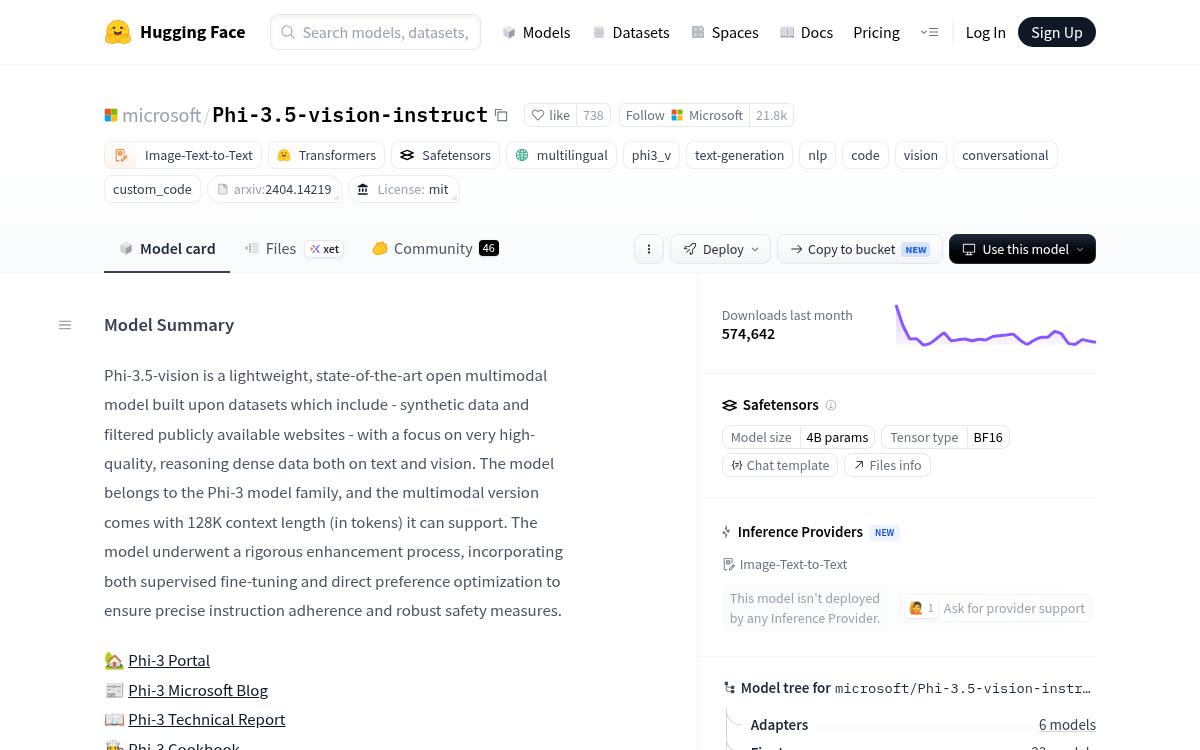
- Microsoft released Phi-3.5-vision-instruct, a 4.2B parameter MIT-licensed multimodal model.
- Adds multi-frame reasoning: image comparison, multi-image summarization, and video summarization.
- MMMU jumped from 40.2 to 43.0; TextVQA from 70.9 to 72.0; 128K context length.
- Beats similarly sized models on BLINK (57.0) and leads on ChartQA (81.8) vs GPT-4o.
- Weaker on long video (43.8 on 30-60min clips) and visual math (43.9 MathVista).
- Trained on 500B tokens with 256 A100-80G GPUs over 6 days; runs on a single A100/H100.
Microsoft has released Phi-3.5-vision-instruct, a 4.2B-parameter multimodal model that handles single images, multi-image comparisons, and short video clips while fitting on a single consumer or workstation GPU. It is MIT licensed and has crossed 680K downloads on Hugging Face.
Multi-frame reasoning arrives
The main addition is multi-frame image understanding: detailed image comparison, multi-image summarization, and video summarization are now first-class capabilities. Single-image benchmarks also improved, with MMMU rising from 40.2 to 43.0, MMBench from 80.5 to 81.9, and TextVQA from 70.9 to 72.0. The architecture combines an image encoder, connector, projector, and the Phi-3 Mini language backbone inside a 128K token context window, which makes stuffing a 20-slide deck or a sequence of video frames into a single prompt practical.
Where it pulls ahead
On the BLINK benchmark of 14 visual tasks that humans solve quickly but that remain hard for multimodal LLMs, Phi-3.5-vision scores 57.0 overall, ahead of LlaVA-Interleave-Qwen-7B (53.1), InternVL-2-8B (45.4), Gemini-1.5-Flash (45.8), and GPT-4o-mini (51.9), and just above Claude-3.5-Sonnet (56.5). Its strongest results:
- Chart reasoning: 81.8 on ChartQA, beating GPT-4o (64.0) and Claude-3.5-Sonnet (73.2)
- Document OCR: 72.0 on TextVQA, competitive with several frontier models
- Art style recognition (87.2) and forensic detection (92.4) on BLINK
- Scientific diagrams: 91.3 on ScienceQA
Where it falls short
Video-MME tells the honest story on longer sequences. Phi-3.5-vision scores 50.8 overall against 68.4 for GPT-4o and 62.6 for Gemini-1.5-Pro, dropping to 43.8 on clips between 30 and 60 minutes. Visual math is also weak at 43.9 on MathVista versus 57.4 for Gemini-1.5-Pro. Training is primarily English text, so other languages will degrade in quality.
How it was trained
Training ran on 256 A100-80G GPUs over six days on 500B tokens of mixed vision and text data. The mix leans heavily on synthetic textbook-style content covering math, coding, and common-sense reasoning, plus image data including charts, tables, diagrams, and slides, and multi-image and video data such as short clips and pairs of similar images. That curriculum explains the unusually strong chart and slide-deck numbers. Microsoft refined the result with supervised fine-tuning and direct preference optimization.
Running it
The model works out of the box with Transformers, vLLM, SGLang, and Docker Model Runner. A minimal Transformers snippet:
from transformers import AutoModelForCausalLM, AutoProcessor
model_id = "microsoft/Phi-3.5-vision-instruct"
model = AutoModelForCausalLM.from_pretrained(
    model_id, device_map="cuda", trust_remote_code=True,
    torch_dtype="auto", _attn_implementation="flash_attention_2"
)
processor = AutoProcessor.from_pretrained(
    model_id, trust_remote_code=True, num_crops=4
)
Set num_crops=4 for multi-frame inputs and num_crops=16 for single-frame to get the best results. Flash Attention is on by default, with an eager attention fallback if installation is not possible. Tested hardware includes A100, A6000, and H100.
When to reach for it
Microsoft targets memory-constrained and latency-sensitive deployments: document pipelines heavy on charts, forms, and tables; slide deck and screenshot summarization for Office-style workflows; and low-latency visual QA where a hosted API is too slow or expensive. Specifically:
- On-device or edge deployments where a 70B VLM is out of reach
- Document processing pipelines with heavy chart, form, and table content
- Slide deck and screenshot summarization for Office-style workflows
- Low-latency visual QA where round-tripping to a hosted API is too slow or too costly
A 4B open-weights model that handles interleaved multi-image reasoning credibly is a meaningful shift. Until recently that capability required either a much larger open model or a closed API. Paired with the Phi-3 technical report and the Phi-3 Cookbook fine-tuning recipes, it gives teams a realistic starting point for vertical vision assistants without a training budget in the millions.