
Microsoft's mDeBERTa-v3 Still Beats XLM-R on 16 Languages for Free
Microsoft's compact multilingual encoder keeps racking up millions of downloads thanks to strong XNLI scores across 100 languages and a permissive MIT license.
 Pro
Takeaways
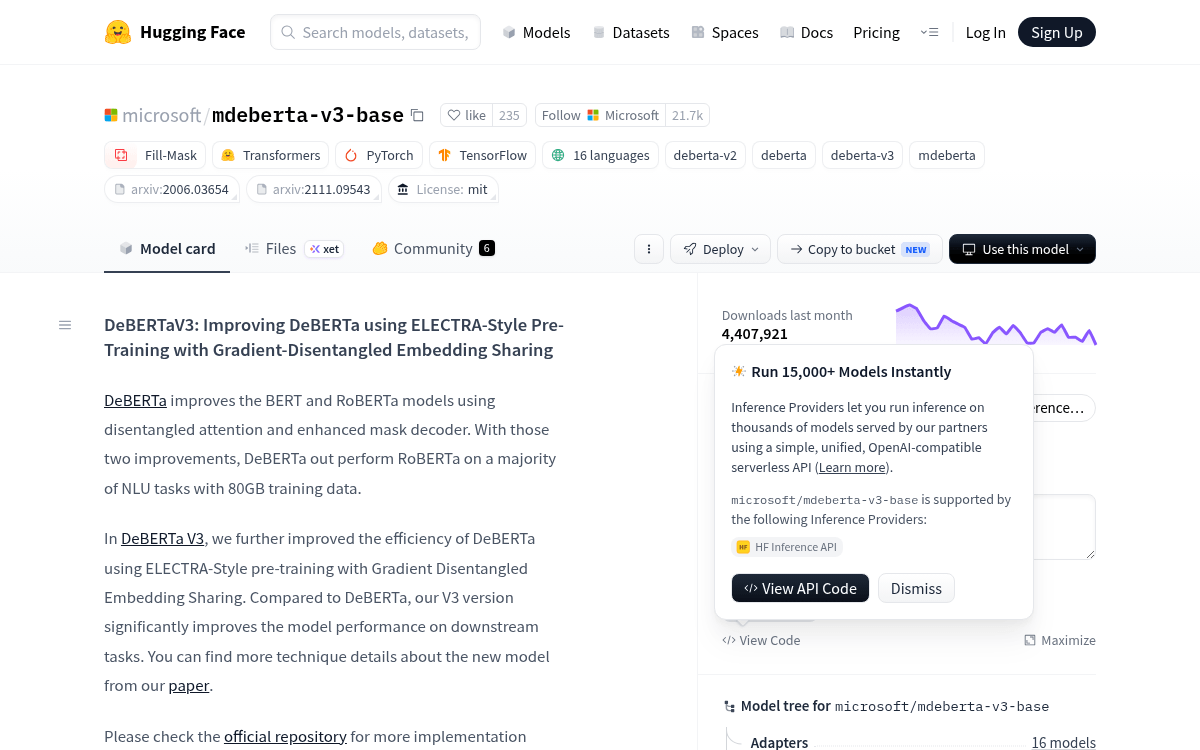
- Microsoft's mDeBERTa-v3-base keeps trending with millions of monthly Hugging Face downloads
- 12 layers, 86M backbone params plus 190M embedding params, 250K token vocabulary
- Scores 79.8% average on XNLI zero-shot cross-lingual transfer vs 76.2% for XLM-R-base
- Uses ELECTRA-style replaced token detection with gradient-disentangled embedding sharing
- MIT licensed, works with 100 CC100 languages, 294 community fine-tunes available
- Best for classification, NER, NLI and zero-shot tasks, not generation
Encoder-only transformers rarely trend on model hubs anymore, but Microsoft's mDeBERTa-v3-base keeps pulling in millions of monthly downloads on Hugging Face. As the multilingual variant of DeBERTaV3, it remains one of the strongest base-sized cross-lingual encoders you can drop into a classification or NLI pipeline without paying an API bill.
A small model with a big vocabulary
mDeBERTa shares its architecture with DeBERTa and was trained on the 2.5T CC100 corpus, the same data used for XLM-R. The V3 base checkpoint has 12 layers, a hidden size of 768, 86M backbone parameters, and a 250K-token vocabulary that adds another 190M parameters in the embedding layer.
That 250K vocabulary is the tell. Most of the parameter budget goes into embeddings so the tokenizer can carve up scripts as different as Arabic, Thai, Chinese, and Swahili without shredding them into byte fragments. The transformer stack itself is small enough to fine-tune on a single consumer GPU.
Why it still beats XLM-R
On the standard cross-lingual transfer setup, mDeBERTa is trained on English NLI data and then evaluated on 14 other languages it never saw labels for. It hits 79.8% average accuracy on XNLI versus 76.2% for XLM-R-base, and supports zero-shot transfer across 16 languages. The lift is largest exactly where multilingual models usually collapse: Swahili jumps from 66.5 to 73.9, and Urdu from 68.3 to 72.4.
One community maintainer bluntly warns that if other multilingual model cards claim around 90% on non-English languages, the authors have most likely made a mistake during testing, since no recent paper shows multilingual XNLI averages more than a few points above 80%. The mid-to-high 70s here is genuinely close to the state of the art for base-sized encoders.
ELECTRA-style training without the tug-of-war
The V3 line's contribution is a change to how the model is pretrained. DeBERTaV3 replaces masked language modeling with replaced token detection, a more sample-efficient pretraining task borrowed from ELECTRA. Instead of predicting a hidden word, the model learns to spot which tokens in a sentence were swapped in by a smaller generator network.
That setup has a well-known failure mode. Vanilla embedding sharing in ELECTRA hurts training efficiency and model quality because the discriminator and generator losses pull token embeddings in different directions, creating tug-of-war dynamics. The authors propose a gradient-disentangled embedding sharing method that avoids this pull, improving both training speed and the quality of the resulting checkpoint. Concretely, the generator shares its embeddings with the discriminator, but gradients from the discriminator are stopped from backpropagating into the generator embeddings. That single design choice is what lets the multilingual version squeeze extra points out of the same CC100 data XLM-R saw.
What it's actually good for
This is a base encoder, not a chat model. Its sweet spot is anything where you need a language-agnostic representation and want to fine-tune cheaply:
- Multilingual text classification (toxicity, intent, topic, sentiment) trained on English labels and deployed globally
- Zero-shot classification via NLI, where community fine-tunes like MoritzLaurer's XNLI variant hit 87.1% on English MNLI while typically holding above 80% accuracy across multiple languages
- Named entity recognition and token classification for low-resource languages
- Cross-lingual retrieval and reranking as a bi-encoder or cross-encoder
- Backbone for GLiNER-style span extractors and other structured predictors
Multilingual NLI models can classify texts without receiving training data in the specific language, and mDeBERTa can do NLI on the other 73 languages it was pretrained on, though performance is likely lower than for languages seen during fine-tuning. That makes it a reasonable default when your production traffic includes languages you can't afford to label.
Where it falls short
It is not a generative model. You cannot prompt it, you cannot chat with it, and it will not write your code. It also inherits the usual encoder headaches: a fixed context window, tokenizer quirks on very low-resource scripts, and the fact that DeBERTa-v3 was released in late 2021 and older versions of HF Transformers have issues running the checkpoint, so pinning a recent transformers version matters. Domain adaptation to legal, medical, or code text still requires continued pretraining.
Getting started
The model is MIT licensed and free to download. The minimal path is a two-liner through the standard pipeline API:
from transformers import pipeline
pipe = pipeline("fill-mask", model="microsoft/mdeberta-v3-base")
pipe("Paris is the capital of [MASK].")
For classification, load it with an AutoModelForSequenceClassification head and fine-tune on your labeled data, or grab one of the 294 community fine-tunes tracked on the model page. The official DeBERTa repo holds the reference implementation, and the V3 paper covers the training recipe if you want to reproduce or extend it. For anyone building multilingual NLP that has to work in production without a hosted LLM in the loop, this is still one of the most cost-effective encoders on the shelf.