
Microsoft's LayoutLMv3 Kills the CNN Backbone to Dominate Document AI
Microsoft Research's document AI transformer unifies text and image masking, hitting state of the art on form parsing, receipts, and layout tasks.
 Pro
Takeaways
- Microsoft's LayoutLMv3 is a multimodal transformer for Document AI with unified text and image masking.
- First document model to skip CNN backbones, using linear patch embeddings ViT-style for major parameter savings.
- Three pretraining objectives: masked language modeling, masked image modeling, and word-patch alignment.
- State of the art on FUNSD (92.08 F1), CORD (97.46 F1), and DocVQA (83.37 ANLS) benchmarks.
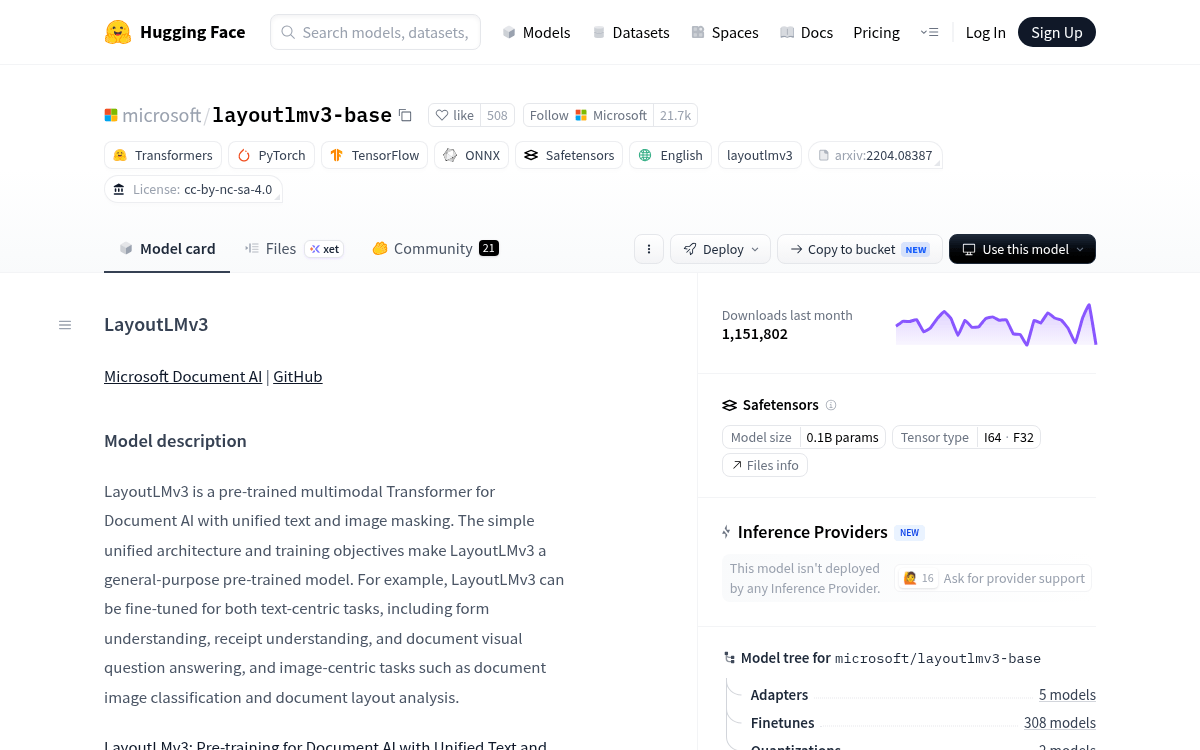
- Pretrained on 11M pages from IIT-CDIP; base checkpoint is roughly 100M parameters.
- Licensed CC-BY-NC-SA-4.0, so commercial deployment requires a separate agreement with Microsoft.
Microsoft Research proposed LayoutLMv3, a multimodal transformer for Document AI that drops the CNN backbone and pretrains text and image patches with the same masked-modeling recipe. The design is described in Pre-training for Document AI with Unified Text and Image Masking, and the checkpoints live on the Hugging Face hub with the training code in microsoft/unilm. If you have ever wired up OCR plus a language model to parse invoices, forms, or scanned receipts, this is the model that many current production pipelines are quietly built on.
Killing the CNN backbone
Prior document transformers like LayoutLMv2 and DocFormer relied on Faster R-CNN or ResNet to extract visual features before feeding them into a transformer. That approach is expensive and forces you to carry region annotations around. LayoutLMv3 is the first multimodal model in Document AI that ditches the pre-trained CNN, which cuts parameters and eliminates the annotation dependency. The image is instead chopped into linear patch embeddings, ViT-style, and fed straight to the transformer alongside text tokens and 2D layout coordinates.
One masking recipe for two modalities
The core research bet: text and images should be pretrained the same way. Earlier multimodal models used masked language modeling on text but reached for different objectives on the image side, and that mismatch made cross-modal learning harder than it needed to be. LayoutLMv3 unifies the two under a shared masking framework, training on three objectives:
- Masked Language Modeling (MLM): standard BERT-style token masking over the OCR text.
- Masked Image Modeling (MIM): 40% of image tokens are masked and reconstructed based on surrounding text and image tokens, pushing the model toward high-level layout structure rather than pixel noise.
- Word-Patch Alignment (WPA): a cross-modal objective that predicts whether the image patch corresponding to a given text word has been masked.
Pretraining runs on 11 million document pages from the IIT-CDIP corpus, with RoBERTa and a pre-trained DiT providing initial weights for the text and image-tokenizer components.
Benchmark numbers
The base checkpoint on Hugging Face is roughly 100M parameters, and it holds up against much larger competitors. Reported results across the standard document AI benchmarks:
| Benchmark | Task | LayoutLMv3 Large |
|---|---|---|
| FUNSD | Form understanding (F1) | 92.08 |
| CORD | Receipt understanding (F1) | 97.46 |
| DocVQA | Document VQA (ANLS) | 83.37 |
| RVL-CDIP | Document classification (Acc) | ~95.5 |
The 92.08 F1 on FUNSD and 97.46 on CORD beat DocFormer and StructuralLM at similar or smaller parameter counts, and the model matches or exceeds them on the image-heavy tasks too.
How you actually use it
Loading the base model is a one-liner through the Transformers library:
from transformers import AutoProcessor, AutoModel
processor = AutoProcessor.from_pretrained("microsoft/layoutlmv3-base")
model = AutoModel.from_pretrained("microsoft/layoutlmv3-base", device_map="auto")
# processor handles OCR + image patching + bbox normalization
encoding = processor(image, words, boxes=boxes, return_tensors="pt")
outputs = model(**encoding)
The processor bundles OCR output (words and their bounding boxes) with the image, so you only have to think in terms of tokens and coordinates. Fine-tuning follows the usual pattern: attach a token classification head for FUNSD-style entity extraction, or a sequence classification head for RVL-CDIP.
Where it fits and where it does not
LayoutLMv3 is meant as a general encoder that fine-tunes cleanly for text-centric jobs (form understanding, receipt parsing, document VQA) and image-centric ones (document classification, layout analysis). Practical fits include invoice parsing, KYC document extraction, contract clause tagging, and PubLayNet-style page segmentation.
Two things to keep in mind before shipping it:
- OCR dependency. Accuracy is state of the art on FUNSD and CORD, but the model inherits whatever errors your OCR stage produces, and severe visual distortion still degrades results. Bad OCR upstream will cap your accuracy.
- License. The checkpoints ship under CC-BY-NC-SA-4.0, so commercial deployment requires talking to Microsoft or fine-tuning a permissively licensed alternative.
Why it still matters
The document AI stack has been trending toward general vision-language models like Donut, Pix2Struct, and GPT-4V that skip OCR entirely. LayoutLMv3 sits in the other camp: OCR-first, encoder-only, cheap to fine-tune, and small enough to run on a single GPU. For structured extraction jobs where you need deterministic token spans mapped to bounding boxes, that architecture is still hard to beat, which is why the base checkpoint has accumulated over a million downloads and more than 300 public fine-tunes on the hub.