
Microsoft's DeBERTaV3 Beats RoBERTa and ELECTRA on GLUE With a Smarter Training Fix
Microsoft researchers introduce DeBERTaV3, a pre-trained encoder that swaps masked language modeling for ELECTRA-style training with a novel embedding sharing trick.
 Pro
Takeaways
- Microsoft researchers published DeBERTaV3, accepted at ICLR 2023, improving DeBERTa with ELECTRA-style pre-training.
- Introduces Gradient-Disentangled Embedding Sharing to fix the tug-of-war between generator and discriminator embeddings.
- DeBERTaV3 Large hits 91.37% average on GLUE, beating DeBERTa by 1.37% and ELECTRA by 1.91%.
- Multilingual mDeBERTa Base sets new XNLI SOTA at 79.8% zero-shot cross-lingual accuracy.
- Weights are MIT-licensed and available on Hugging Face and GitHub.
- 304M backbone params, 128K vocab, trained on 160GB of English text for NLU tasks.
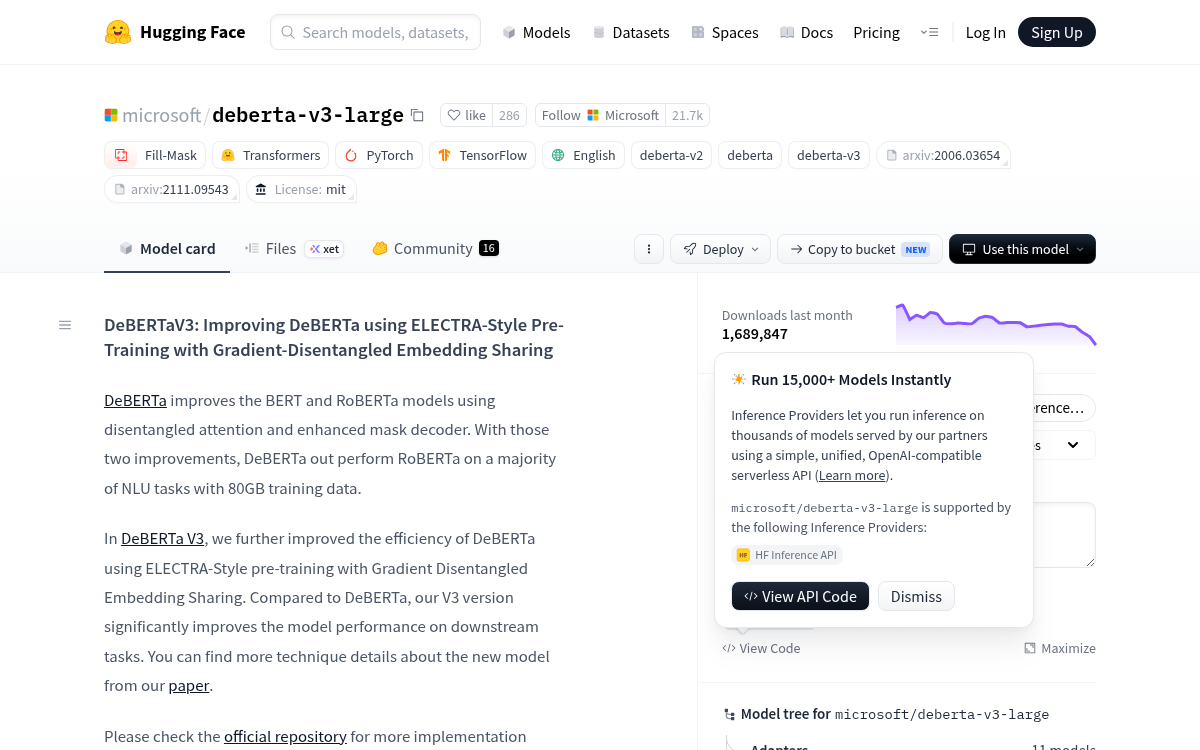
Microsoft researchers Pengcheng He, Jianfeng Gao, and Weizhu Chen have released DeBERTaV3, a pre-trained language model that reworks how DeBERTa is trained. The core change: replacing masked language modeling (MLM) with replaced token detection (RTD), a more sample-efficient pre-training task borrowed from ELECTRA. The work was accepted at ICLR 2023, with weights and code released under an MIT license.
Alongside the training-objective swap, the authors propose Gradient-Disentangled Embedding Sharing (GDES), which fixes a subtle bug in ELECTRA-style training. The resulting encoders outperform RoBERTa, XLNet, and ELECTRA at the same parameter count on standard natural language understanding benchmarks.
The tug-of-war inside ELECTRA
ELECTRA-style pre-training uses a small generator network to corrupt tokens in a sentence, then trains a larger discriminator to spot which tokens were swapped. This is more sample-efficient than MLM because the loss is computed over every token instead of only the masked ones.
The catch shows up in the shared embedding table. The generator wants embeddings that cluster semantically similar tokens together so it can predict plausible replacements. The discriminator wants embeddings that separate those same tokens so it can spot fakes. Sharing the table forces a compromise that hurts both objectives, and the two losses end up dragging the embeddings in opposite directions during backprop.
Simply unsharing the embeddings backfires. When the generator and discriminator maintain separate embedding tables, downstream fine-tuning accuracy drops significantly, which suggests the shared signal carries real value even with the interference.
Stop the gradients, keep the sharing
GDES threads the needle by letting the discriminator read from the generator's embedding table while blocking gradient flow back through it. The discriminator sees the shared parameters at the forward pass, but its gradient signal never updates them. A separate residual embedding on the discriminator side absorbs any discriminator-specific adjustments.
The recipe looks roughly like this:
generator_embeddings = shared_embeddings
discriminator_embeddings = shared_embeddings.detach() + delta_embeddings
# generator loss updates shared_embeddings
# discriminator loss updates delta_embeddings only
The paper reports that this change improves both pre-training convergence and downstream quality relative to both fully shared and fully separate embeddings.
Benchmark numbers
On the eight-task GLUE benchmark, DeBERTaV3 Large hits a 91.37% average, 1.37 points over DeBERTa and 1.91 over ELECTRA, a new state of the art among similarly sized encoders. On SQuAD 2.0 and MNLI, the large variant posts 91.5/89.0 F1/EM and 91.8/91.9 accuracy, edging past DeBERTa-large and clearly beating RoBERTa-large.
The multilingual sibling shows larger gains. mDeBERTa Base reaches 79.8% zero-shot cross-lingual accuracy on XNLI, a 3.6-point jump over XLM-R Base and a new SOTA on that benchmark.
Model specs and how to use it
- 24 transformer layers, hidden size 1024, 304M backbone parameters
- 128K token vocabulary, adding 131M parameters in the embedding layer
- Trained on the same 160GB corpus used for DeBERTa V2
- Also available in xsmall, small, and base sizes via the official repository
The weights drop into the standard transformers pipeline:
from transformers import AutoModel
model = AutoModel.from_pretrained(
    "microsoft/deberta-v3-large",
    device_map="auto",
)
Where this actually helps
DeBERTaV3 is an encoder-only model, so it will not write your emails. It is good at anything that maps text to labels or spans: classification, entailment, extractive question answering, named entity recognition, reranking retrieval results, and sequence labeling. At 304M parameters it fits comfortably on a single consumer GPU, which makes it a strong baseline when a decoder LLM is overkill or too expensive per query.
One trade-off worth flagging: the 128K vocabulary pushes the embedding layer to 131M parameters, so the inference memory footprint is larger than the backbone count suggests. Multilingual workloads should reach for mDeBERTaV3 instead, since this checkpoint is English-only. For teams building production NLU pipelines where latency, cost, and calibration matter more than open-ended generation, DeBERTaV3 is the kind of model that quietly earns its spot in the stack.