
Microsoft's BiomedBERT Beats Every Rival by Training on PubMed From Scratch
Microsoft's biomedical BERT, pretrained from scratch on PubMed abstracts, still pulls 1.4M monthly downloads as the go-to encoder for medical NLP tasks.
 Pro
Takeaways
- Microsoft's BiomedBERT holds ~1.4M downloads as a top biomedical encoder.
- Pretrained from scratch on PubMed abstracts, not continual pretraining from general BERT.
- State-of-the-art on the BLURB biomedical benchmark at release.
- In-domain vocabulary avoids shredding terms like gefitinib into meaningless word pieces.
- Best for NER, relation extraction, retrieval, and classification over biomedical literature.
- MIT licensed, BERT-base size, works with Hugging Face
transformersout of the box.
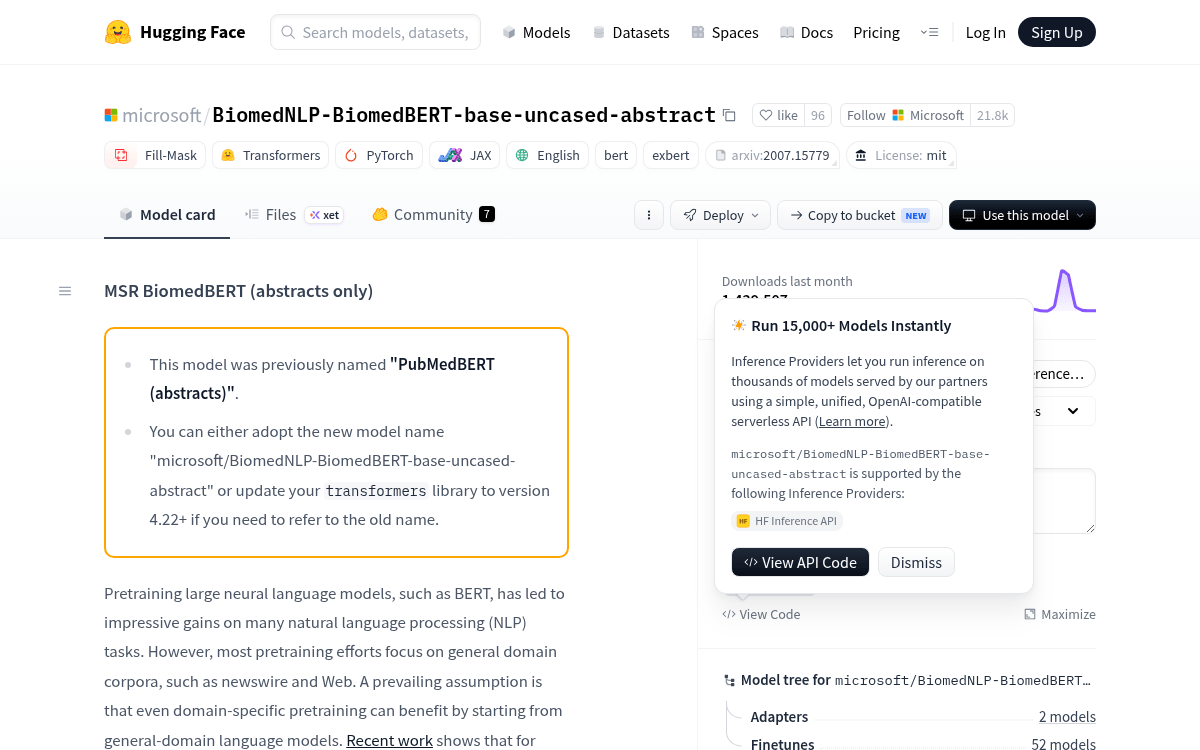
BiomedBERT (formerly PubMedBERT) sits at roughly 1.4M downloads and 96 likes on Hugging Face, making it one of the most-used biomedical language models available. A BERT-base encoder pretrained from scratch on PubMed abstracts, it remains the default starting point for teams building clinical or biomedical NLP pipelines. The model card was renamed and tidied up, but the underlying checkpoint continues to power dozens of fine-tunes and Spaces on the Hub.
Why scratch pretraining beat continual pretraining
Most BERT-family models for specialized domains start from a general-domain checkpoint and keep training on domain text. The Microsoft team behind BiomedBERT took a different route, showing that training solely on biomedical text from scratch outperforms continual pretraining across a wide range of biomedical tasks. The core advantage is vocabulary. General-domain BERT vocabularies were built on newswires and web text, so terms like gefitinib or lymphoma get fragmented into meaningless subword pieces. BiomedBERT's in-domain vocabulary keeps those terms intact, which directly benefits downstream learning.
What the model actually is
- Architecture: BERT-base, uncased, fill-mask head
- Corpus: PubMed abstracts only (a sibling checkpoint adds PubMedCentral full text)
- License: MIT
- Frameworks: PyTorch and JAX, compatible with Hugging Face
transformers - Paper: Domain-Specific Language Model Pretraining
Loading it takes two lines:
from transformers import AutoTokenizer, AutoModelForMaskedLM
tok = AutoTokenizer.from_pretrained("microsoft/BiomedNLP-BiomedBERT-base-uncased-abstract")
model = AutoModelForMaskedLM.from_pretrained("microsoft/BiomedNLP-BiomedBERT-base-uncased-abstract")
The weights are MIT-licensed and mirrored in the Microsoft Foundry catalog for teams that prefer managed Azure endpoints.
Where it excels, and where it falls short
BiomedBERT achieves strong results across the Biomedical Language Understanding and Reasoning Benchmark (BLURB), which covers named entity recognition (diseases, chemicals, genes), relation extraction, PICO extraction, sentence similarity, document classification, and biomedical QA. BioBERT is the closest competitor, also trained on PubMed text, but BiomedBERT's scratch-trained vocabulary gives it consistent gains on most BLURB tasks.
Several use cases fall outside what it handles well:
- Generation. As an encoder, it produces no free-form text. Use it for classification, tagging, or embeddings, and pair it with a decoder if generation is needed.
- Clinical notes. BiomedBERT was trained on structured abstracts, not EHR-style text with heavy abbreviations and irregular spelling. ClinicalBERT and BlueBERT are better fits there.
- Long context. The standard 512-token BERT window applies, with no sliding attention.
- Zero-shot use. Fine-tuning on labeled task data is almost always required.
Practical use cases
- Biomedical NER: extracting drug, disease, gene, and chemical mentions from literature.
- Relation extraction between entities (drug-drug interactions, gene-disease links).
- Document classification and triage for systematic reviews.
- Dense retrieval encoders for RAG systems over PubMed, fine-tuned with a contrastive objective.
- Feature extraction feeding a lightweight classifier for cohort selection or eligibility screening.
The Hub lists 50 fine-tunes and 2 adapters built on this base, plus 36 Spaces, a reasonable signal that it holds up as a starting point. Microsoft also ships an abstracts-plus-full-text variant and a large uncased checkpoint under the same naming scheme. For most fine-tuning budgets, the base abstracts-only model is the practical choice: small, fast, and well-validated on BLURB.