
Microsoft Releases BitNet b1.58 2B4T, a 1-Bit Open-Source LLM Running on CPU
Microsoft Research trained a 2B-parameter language model with ternary weights from scratch on 4T tokens, matching full-precision peers at a fraction of the memory and energy.
 Pro
Takeaways
- Microsoft Research released BitNet b1.58 2B4T, the first open-source native 1-bit LLM at 2B parameters.
- Weights are ternary (-1, 0, +1), roughly 1.58 bits each, with 8-bit activations, trained from scratch.
- Trained on 4 trillion tokens with pre-training, SFT, and DPO stages; MIT license.
- Uses 0.4 GB memory and 29 ms CPU latency per token, well below Qwen, LLaMA, and Gemma peers.
- Average benchmark score of 54.19 matches Qwen2.5 1.5B, with strong GSM8K, ARC, and WinoGrande.
- Efficiency gains require the bitnet.cpp runtime, not stock transformers.
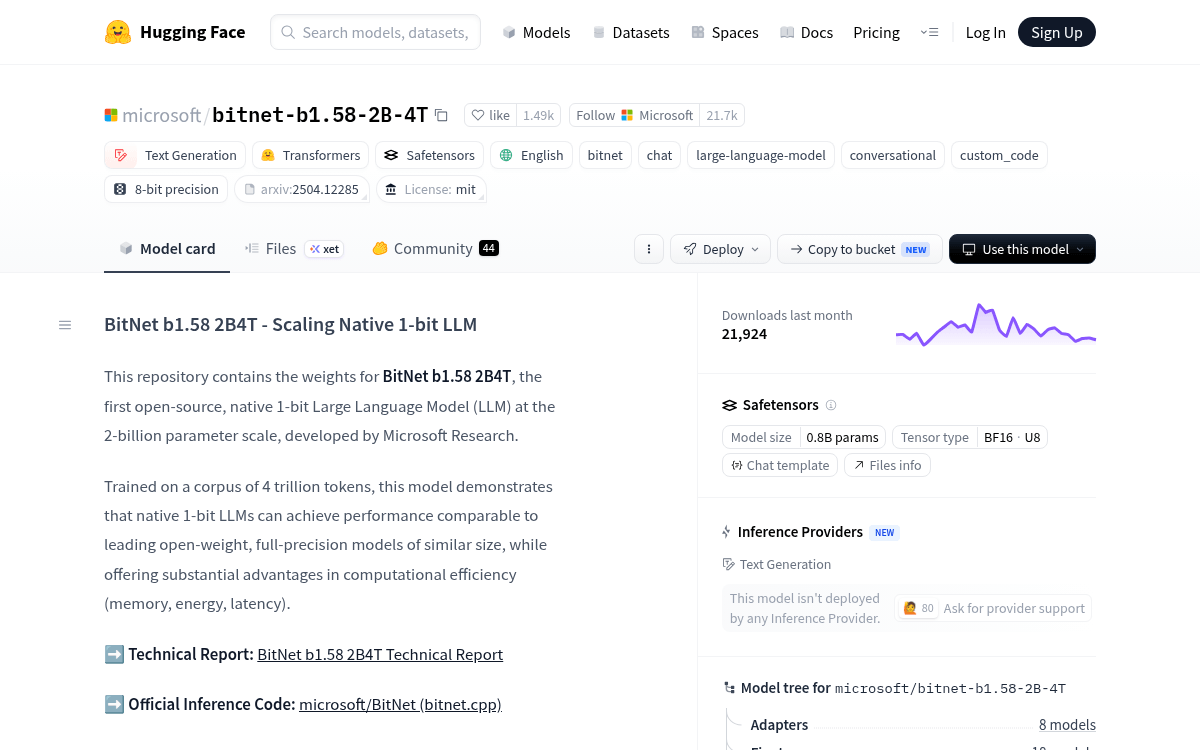
Microsoft Research has released the weights for BitNet b1.58 2B4T, the first open-source, native 1-bit Large Language Model at the 2-billion parameter scale, trained on a corpus of 4 trillion tokens. Rather than taking a full-precision model and squeezing it down after training, the team baked extreme quantization into the model from the very first step. The result competes with FP16 peers on benchmarks while running with a fraction of the memory, energy, and CPU latency.
Ternary weights, not marketing
The b1.58 in the name comes from information theory. Each weight takes only three values, which works out to log2(3) or roughly 1.58 bits of information per parameter. Concretely, the architecture is a Transformer modified with BitLinear layers where weights are quantized to ternary values of minus one, zero, or plus one using absmean quantization during the forward pass, and activations are quantized to 8-bit integers using absmax quantization per token. This is often written as W1.58A8.
The key architectural choice is that quantization is native. BitNet was trained from scratch under the ternary constraint rather than post-training quantized from a full-precision checkpoint. That distinction is what allows accuracy to hold up at a compression level where naive post-hoc quantization typically collapses.
Other design decisions read like a modern small LLM checklist: Rotary Position Embeddings, squared ReLU activation in the FFN layers, subln normalization, and no bias terms in linear or normalization layers. The tokenizer is borrowed from LLaMA 3 with a 128,256 vocabulary, and the context window is 4,096 tokens.
How it was built
Training followed a three-stage recipe that would look familiar to anyone who has read a Llama or Qwen technical report, adapted for the ternary regime:
- Pre-training on public text and code plus synthetic math data, using a two-stage learning rate and weight decay schedule.
- Supervised fine-tuning on instruction and conversation datasets with sum-based loss aggregation.
- Direct Preference Optimization to align with human preferences.
Microsoft also publishes a BF16 master-weight variant intended for further training and fine-tuning, and a GGUF variant meant for CPU inference through the bitnet.cpp runtime. The packed 1.58-bit weights on the main repo are the ones you deploy.
The efficiency numbers
The headline comparison is against instruction-tuned open-weight models in the 1B to 2B range. Non-embedding memory drops to 0.4 GB, versus 2 GB for LLaMA 3.2 1B, 2.6 GB for Qwen2.5 1.5B, and 4.8 GB for MiniCPM 2B. CPU decoding latency comes in at 29 ms per token, roughly two to four times faster than the same peers on CPU. Estimated energy per token is 0.028 J, about an order of magnitude lower than the comparison set.
| Model | Non-emb memory | CPU latency | Energy | Avg score |
|---|---|---|---|---|
| LLaMA 3.2 1B | 2.0 GB | 48 ms | 0.258 J | 44.90 |
| Gemma 3 1B | 1.4 GB | 41 ms | 0.186 J | 43.74 |
| Qwen2.5 1.5B | 2.6 GB | 65 ms | 0.347 J | 55.23 |
| SmolLM2 1.7B | 3.2 GB | 67 ms | 0.425 J | 48.70 |
| MiniCPM 2B | 4.8 GB | 124 ms | 0.649 J | 42.05 |
| BitNet b1.58 2B | 0.4 GB | 29 ms | 0.028 J | 54.19 |
Where it holds up, and where it does not
Averaged across the reported benchmarks, BitNet lands at 54.19, a hair behind Qwen2.5 1.5B at 55.23 and clearly ahead of LLaMA 3.2 1B, Gemma 3 1B, SmolLM2 1.7B, and MiniCPM 2B. Individual strengths worth calling out:
- Best in the group on ARC-Challenge (49.91), PIQA (77.09), WinoGrande (71.90), and GSM8K (58.38).
- Competitive on MMLU at 53.17, behind Qwen2.5 1.5B but ahead of LLaMA and Gemma.
- Notably strong grade-school math performance, with GSM8K well above every peer in the table.
Weak spots are also visible. HumanEval+ sits at 38.4, behind Qwen2.5 1.5B at 50.6, so code generation is not where you would send this model first. TriviaQA and IFEval both trail the pack, and MT-bench at 5.85 is mid-tier for open-weight chat models. Microsoft is also explicit that the model may perpetuate biases in training data, has limited non-English support, and has an elevated defect rate on election-related queries, and does not recommend production use without further testing.
The catch with transformers
Loading the model through the standard Hugging Face transformers library will not give you the efficiency gains from the paper. The current transformers execution paths lack the specialized kernels needed for ternary matmul, so running through transformers will likely produce speed and energy numbers comparable to, or worse than, a full-precision model. To actually get the reported latency and energy, you need the dedicated C++ implementation in bitnet.cpp.
You can still load it the usual way for correctness testing or fine-tuning experiments:
from transformers import AutoTokenizer, AutoModelForCausalLM
import torch
model_id = "microsoft/bitnet-b1.58-2B-4T"
tokenizer = AutoTokenizer.from_pretrained(model_id)
model = AutoModelForCausalLM.from_pretrained(
    model_id, torch_dtype=torch.bfloat16
)
messages = [{"role": "user", "content": "Explain ternary quantization."}]
prompt = tokenizer.apply_chat_template(messages, tokenize=False, add_generation_prompt=True)
inputs = tokenizer(prompt, return_tensors="pt").to(model.device)
out = model.generate(**inputs, max_new_tokens=128)
print(tokenizer.decode(out[0][inputs.input_ids.shape[-1]:], skip_special_tokens=True))
For deployment, the GGUF variant plus bitnet.cpp is the intended path. The model is MIT licensed, weights are on Hugging Face, and vLLM and SGLang commands are provided in the model card for OpenAI-compatible serving.
Why this matters
Two things are actually new here. The paper positions BitNet b1.58 2B4T as the leading model in the 1-bit category, showing significantly stronger overall performance than other compared 1-bit models, including both smaller natively trained variants and larger post-training quantized ones like Falcon3-1.58bit-7B and Llama3-8B-1.58. Second is the Pareto claim: on average score versus memory footprint, BitNet sits above Qwen2.5, LLaMA 3.2, Gemma 3, SmolLM2, and MiniCPM in the sub-3B range.
The practical implication is a category of edge and CPU-only deployments that were previously awkward. A 0.4 GB non-embedding memory footprint and sub-30 ms per-token CPU decoding put decent chat quality within reach of laptops, phones, and small ARM boxes without a GPU. Realistic use cases include:
- On-device assistants where GPU is unavailable or expensive.
- Batch classification, summarization, or extraction pipelines where energy per token matters.
- Local RAG systems for privacy-sensitive workflows.
- Research on scaling behaviors of native low-bit training.
What assumptions should shift
Post-training quantization has been the default answer for shrinking LLMs, and the going wisdom has been that dropping below 4 bits costs real accuracy. BitNet b1.58 2B4T is evidence that with quantization-aware training from scratch, 1.58 bits per weight can hold competitive benchmark scores at the 2B scale. That does not overturn the case for FP16 or INT4, but it does suggest ternary is a viable operating point when the target is CPU inference or energy-constrained hardware. The open question is whether the recipe scales cleanly to 7B, 13B, and beyond, and whether specialized silicon starts to treat ternary matmul as a first-class operation.