
Microsoft Foundry Deploys XLM-RoBERTa-Large Across 100 Languages in One Click
Microsoft Foundry adds Meta's 100-language XLM-RoBERTa-large encoder to its deployable catalog, one-click hosted on Azure via the Hugging Face Inference Toolkit.
 Pro
Takeaways
- FacebookAI/xlm-roberta-large is now generally available as a managed inference endpoint on Microsoft Foundry.
- Deployment is powered by the Hugging Face Inference Toolkit with REST access via AzureML endpoints.
- Part of an expanded Hugging Face and Microsoft partnership bringing 10,000+ open models to Foundry.
- Model covers 100 languages, pre-trained on 2.5TB of filtered CommonCrawl using masked language modeling.
- Best for fine-tuned classification, NER, QA, and feature extraction rather than text generation.
- All Foundry-listed Hugging Face models pass security scans and ship as safetensors weights.
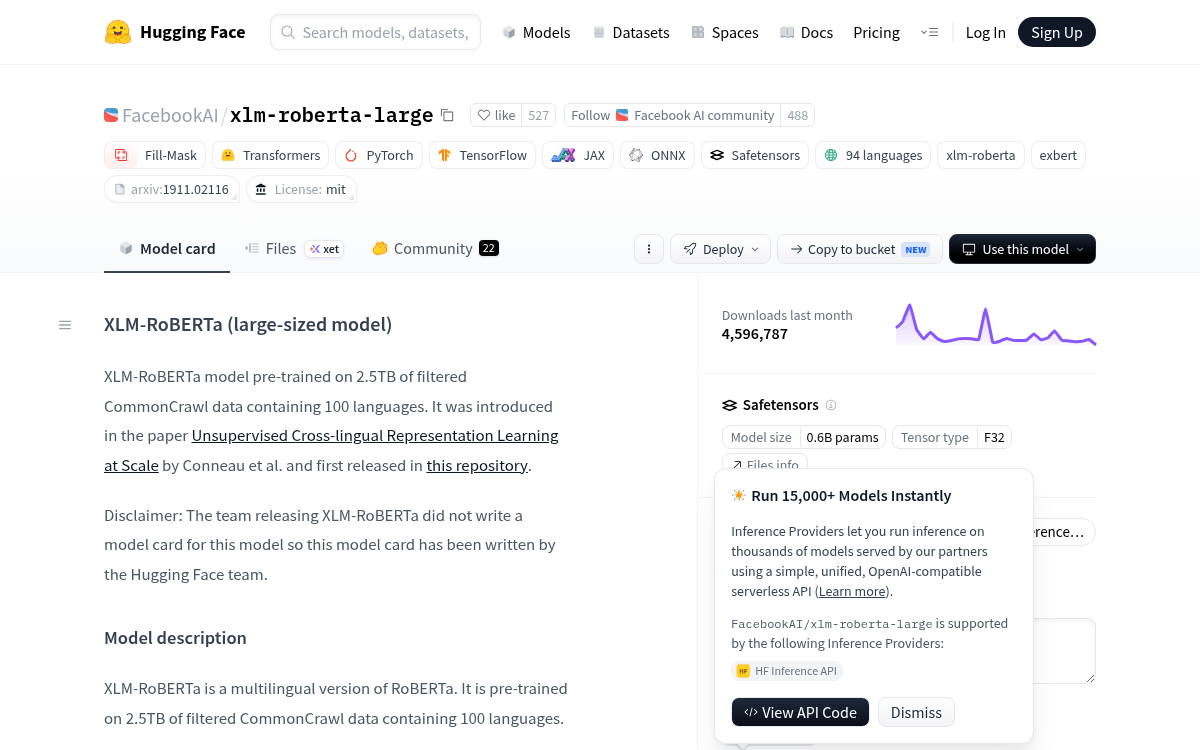
Microsoft's model catalog just added a workhorse of multilingual NLP as a one-click deployable endpoint. FacebookAI/xlm-roberta-large is now listed on Microsoft Foundry as a generally available, managed inference endpoint powered by the Hugging Face Inference Toolkit. You can spin it up behind an AzureML REST endpoint without packaging containers, wiring up tokenizers, or provisioning GPUs by hand.
The listing is part of a wider integration between Hugging Face and Microsoft that pulls open-source models from the Hub into Microsoft Foundry and Azure Machine Learning. The Hub itself carries over 1.7 million public models, and the Foundry and AzureML catalogs now surface more than 11,000 of the most-downloaded ones with verified weights, ready to deploy to managed online endpoints. XLM-RoBERTa-large sits near the top of that download list.
What actually got shipped
The Foundry listing wraps the existing checkpoint in Azure's managed inference plane. You hit an AzureML endpoint with a bearer token and a JSON payload, and the toolkit handles the model container, tokenization, and scaling. A minimal request looks like this:
curl <AZUREML_ENDPOINT_URL> \
    -X POST \
    -H "Authorization: Bearer <AZUREML_TOKEN>" \
    -H "Content-Type: application/json" \
    -d '{"inputs":"The answer to the universe is <mask>."}'
The endpoint accepts an inputs string with masked tokens, plus optional parameters:
top_koverrides the number of predictions returned.targetsrestricts scoring to a specific vocabulary subset. Anything outside the model vocab gets tokenized with a warning.
Underneath, it is still the standard fill-mask task, now with Azure's auth, logging, and autoscale wrapped around it.
The model, briefly
XLM-RoBERTa-large is not new, but it is worth a refresher on why it keeps showing up in production pipelines. It is a multilingual version of RoBERTa, pre-trained on 2.5TB of filtered CommonCrawl data covering 100 languages, using the masked language modeling objective. The result is an inner representation across those languages that can be used to extract features for downstream work. You can use the raw checkpoint for masked language modeling, but the intended workflow is fine-tuning.
Practically, this is an encoder, not a chatbot. It produces language-agnostic representations through self-supervision, and pre-trained checkpoints are typically fine-tuned for classification, NER, retrieval, and similar downstream tasks.
Where it fits, where it does not
Good fits for this deployment path:
- Multilingual text classification (intent, sentiment, topic) across mixed-language inbound traffic
- Named entity recognition and token tagging with a fine-tuned CoNLL variant
- Zero-shot classification via NLI-tuned checkpoints like joeddav/xlm-roberta-large-xnli, which is also listed on the Foundry catalog powered by the Hugging Face Inference Toolkit
- Feature extraction to feed a lightweight classifier or a retrieval index
- Question answering with the deepset SQuAD2 fine-tune
Anything generative is the wrong job for this checkpoint. There is no decoder, so text generation, chat, summarization, and code completion belong to a different model family. The large variant is also heavier than a distilled base model, so latency-bound CPU workloads are usually better served by xlm-roberta-base.
Why Foundry availability actually matters
For teams already inside the Azure perimeter, the value is the deployment path rather than the weights. Microsoft is only featuring Hugging Face models that have passed security screening for vulnerabilities, including checks from ProtectAI Guardian and the JFrog security scanner, with weights stored in safetensors. That matters when you are trying to push a multilingual NER service through a security review at a regulated employer.
The listing also carries a hardware recommendation. Each model can be deployed on a range of Azure hardware, from NVIDIA GPUs to CPUs, with a default suggested SKU included. For a 550M-parameter encoder, expect a modest single-GPU SKU rather than the multi-node clusters you would provision for an LLM.
Old encoders, new catalog
The interesting signal here is less about XLM-RoBERTa and more about how the cloud catalogs are evolving. Foundry now hosts more than 10,000 Hugging Face models deployable in a couple of clicks across text, audio, and image workloads. Encoder models from the pre-LLM era are being repackaged as first-class Foundry citizens alongside the frontier decoders, which quietly acknowledges that plenty of real production NLP still runs on fine-tuned BERT-family encoders rather than 70B chat models. If your multilingual classifier is currently glued together with a manual Transformers install on a VM, this is the boring but useful upgrade path.