
Microsoft Azure Now Deploys Hugging Face's Tiny 22M Embedding Model Directly
A compact 22M-parameter semantic search model built for question answering is now one-click deployable through Microsoft Foundry and Azure AI.
 Pro
Takeaways
- multi-qa-MiniLM-L6-cos-v1 added to the curated Hugging Face collection on Microsoft Foundry and Azure AI.
- One-click deploy provisions an Azure ML online endpoint that pulls weights directly from the Hugging Face Hub.
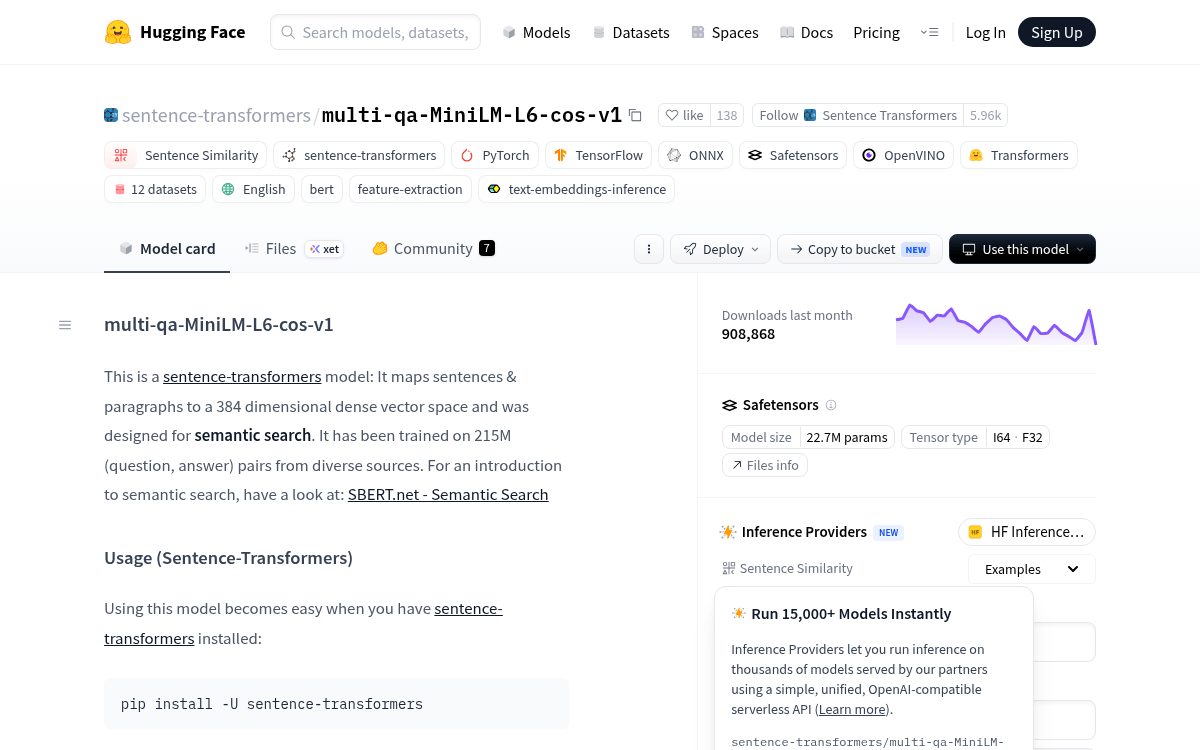
- 22M-parameter BERT model outputs 384-dim cosine-normalized embeddings tuned for question-answer retrieval.
- Trained on 215M QA pairs from MS MARCO, Natural Questions, Stack Exchange, ELI5, and more.
- Requires Safetensors weights, a supported task tag, and no trust_remote_code to qualify for Azure catalog.
- Compatible with TEI's OpenAI-style embeddings API; input capped around 250 to 512 word pieces.
A tiny embedding model that punches well above its weight has quietly joined the growing catalog of Hugging Face models deployable straight from the Microsoft Foundry and Azure AI console. The multi-qa-MiniLM-L6-cos-v1 sentence-transformer, long a staple of open-source semantic search stacks, now shows a Deploy on Azure option on its model card, wiring it directly into Azure Machine Learning online endpoints without any custom container work.
Hugging Face models appear in the Azure Machine Learning model catalog through the HuggingFace registry, which Hugging Face creates and maintains and exposes to Azure as a Community Registry. Weights aren't hosted on Azure. When you deploy, the online endpoints in your workspace download the weights directly from the Hugging Face Hub at deploy time. That keeps versioning honest and avoids the drift you get with mirrored artifacts.
What actually changed
The model itself is unchanged. What is new is its inclusion in the curated Azure collection. Around 11,000 open models from the Hugging Face Hub are available through Microsoft Foundry and Azure Machine Learning, a curated subset of the 2.2 million public open models on the Hub that includes the most downloaded and relevant options, all compatible with Transformers, Sentence Transformers, Diffusers, and other Hugging Face libraries.
To qualify for that catalog, a model has to clear a specific bar. According to the Azure documentation, eligible candidates must meet three conditions:
- The model carries the Transformers, Diffusers, or Sentence-Transformers tag on Hugging Face Hub.
- The model has a supported task such as chat-completion, image-to-text, or embeddings.
- The model weights are in Safetensors format and the model doesn't require trust_remote_code.
Why this particular model earns the slot
multi-qa-MiniLM-L6-cos-v1 is a 22M-parameter BERT variant tuned specifically for question-answer retrieval. It encodes queries and text paragraphs into a dense vector space and finds relevant documents for a given passage. Outputs are 384-dimensional cosine-normalized vectors, which keeps vector database storage cheap and similarity math trivial.
Training used roughly 215 million question-answer pairs pulled from sources including MS MARCO, Natural Questions, Yahoo Answers, Stack Exchange, ELI5, and GooAQ, which is why it tends to outperform general-purpose embedders on retrieval-style workloads. Watch the input length: the encoder caps at 512 word pieces, and training only saw text up to 250 word pieces, so quality degrades on longer passages. Chunk accordingly.
Using it
Outside of Azure, the model is trivially callable through the standard sentence-transformers API:
from sentence_transformers import SentenceTransformer, util
model = SentenceTransformer('multi-qa-MiniLM-L6-cos-v1')
query_emb = model.encode("How many people live in London?")
doc_emb = model.encode(["Around 9 Million people live in London"])
scores = util.dot_score(query_emb, doc_emb)
Inside Azure, the Deploy on Microsoft Foundry button on the model card provisions a managed online endpoint that pulls the weights from the Hub at deploy time. Because the model carries the text-embeddings-inference tag, it plugs into TEI's OpenAI-compatible embeddings interface, so you can point an existing embeddings client at the endpoint URL without rewriting anything.
Where it fits
The practical case for reaching for this model over a larger embedder is straightforward:
- Retrieval-augmented generation pipelines where the retriever is called on every user turn and latency matters.
- Semantic search over FAQ, documentation, or Q&A corpora where the queries look like actual questions.
- On-device or CPU-only inference, since 22M parameters and 384-dim outputs fit comfortably.
- Enterprises already standardized on Azure who want a governed, private endpoint instead of a public inference API.
For teams already running everything in an Azure tenant, this closes one of the more annoying gaps in the embeddings-on-Azure story, which had historically pushed users toward Azure OpenAI's text-embedding-3 models or hand-rolled container deployments.