
Meta's XLS-R Fine-Tune Hits 1.8M Downloads Dominating Romanian Speech Recognition
A fine-tuned Romanian speech recognition model hits 7.31% WER on Common Voice, ranks top-1 on Hugging Face's Robust Speech Challenge, and crosses 1.8M downloads.
 Pro
Takeaways
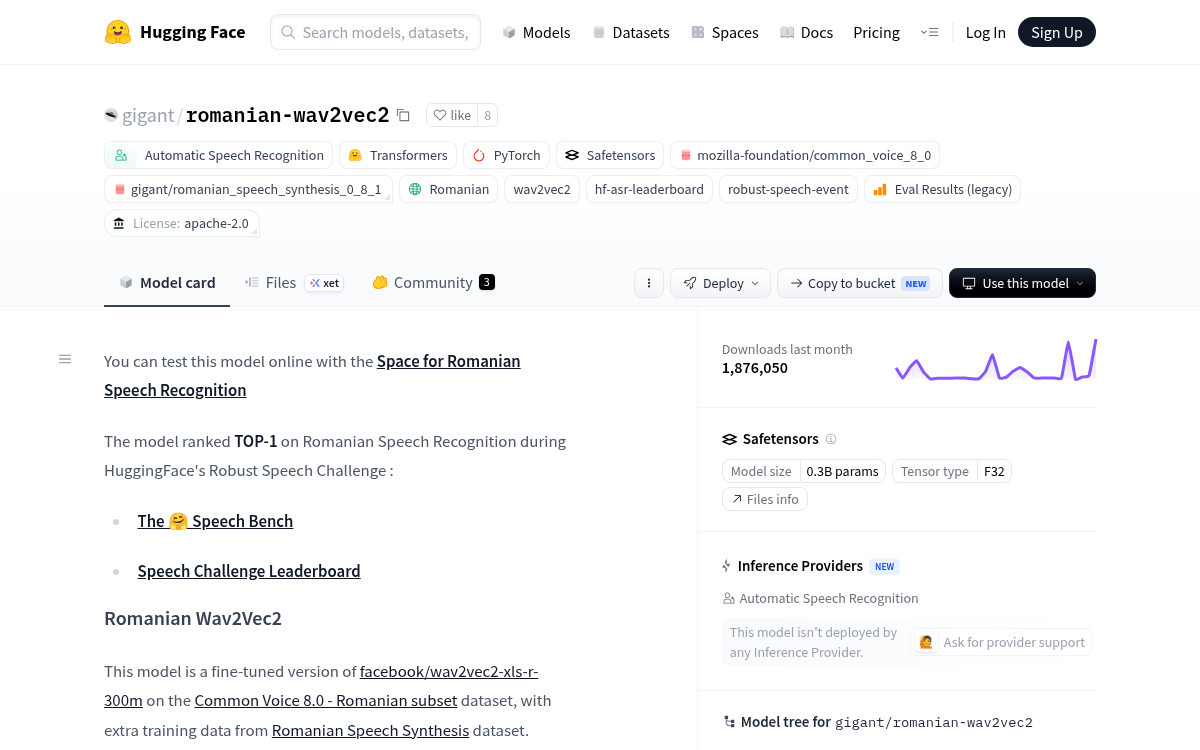
- gigant/romanian-wav2vec2 fine-tunes XLS-R 300M for Romanian speech recognition, now past 1.8M downloads.
- Reaches 7.31% WER on Common Voice 8.0 test with a 5-gram language model.
- Ranked top-1 on Romanian in Hugging Face's Robust Speech Challenge.
- Trained on Common Voice plus a Romanian speech synthesis dataset for extra coverage.
- Apache 2.0, works out of the box with the Transformers
automatic-speech-recognitionpipeline. - Outputs lowercase text with no punctuation and expects 16kHz mono audio.
Romanian speech recognition has quietly become one of the most-downloaded niches on Hugging Face, and a large share of that traffic goes to a single fine-tune of Meta's multilingual XLS-R backbone. The gigant/romanian-wav2vec2 checkpoint has crossed 1.8 million downloads, helped by the fact that it still holds the top spot on the Romanian split of the community speech leaderboard.
The headline numbers
This is a fine-tune of facebook/wav2vec2-xls-r-300m on the Common Voice 8.0 Romanian subset, with extra training data from the Romanian Speech Synthesis corpus. Without a language model, it reaches a word error rate of 11.74% and a character error rate of 2.94% on the Common Voice test split. With the bundled 5-gram LM plugged into the CTC decoder, those drop to 7.31% WER and 2.17% CER.
For context, the checkpoint ranked top-1 on Romanian during Hugging Face's Robust Speech Challenge, and it remains the default recommendation for Romanian ASR in the Transformers ecosystem. It weighs in at roughly 300M parameters and ships under Apache 2.0, so commercial use is fine.
Under the hood
The base checkpoint is Meta's XLS-R. The wav2vec2-xls-r-300m model is Facebook's large-scale multilingual pretrained model for speech, using the wav2vec 2.0 objective and pretrained on 436,000 hours of unlabeled audio across 128 languages, including VoxPopuli, MLS, CommonVoice, BABEL, and VoxLingua107. That broad pretraining is why fine-tuning on a relatively small Romanian corpus can still land competitive numbers.
On top of the fine-tuned acoustic model, the author added a statistical language model to rescore CTC outputs: a 5-gram LM built with pyctcdecode and kenlm, trained on the Romanian Corpora Parliament dataset. That n-gram is what closes the gap from 11.7% to 7.3% WER, biasing the decoder toward sequences that look like real Romanian sentences.
How the training was set up
The recipe is a fairly standard XLS-R fine-tune, but the hyperparameters are worth knowing if you want to reproduce it on another low-resource language:
- Learning rate 0.003 with Adam, linear scheduler, 500 warmup steps
- Train batch size 16, gradient accumulation 3, for an effective batch size of 48
- 50 epochs with native AMP mixed precision
- Trained on Common Voice 8.0 Romanian train, validation, and other splits, plus the Romanian Speech Synthesis train and test splits, evaluated on the Common Voice 8.0 Romanian test split
Mixing synthetic TTS audio into the training set is the interesting bit. It is one of the cheaper ways to expand coverage when a language only has a few hundred hours of labeled real speech, and the leaderboard result suggests it did not tank generalization to Common Voice's human recordings.
Using it in practice
The quickest path is the standard Transformers pipeline. Audio has to be mono 16kHz.
from transformers import pipeline
asr = pipeline("automatic-speech-recognition",
               model="gigant/romanian-wav2vec2")
text = asr("sample_ro.wav")
print(text)
To get the boosted WER, install the decoder dependencies with pip install https://github.com/kpu/kenlm/archive/master.zip pyctcdecode. The processor bundled with the checkpoint already knows about the 5-gram file, so AutoProcessor.from_pretrained wires the LM decoder automatically.
Where it falls short
Two limitations matter for production use. The model expects Romanian audio sampled at 16kHz, and its output is lowercased with no punctuation. If you need casing or punctuation, plan on a second-stage restoration model.
The other caveat is domain drift. On the noisier Robust Speech Event dev set, WER climbs to 46.99% without LM and 38.63% with LM, far worse than the Common Voice numbers. Read-speech quality is excellent; wild acoustic conditions, telephony audio, or strong regional accents will degrade noticeably. Whisper large remains a stronger choice when you need robustness across recording conditions, though this model is much smaller, cheaper to run, and generally faster on Romanian read speech.
Why a 300M CTC model still earns its keep
Whisper and other large multilingual systems have absorbed much of the ASR conversation, but for many teams a 300M parameter CTC model that transcribes a specific language cleanly at low latency is the pragmatic choice. This checkpoint is a useful reference for anyone building a Romanian voice interface, transcribing Romanian call center audio, or bootstrapping datasets for a smaller distilled model. It also works as a solid template if you plan to fine-tune XLS-R for another under-served European language.