
Meta's Llama 4 Scout Runs 109B Parameters on a Single GPU
Meta's new open Llama 4 Scout packs 109B total parameters into a mixture-of-experts that fits on one H100 and swallows 10M-token contexts.
 Pro
Takeaways
- Meta released Llama 4 Scout, a 17B-active/109B-total mixture-of-experts model with native multimodality.
- Context window reaches 10M tokens, roughly 80x Llama 3's 128K ceiling.
- Fits on a single H100 with on-the-fly int4 quantization, keeping serving costs low.
- Pretrained on ~40T tokens with an August 2024 knowledge cutoff across 12 languages.
- Beats Llama 3.3 70B on MMLU Pro (74.3) and GPQA Diamond (57.2), matches on coding.
- Licensed under the custom Llama 4 Community License, with limits for companies over 700M MAU.
Meta has quietly cracked open a new tier of open-weight models with Llama 4 Scout, a natively multimodal system that squeezes a 109B-parameter mixture-of-experts down to something you can serve on a single GPU. It ships alongside a bigger sibling called Maverick, though Scout is the one most teams will actually run, and it arrives with a context window that reaches into territory previously reserved for research demos.
A sparse model wearing small clothes
Llama 4 Scout activates 17 billion parameters per token across 16 experts. Its launch partner, Maverick, uses the same 17B activation budget but spreads it over 128 experts. Total weights land at 109B for Scout and 400B for Maverick, with only one expert plus shared parameters firing on any given forward pass.
Both are auto-regressive models built on a mixture-of-experts (MoE) backbone with early fusion for native multimodality. Early fusion means image and text tokens flow into the same transformer stack from the first layer, rather than being stitched together by a separate vision adapter. In practice, the same model handles interleaved image-text prompts without a bolted-on encoder pipeline.
Ten million tokens, one GPU
Two numbers set Scout apart from the rest of the open-weight field. The first is the context window: 10 million tokens, with Maverick sitting at 1M. The second is deployment cost. Scout ships as BF16 weights but fits on a single H100 with on-the-fly int4 quantization. Maverick is released as both BF16 and FP8; the FP8 build fits on a single H100 DGX host while holding quality.
That combination means you can point Scout at an entire codebase, a stack of legal filings, or a multi-hour transcript without chunking gymnastics, and still serve it from one accelerator. Third-party testing has been mostly positive with caveats. Scout hit roughly 99% accuracy in needle-in-a-haystack style evaluations, though users should still watch for context rot, where quality degrades as prompts approach the ceiling. The window is real; the tail end still tapers.
What the benchmarks say
Meta positions Scout as a replacement for its own Llama 3.3 70B dense model, and the reported numbers back that up. Highlights from the instruction-tuned evaluations:
- MMLU Pro: 74.3 vs 68.9 for Llama 3.3 70B
- GPQA Diamond: 57.2 vs 50.5 for Llama 3.3 70B
- MMMU (image reasoning): 69.4, with 70.7 on MathVista
- DocVQA: 94.4, ChartQA at 88.8
- LiveCodeBench: 32.8, roughly matching Llama 3.3 70B
Maverick pulls ahead almost everywhere, hitting 80.5 on MMLU Pro, 69.8 on GPQA Diamond and 43.4 on LiveCodeBench. Coding is the one area where Scout does not really move the needle over the previous generation, so teams building agentic code tools will probably want to reach for Maverick or a specialized coder model instead.
Training scale
The pretraining budget is enormous even by frontier standards. Scout saw roughly 40 trillion tokens; Maverick saw about 22 trillion, all multimodal. The corpus mixes publicly available and licensed data with information from Meta's products and services, including public posts from Instagram and Facebook and user interactions with Meta AI. The cutoff is August 2024, so any libraries, APIs or facts that shipped later will need retrieval or fine-tuning to land reliably.
Meta also disclosed the compute footprint. Scout alone consumed 5.0M H100 GPU-hours during pretraining, with Maverick adding another 2.38M. The full run drew 700W per device and produced an estimated 1,999 tons CO2eq on a location basis.
Languages, vision limits, and the fine print
Officially supported languages are Arabic, English, French, German, Hindi, Indonesian, Italian, Portuguese, Spanish, Tagalog, Thai, and Vietnamese. Meta notes the pretraining corpus actually covers 200 languages, so fine-tuning for lower-resource languages is on the table but unsupported out of the box. On the vision side, the model card says image understanding was tested up to five input images per prompt, which is worth keeping in mind before you feed it a 40-page slide deck.
The license is the usual Llama sticking point: a custom commercial license rather than a permissive OSS one, with any company above 700 million monthly active users required to negotiate a separate agreement. Attribution rules also apply: derivative models must carry a "Llama" prefix in their name and a "Built with Llama" notice.
Getting it running
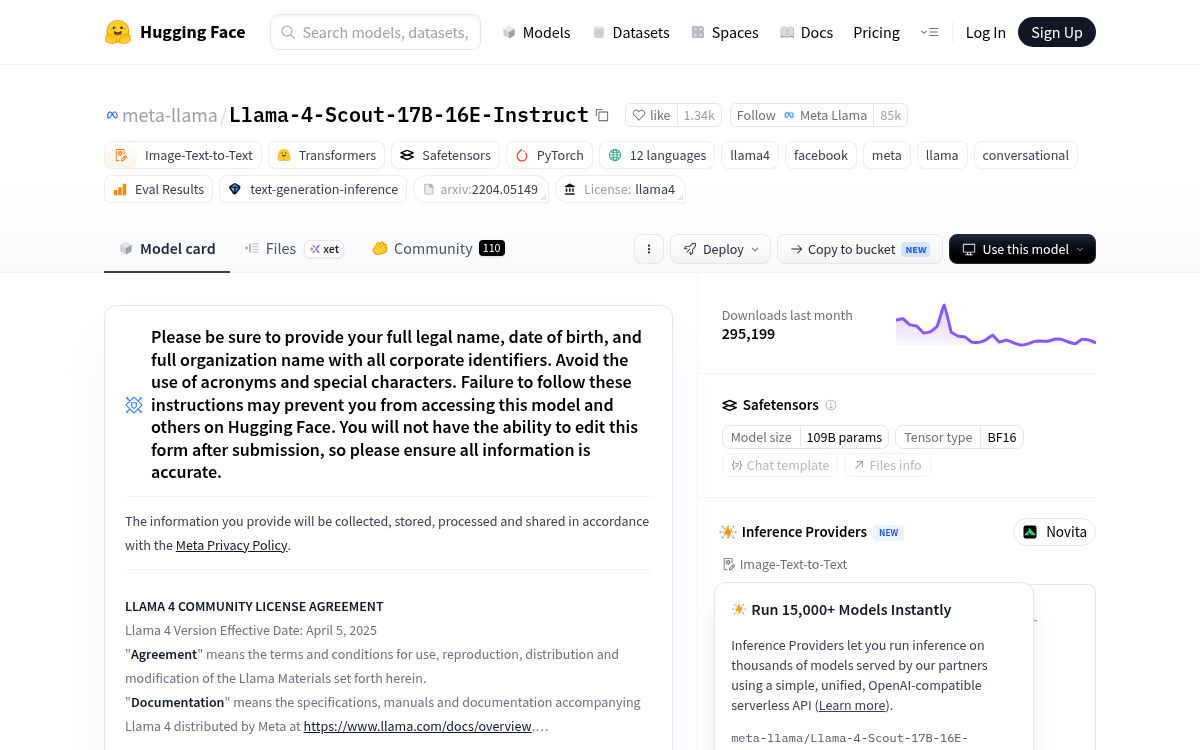
Scout is already integrated into the mainstream serving stacks. vLLM, SGLang, TGI and Docker Model Runner all support it, and Hugging Face lists 39 community quantizations for llama.cpp, Ollama and LM Studio. Transformers 4.51.0 or newer is required. A minimal load looks like this:
from transformers import AutoProcessor, Llama4ForConditionalGeneration
import torch
model_id = "meta-llama/Llama-4-Scout-17B-16E-Instruct"
processor = AutoProcessor.from_pretrained(model_id)
model = Llama4ForConditionalGeneration.from_pretrained(
    model_id,
    attn_implementation="flex_attention",
    device_map="auto",
    torch_dtype=torch.bfloat16,
)
For serving, vllm serve "meta-llama/Llama-4-Scout-17B-16E-Instruct" exposes an OpenAI-compatible endpoint that accepts image URLs directly in chat messages. The int4 quantization path is what makes single-H100 inference viable; without it, the 109B total weight count blows past 80GB of VRAM.
Where Scout earns its keep
The most interesting use cases lean on the two things Scout does that other open models struggle with: very long context and native vision. That points to:
- Whole-repo code analysis where you want the model to see every file at once rather than embed-and-retrieve
- Document understanding pipelines that mix scanned pages, charts and prose, since DocVQA at 94.4 is genuinely production-grade
- Multi-document research assistants that would otherwise need aggressive RAG chunking
- Multilingual assistants across the 12 officially supported languages
- Synthetic data and distillation for smaller models, which the license explicitly permits
Poor fits include heavy coding agents, math-heavy reasoning where a dedicated model like DeepSeek-R1 or an o-series release will dominate, and any workload where the sub-700M-MAU carve-out creates procurement friction.
The bigger picture
Scout is Meta's clearest bet yet on sparse MoE as the default architecture for open weights. The pitch is straightforward: dense 70B-class quality, dense 17B-class inference cost, and a context window that changes what you can even try. If the accuracy holds up past a few hundred thousand tokens in your own testing, it collapses a lot of the RAG infrastructure teams built specifically to work around Llama 3's 128K ceiling. Worth an afternoon of benchmarking against whatever you are running today.