
Meta's Llama 3 8B Matches a 70B Model on 15T Tokens
Meta's compact open model packs 15 trillion training tokens into 8 billion parameters, rivaling much larger predecessors on reasoning and code benchmarks.
 Pro
Takeaways
- Meta-Llama-3-8B is an 8B parameter open-weights model trained on over 15 trillion tokens with an 8K context window
- Uses Grouped-Query Attention plus SFT and RLHF; training consumed 1.3M H100 GPU hours
- Instruct version hits MMLU 68.4, HumanEval 62.2, GSM-8K 79.6, roughly matching Llama 2 70B at a fraction of the size
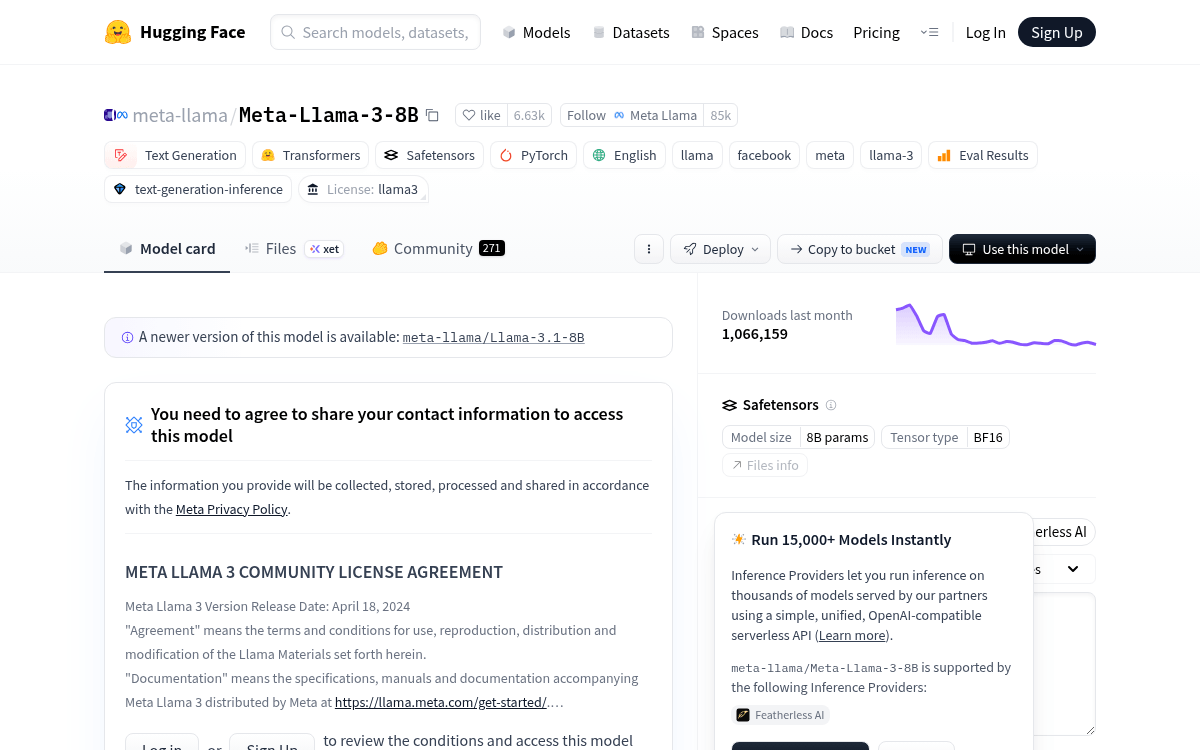
- Available on Hugging Face under Meta's custom community license, free to use commercially with restrictions
- Runs on Transformers, vLLM, SGLang, llama.cpp, Ollama, and LM Studio with 280+ community quantizations
- Superseded by Llama 3.1 8B, which adds 128K context and multilingual support
Meta's Meta-Llama-3-8B is the small end of the Llama 3 family, and it punches far above its weight class. The pretrained base is available on Hugging Face under Meta's custom community license, alongside an instruction-tuned variant aimed at dialogue and general assistant use. It has become one of the most downloaded open models on the Hub, racking up over a million monthly downloads and spawning hundreds of finetunes, adapters, and quantized variants.
Mark Zuckerberg described the 8B model as roughly matching the capability of the 70B Llama 2 from the prior generation. The key ingredient behind that jump is a large increase in the size and quality of the training data.
What ships in the release
Meta released Llama 3 as pretrained and instruction-tuned generative text models in 8B and 70B sizes, with the instruction-tuned variants designed to outperform many available open chat models on common industry benchmarks. The technical shape of the 8B is straightforward:
- Architecture: auto-regressive transformer with Grouped-Query Attention (GQA), which shares key and value projections across groups of attention heads to speed up inference and cut memory during long generations
- Context length: 8,000 tokens
- Training tokens: over 15 trillion, from publicly available sources
- Knowledge cutoff: March 2023 for the 8B, December 2023 for the 70B
- Alignment: supervised fine-tuning (SFT) followed by reinforcement learning with human feedback (RLHF) for helpfulness and safety
- Languages: officially English only, though the license permits fine-tuning for other languages
The data is the story
The jump from Llama 2 to Llama 3 is mostly about data. Llama 3 was pretrained on over 15 trillion tokens from publicly available sources, with a training corpus seven times larger than Llama 2's and four times more code. Meta paired that scale with a rigorous methodology for picking the mix. The team developed detailed scaling laws for downstream benchmark evaluations, allowing them to select an optimal blend, make informed decisions about how to spend training compute, and predict the performance of the largest models on tasks like HumanEval code generation before actually training them.
Compute-wise, the 8B consumed 1.3M GPU hours on H100-80GB accelerators, part of a cumulative 7.7M GPU hours across the family. That is a large budget for an 8B model, and it shows up on the leaderboards.
Benchmarks that actually moved
The base pretrained 8B posts an MMLU score of 66.6, versus 45.7 for Llama 2 7B and 53.8 for Llama 2 13B. The instruction-tuned version widens the gap considerably:
| Benchmark | Llama 3 8B Instruct | Llama 2 7B | Llama 2 13B |
|---|---|---|---|
| MMLU (5-shot) | 68.4 | 34.1 | 47.8 |
| HumanEval (0-shot) | 62.2 | 7.9 | 14.0 |
| GSM-8K (8-shot CoT) | 79.6 | 25.7 | 77.4 |
| MATH (4-shot CoT) | 30.0 | 3.8 | 6.7 |
| GPQA (0-shot) | 34.2 | 21.7 | 22.3 |
HumanEval going from 7.9 to 62.2 in a single generation at the same parameter class is the kind of number that reshuffles the small-model landscape. Chain-of-thought math on GSM-8K crossing 79 percent at 8B was also new territory for open weights.
Where it falls short
Real limitations show up in production. The 8K context window is short by current standards, especially for retrieval-augmented generation over long documents or multi-file code review. Multilinguality is limited by design, and Meta positions the 8B as best suited to efficient text summarization, classification, sentiment analysis, and translation in low-latency scenarios rather than heavy reasoning. Community evaluations on MMLU-Pro, a harder MMLU variant, put the model at 35.36, a reminder that vanilla MMLU gains do not fully carry over to more adversarial benchmarks.
Running it locally
The Hugging Face repository ships weights in both native llama3 format and Transformers-compatible safetensors. The simplest path is a two-liner:
from transformers import pipeline
import torch
pipe = pipeline(
    "text-generation",
    model="meta-llama/Meta-Llama-3-8B",
    model_kwargs={"torch_dtype": torch.bfloat16},
    device_map="auto",
)
print(pipe("Hey how are you doing today?"))
For serving, vLLM and SGLang both support the model with OpenAI-compatible endpoints out of the box, and there are 280+ community quantizations targeting llama.cpp, Ollama, and LM Studio for running on a single consumer GPU or even a laptop. No API price is attached because the weights are free under the license; your cost is whatever infrastructure you deploy on.
License fine print
Llama 3 is not open source in the OSI sense. Redistribution requires displaying "Built with Meta Llama 3," derivative models must begin their name with "Llama 3," and companies with more than 700 million monthly active users must request a separate license from Meta. The terms permit commercial and private use, with restrictions that are limited but real.
Where this fits in the broader herd
Llama 3 8B was the opening move in a much larger release train. Meta later announced the Llama 3.1 collection of multilingual LLMs, with pretrained and instruction-tuned open weights at 8B, 70B, and, for the first time, 405B parameters. The 3.1 release upgraded the 8B and 70B to be multilingual, extended context to 128K, added tool use, and improved reasoning. Meta then extended the family further with Llama 3.2, which added vision LLMs at 11B and 90B and lightweight text-only models at 1B and 3B that fit onto select edge and mobile devices.
If you are picking a model today, Llama 3.1 8B is the natural successor with a longer context and multilingual support. The original Meta-Llama-3-8B remains the reference base for a huge ecosystem of finetunes and the model most existing tutorials, quantizations, and inference stacks were first optimized against. It is the point at which "small open model that is genuinely useful for real work" stopped being a stretch and started being the default assumption.