
Meta's Llama 3 8B Beats the Old 70B on Most Benchmarks
Meta's 8B open-weight chat model ships with 15T training tokens, Grouped-Query Attention, and benchmark scores that top Llama 2 70B.
 Pro
Takeaways
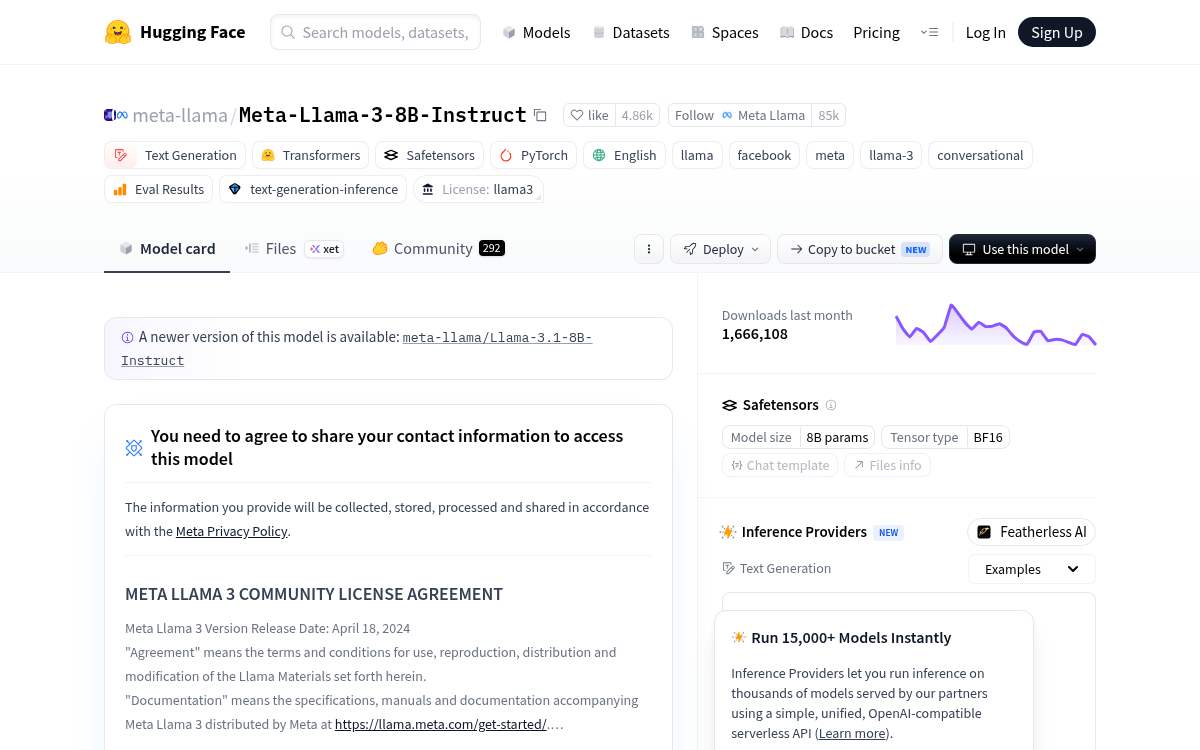
- Meta-Llama-3-8B-Instruct is an 8B parameter open-weight chat model with over 1.6M downloads on Hugging Face
- Trained on 15 trillion tokens using 1.3M H100 GPU hours, with SFT and RLHF post-training
- Scores MMLU 68.4, HumanEval 62.2, GSM-8K 79.6, outperforming Llama 2 70B on most benchmarks
- Uses Grouped-Query Attention, 128K vocabulary, and an 8K context window
- Runs via Transformers, vLLM, SGLang, or Docker with an OpenAI-compatible API
- Successor Llama 3.1 8B Instruct adds multilingual support and a 128K context window
Meta has released Meta-Llama-3-8B-Instruct, the smaller instruction-tuned member of the Llama 3 family, and it is doing something unusual for a model of this size: beating the previous generation's 70B on most standard benchmarks. Downloads have crossed 1.6 million on Hugging Face, with more than 4,400 likes, putting it among the most widely pulled open-weight chat models in circulation.
The release includes two sizes, 8B and 70B parameters, each in a base and an instruction-tuned variant. The chat-tuned versions are optimized for dialogue and beat many open source competitors on common industry benchmarks, with Meta stating it worked to balance helpfulness and safety. Most teams will actually deploy the 8B, because it fits on a single consumer or workstation GPU while getting close to frontier reasoning quality.
Under the hood
Llama 3 is an auto-regressive transformer. The interesting architectural choice is that both the 8B and 70B use Grouped-Query Attention across an 8,192-token context, which was previously reserved for the larger Llama 2 models. GQA sits between full multi-head attention and multi-query attention, letting several query heads share a single key/value head. That cuts the KV cache footprint substantially and makes batched inference cheaper without much quality loss.
The tokenizer also got a major upgrade to a 128K-token vocabulary, roughly quadruple Llama 2's. A larger vocabulary means fewer tokens per sentence, which translates directly into faster generation and more usable context.
Training scale and data
The pretraining budget is what makes this model punch above its weight. Llama 3 was trained on 15 trillion tokens, roughly seven times more than its predecessor. The 8B alone consumed 1.3 million H100 GPU hours, and Meta reports a knowledge cutoff of March 2023 for the pretraining corpus.
Post-training followed the standard modern recipe: supervised fine-tuning on human-written instructions, then reinforcement learning with human feedback, with rejection sampling and direct preference optimization layered on top. The fine-tuning corpus includes public instruction datasets plus over 10 million human-annotated examples, and Meta notes that future versions will ship as safety improves with community feedback.
The benchmarks that matter
Here is where the 8B Instruct model stacks up against the previous generation. The gap is not subtle.
| Benchmark | Llama 3 8B Instruct | Llama 2 7B | Llama 2 70B |
|---|---|---|---|
| MMLU (5-shot) | 68.4 | 34.1 | 52.9 |
| GPQA (0-shot) | 34.2 | 21.7 | 21.0 |
| HumanEval (0-shot) | 62.2 | 7.9 | 25.6 |
| GSM-8K (8-shot, CoT) | 79.6 | 25.7 | 57.5 |
| MATH (4-shot, CoT) | 30.0 | 3.8 | 11.6 |
The HumanEval jump from 7.9 to 62.2 at the same parameter budget is the most striking number here. At launch, the 8B outperformed Gemma 7B, Mistral 7B, and Llama 2 70B on most benchmarks. The 34.2 on GPQA (graduate-level science questions) is respectable for a model this small, though still far from the 70B.
Getting it running
The model integrates natively with Transformers, vLLM, SGLang, and Docker Model Runner. The minimum viable pipeline is three lines:
from transformers import pipeline
pipe = pipeline("text-generation", model="meta-llama/Meta-Llama-3-8B-Instruct")
pipe([{"role": "user", "content": "Who are you?"}])
For production serving, vLLM exposes an OpenAI-compatible endpoint with a single command:
pip install vllm
vllm serve "meta-llama/Meta-Llama-3-8B-Instruct"
One gotcha for chat applications: the model uses a custom end-of-turn token, <|eot_id|>, that needs to be added as a stop condition alongside the standard EOS token. Skip this, and the model will happily hallucinate follow-up user turns.
Licensing and the fine print
The model ships under the Llama 3 Community License, which permits commercial use with one big carve-out: if your product has more than 700 million monthly active users at the release date, you need to negotiate separately with Meta. A redistribution clause also requires displaying "Built with Meta Llama 3" and prefixing any derivative model name with "Llama 3". This is not OSI-approved open source, but for most teams it is functionally close enough.
Training was English-only, and official support covers English alone, though the follow-up Llama 3.1 collection extended coverage to German, French, Italian, Portuguese, Hindi, Spanish, and Thai.
Where it shines and where it does not
The strengths are predictable from the numbers:
- Strong instruction following and dialogue quality for a model that runs on a single GPU
- Solid Python code generation (62.2 on HumanEval)
- Reasonable arithmetic and word problems via chain-of-thought (79.6 on GSM-8K)
- Meta explicitly tuned it to refuse benign prompts less often than Llama 2, a real quality-of-life improvement for chat products
The weaknesses are equally clear:
- The 8K context window feels tight next to Mistral and later Llama 3.1 releases pushing 128K
- English-only training makes multilingual work a fine-tuning project rather than plug-and-play
- Advanced math (30.0 on MATH) and graduate-level reasoning (34.2 on GPQA) lag well behind the 70B
- The March 2023 knowledge cutoff means any recent-events use case needs retrieval augmentation
What it changes for smaller teams
The practical shift is that an 8B model now works as a genuine default assistant backbone rather than a prototyping toy. Teams previously reaching for Llama 2 70B, or paying per-token for hosted APIs to get acceptable code and reasoning quality, can now serve comparable output from a single H100 or a well-quantized deployment on consumer hardware. That reshapes the cost math for RAG systems, chatbots, and code assistants where inference volume dominates the budget.
Meta has since released Llama 3.1 8B Instruct as the direct successor, extending the collection to 8B, 70B, and 405B multilingual variants that beat many open source and closed chat models on common industry benchmarks. The original Meta-Llama-3-8B-Instruct remains heavily downloaded because it is the base for over a thousand community fine-tunes and quantized derivatives, and its behavior is well understood at this point. For anyone starting a new project today, the 3.1 version is the obvious pick; for anyone already shipping on the 3.0 weights, there is no urgent reason to migrate.