
Meta's Llama 3 70B Beats Claude Sonnet on Open Weights
Meta released its 70-billion parameter Llama 3 as an open weights model, trained on 15 trillion tokens and rivaling top proprietary models at its scale.
 Pro
Takeaways
- Meta released Llama 3 70B, an open-weight decoder-only transformer with pretrained and instruction-tuned variants.
- Trained on 15T+ tokens from public sources, 7x the Llama 2 corpus with 4x more code.
- Uses a 128K token vocabulary and Grouped Query Attention across both 8B and 70B sizes.
- Beats Claude Sonnet, Mistral Medium, and GPT-3.5 on Meta's 1,800-prompt human eval set.
- Limits: 8K context, English-first, text-only, no native tool use.
- Available on AWS, Azure, GCP, Hugging Face, Databricks, and more; see Meta's launch post.
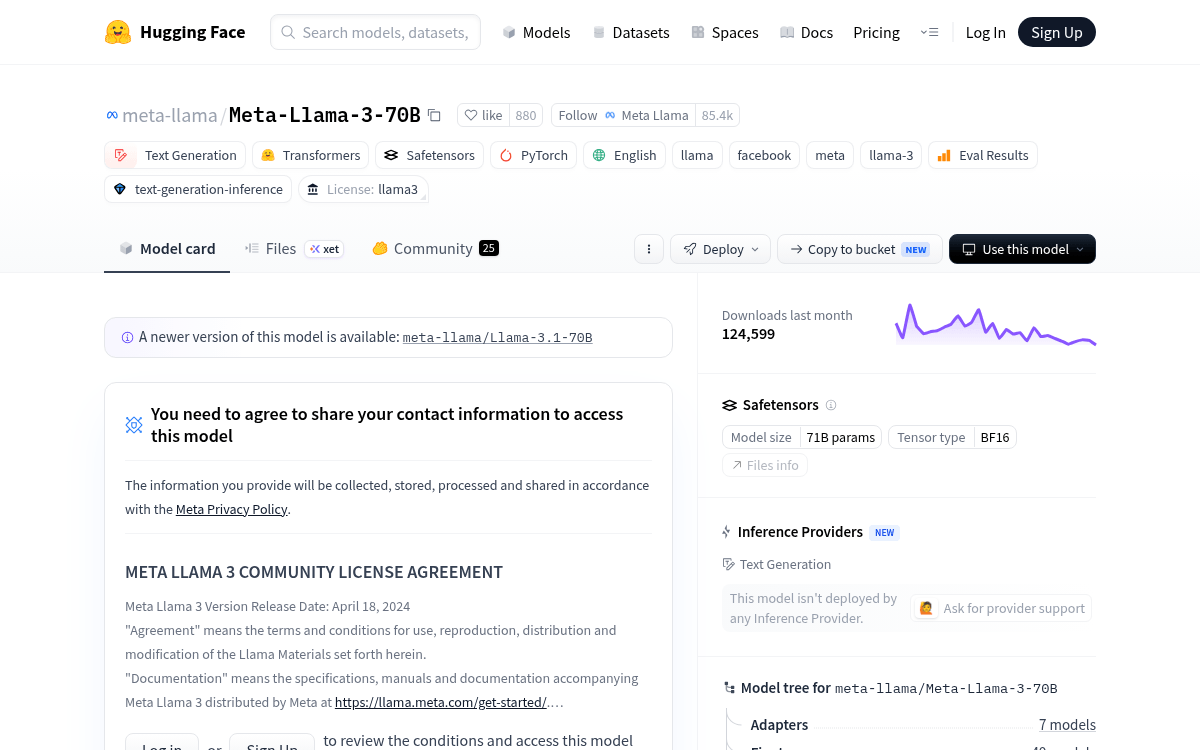
Meta has released Meta Llama 3 70B, the larger of two new open-weight language models offered as pretrained base models and instruction-tuned variants under Meta's Llama 3 community license. An 8B sibling ships alongside it. The 70B checkpoint is what most teams will care about: it starts trading blows with closed frontier systems at a fraction of the operational overhead.
What shipped
Llama 3 70B is a text-in, text-out decoder-only transformer with open weights you can download, fine-tune, and deploy on your own infrastructure. It is rolling out across AWS, Databricks, Google Cloud, Hugging Face, Kaggle, IBM WatsonX, Microsoft Azure, NVIDIA NIM, and Snowflake, with hardware support from AMD, AWS, Dell, Intel, NVIDIA, and Qualcomm. Access is free under Meta's community license, so cost comes down to where you run it. Pull the weights from Hugging Face, serve through a managed API on any of the above clouds, or run locally if you have the GPU budget: roughly 140GB in fp16, or around 40GB with 4-bit quantization.
Architecture and training
Meta used a conservative architecture and pushed hard on data volume and curation. The team built detailed scaling laws for downstream benchmark evaluations, letting them select an optimal data mix and predict performance on key tasks like HumanEval code generation before training began.
Key choices for the 70B:
- Standard decoder-only transformer with a new 128K-vocabulary tokenizer that encodes text more efficiently than Llama 2's.
- Grouped Query Attention (GQA) across both the 8B and 70B sizes, sharing key/value projections across query heads to cut inference memory and accelerate decoding.
- 8,192-token sequence length during training, with masking to prevent self-attention crossing document boundaries.
- 15T+ pretraining tokens from publicly available sources, seven times larger than Llama 2's corpus and with four times more code.
- 5%+ non-English data covering more than 30 languages, though Meta flags that English quality will be higher.
The scaling approach deserves attention. Chinchilla-optimal compute for an 8B model corresponds to roughly 200B tokens, but Meta found performance kept improving well beyond that point. Both the 8B and 70B models improved log-linearly through 15T tokens. Chinchilla told the field to stop feeding small models more data; Meta ignored that and got paid for it.
Training ran on two custom 24K H100 GPU clusters. Meta reports over 400 TFLOPS per GPU across 16K GPUs simultaneously, with effective training time above 95% through automated error detection and improved silent-data-corruption handling, claiming roughly 3x the training efficiency of Llama 2.
Post-training combined supervised fine-tuning, rejection sampling, PPO, and DPO. One notable finding: on reasoning problems, the model frequently generates a correct chain of thought but lands on the wrong final answer. Preference learning is what teaches it to select correctly.
Benchmark results
On Meta's internal human evaluation set of 1,800 prompts spanning 12 use cases, the 70B instruction-tuned model beats Claude Sonnet, Mistral Medium, and GPT-3.5 on preference rankings. The use cases covered include coding, reasoning, creative writing, summarization, classification, extraction, closed and open question answering, brainstorming, advice, rewriting, and persona. Meta says its own modeling teams lack access to the set, to prevent overfitting.
Where the model is strong:
- Reasoning and code generation, which saw the biggest post-training gains.
- Instruction following and steerability, with substantially reduced false refusal rates.
- General knowledge and math benchmarks at the 70B tier, setting a new open-source high-water mark.
Current limitations:
- Context window is 8K tokens, well short of the 128K windows frontier competitors offer. Long-document workflows need chunking or RAG.
- Text only: no vision, audio, or out-of-the-box tool use.
- Non-English performance is explicitly below English quality.
- No native function calling, which limits agentic use compared with GPT-4 or Claude tool-use APIs.
Safety tooling
Meta is treating safety as a system-level concern rather than a model-level one. The release includes updated Purple Llama components:
- Llama Guard 2, a prompt/response safety classifier aligned to the MLCommons taxonomy.
- CyberSec Eval 2, adding measurement of code interpreter abuse, offensive cyber capabilities, and prompt injection susceptibility.
- Code Shield, an inference-time filter for insecure code suggestions.
Why developers should care
A 70B open-weight model is now credible as a drop-in replacement for closed API calls across many production workloads. The concrete problems this solves:
- Data residency and privacy. Regulated industries that cannot send prompts to OpenAI or Anthropic can self-host a competitive model.
- Cost at scale. High-volume workloads like classification, summarization, and extraction become significantly cheaper when you own the inference stack.
- Fine-tuning freedom. Full weight access enables real domain adaptation, not prompt engineering against a black box.
- Synthetic data pipelines. A capable 70B under a permissive license is a practical workhorse for generating training data for smaller distilled models.
Meta CEO Mark Zuckerberg has framed the shift directly: Llama 2 was comparable only to an older generation of models behind the frontier; Llama 3 is competitive with the most advanced models and leads in some areas. Meta has also signaled that a 400B+ parameter Llama 3 is still training, which would put a genuinely frontier-class model into open-weight territory.
For two years the default assumption was that open models trail closed ones by roughly a generation, and that closing the gap requires proprietary data or reinforcement learning techniques only a handful of labs can execute. Llama 3 70B challenges both claims with a straightforward recipe: a standard transformer, aggressive data curation, and far more training tokens than scaling laws suggested were worth spending. If your architecture assumes a hosted API call is required to reach GPT-3.5-level quality, that assumption no longer holds.