
Meta's Llama 3.3 70B Beats the 405B on Math and Instruction Following
Meta shipped a 70B open-weights model that matches its own 405B system on most text benchmarks, dropping serving costs and hardware requirements dramatically.
 Pro
Takeaways
- Meta released Llama 3.3 70B Instruct, matching Llama 3.1 405B quality at 70B scale.
- IFEval 92.1, MATH 77.0, HumanEval 88.4, MMLU 86.0, GPQA Diamond 50.5, MGSM 91.1.
- 128K context window, 8 languages, tool-calling and JSON output through the chat template.
- Text-only, no reasoning mode, and knowledge cutoff frozen at December 2023.
- API pricing as low as $0.10/$0.32 per million tokens; Groq serves it at 312 tokens per second.
- Llama 3.3 Community License allows commercial use below the 700M MAU threshold.
Meta released Llama-3.3-70B-Instruct, a text-only, instruction-tuned model that closes most of the quality gap with the much larger Llama 3.1 405B while running on a fraction of the hardware. It is the last significant drop in the Llama 3 family before the multimodal Llama 4 line, and it reshapes what a mid-size open-weights model can do.
The pitch: a text-only, open-weight, 70B instruction-tuned model that outperforms Llama 3.1 405B on instruction following and mathematics while being 5.78x smaller. Meta positions it for multilingual dialogue and claims it beats many open-source and closed chat models on common industry benchmarks.
One fifth the parameters, same class of answers
The benchmark table Meta shipped with the release tells the story. Llama 3.3 70B matches or beats Llama 3.1 405B on several key evals while staying at 70B params:
| Benchmark | Llama 3.1 70B | Llama 3.3 70B | Llama 3.1 405B |
|---|---|---|---|
| MMLU (CoT) | 86.0 | 86.0 | 88.6 |
| MMLU Pro (CoT) | 66.4 | 68.9 | 73.3 |
| IFEval | 87.5 | 92.1 | 88.6 |
| GPQA Diamond | 48.0 | 50.5 | 49.0 |
| HumanEval | 80.5 | 88.4 | 89.0 |
| MATH (CoT) | 68.0 | 77.0 | 73.8 |
| BFCL v2 (tool use) | 77.5 | 77.3 | 81.1 |
| MGSM (multilingual math) | 86.9 | 91.1 | 91.6 |
IFEval is the standout: 92.1 for Llama 3.3 70B versus 88.6 for the 405B, a real regression at the larger scale that the 70B training run corrected and surpassed. For workloads that lean on structured output, prompt adherence, and tool orchestration, 3.3 70B beats 3.1 405B regardless of cost. Math jumps too: 77.0% on MATH is a 9.2-point gain over Llama 3.1 70B's 67.8%, coming from training rather than scale.
How it was built
Architecturally there are no surprises. Llama 3.3 uses the same decoder-only transformer as the rest of the family, fine-tuned from Llama 3.1 70B rather than pretrained from scratch. Meta reports pretraining on roughly 15 trillion tokens from publicly available sources, with a December 2023 data cutoff and a 128K context window backed by Grouped-Query Attention. The tuned versions use supervised fine-tuning and RLHF to align with human preferences for helpfulness and safety.
Gains come almost entirely from the post-training recipe. The fine-tuning data blends public instruction datasets with more than 25M synthetically generated examples. That synthetic pipeline, paired with a refreshed RLHF stage, pulls a 70B checkpoint up to 405B territory on several evals. Training was still expensive: 39.3M cumulative GPU hours on H100-80GB across the family, with 7M of those attributed to the 70B run.
Cheaper inference, everywhere
At 70B, the model fits comfortably on serving stacks that could not touch 405B. It runs locally with 48GB of VRAM at 4-bit quantization, and hosted APIs are aggressive on price. On OpenRouter, Llama 3.3 70B Instruct costs $0.10 per million input tokens and $0.32 per million output tokens, with a 131,072-token context window and up to 16,384 completion tokens.
Provider choice drives latency more than most teams expect. Groq clocks 312 tokens per second, SambaNova 288, and Google Vertex 149. The spread between the fastest and slowest hosts is more than 20x.
The multilingual side also grew. Officially supported languages are English, German, French, Italian, Portuguese, Hindi, Spanish, and Thai. The 91.1 MGSM score means the model can reason mathematically across those languages, not just chat in them.
Getting it running
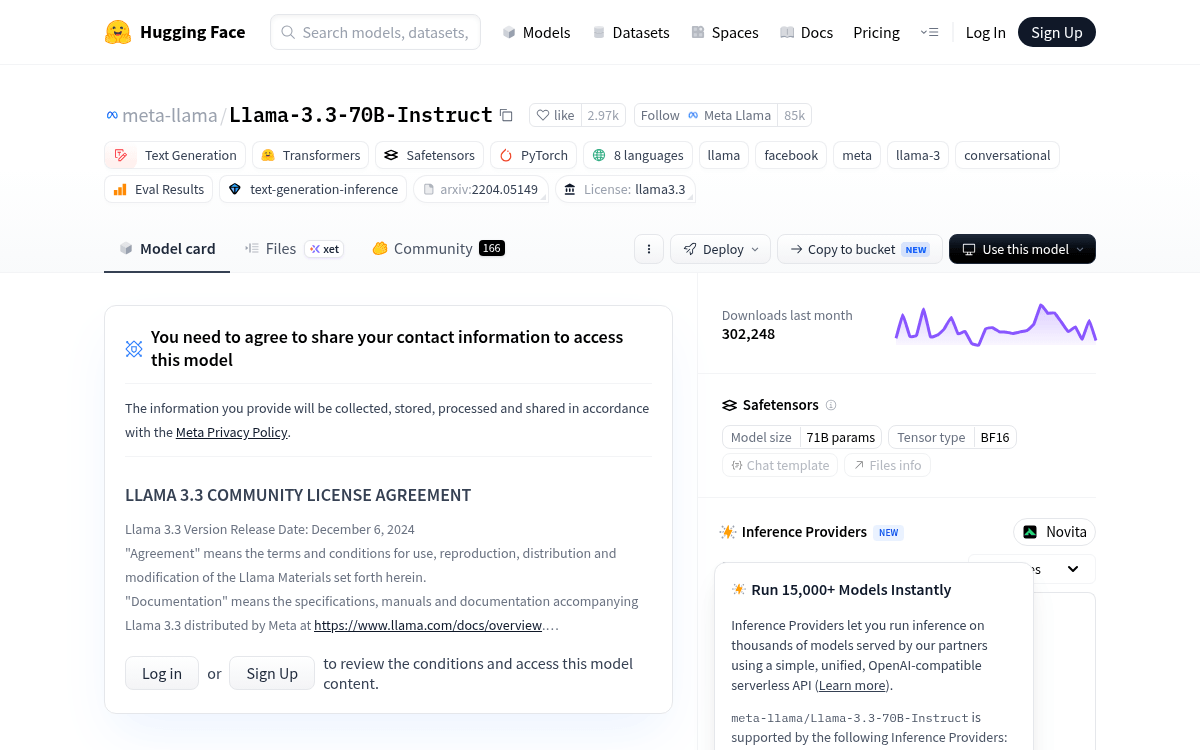
The weights are gated on Hugging Face but easy to pull once you accept the license. The minimum viable snippet with Transformers:
import transformers, torch
pipeline = transformers.pipeline(
    "text-generation",
    model="meta-llama/Llama-3.3-70B-Instruct",
    model_kwargs={"torch_dtype": torch.bfloat16},
    device_map="auto",
)
messages = [
    {"role": "system", "content": "You are a helpful assistant."},
    {"role": "user", "content": "Explain KV cache in one paragraph."},
]
print(pipeline(messages, max_new_tokens=256)[0]["generated_text"][-1])
For production, vLLM and SGLang both serve the model behind an OpenAI-compatible API, and bitsandbytes gives you 8-bit or 4-bit quantization if you want to fit everything on a single 48GB card. Tool calling is first-class through the chat template: the model accepts a tools argument and emits structured tool calls that you round-trip back through a tool-role message.
Where it shines and where it stalls
Strengths cluster in areas where post-training helps most:
- Instruction adherence and structured output (IFEval 92.1 tops the whole Llama family).
- Math and step-by-step reasoning without a dedicated reasoning mode.
- Function calling and tool orchestration for agent stacks.
- Multilingual chat across the eight officially supported languages.
- Cheap self-hosting compared to any 405B-class model.
The weaknesses are equally clear. Llama 3.3 70B Instruct is not a reasoning model and gives direct responses without extended chain-of-thought. It is text-only, with no image or audio input. The December 2023 knowledge cutoff means the model has no awareness of anything from 2024 onward, a one-year lag for a December 2024 release. Anything requiring current facts needs retrieval augmentation.
Compression, not scale
The industry story here is compression through better data rather than bigger models. A year earlier, matching 405B on IFEval and MATH required a 405B model. Meta showed that a refreshed synthetic-data pipeline and a stronger RLHF pass can move a 70B checkpoint into the same league at roughly one-fifth the serving cost. Independent benchmarks put Llama 3.3 70B at 276 tokens per second on Groq hardware, 25 tokens per second ahead of Llama 3.1 70B, which makes it usable for latency-sensitive applications. Developers can deploy it on mid-tier GPUs or run it locally on consumer-grade laptops with quantization.
One catch worth reading: the license is still the Llama Community License, not a fully open-source one. Commercial use is allowed, but products with more than 700 million monthly active users need a separate license from Meta, a clause aimed squarely at other hyperscalers. For everyone below that threshold, this is now the default 70B baseline to beat when picking an open-weights model for agents, coding assistants, and multilingual chat products.