
Meta's Llama 3.2 Squeezes a 128K AI Into Your Phone at 4x Speed
Meta ships a compact 3B instruction-tuned model built for on-device dialogue, agentic tasks, and multilingual chat with a 128K context window.
 Pro
Takeaways
- Meta released Llama-3.2-3B-Instruct, a 3B multilingual chat model with 128K context
- Trained on 9T tokens with knowledge distillation from Llama 3.1 8B and 70B logits
- Scores 63.4 MMLU, 77.4 IFEval, 77.7 GSM8K, 67.0 BFCL V2 tool use
- SpinQuant and QLoRA variants deliver 2.6x decode speedup and 60% smaller size on ARM
- Officially supports 8 languages including Hindi, Thai, Portuguese; December 2023 cutoff
- Custom commercial license with 700M MAU threshold and Built with Llama attribution requirement
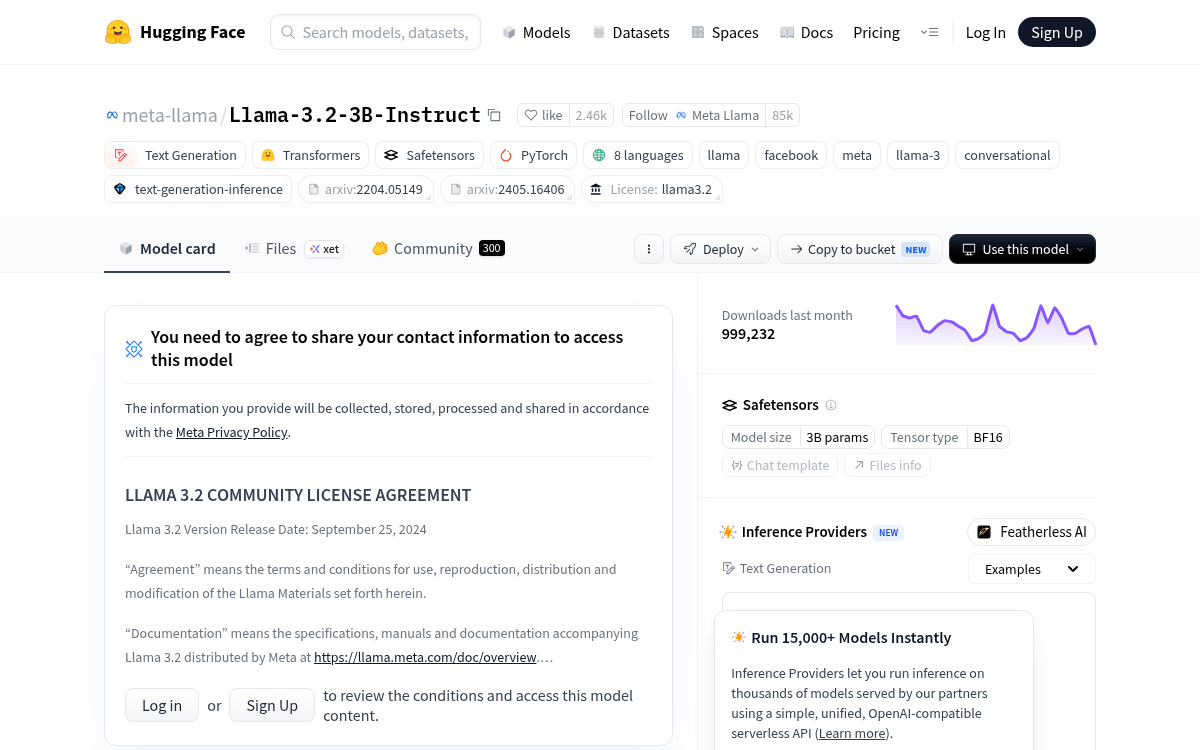
Meta has released Llama-3.2-3B-Instruct, a small but capable text-only model aimed at edge deployment, mobile assistants, and lightweight agentic pipelines. The pitch is straightforward: a 3-billion parameter chat model with a 128K context window that punches above its weight on instruction following and tool use, plus quantized variants that run on ARM CPUs in phones.
What is actually shipping
The Llama 3.2 collection includes pretrained and instruction-tuned generative models in 1B and 3B sizes (text in, text out), with the instruction-tuned variants optimized for multilingual dialogue, agentic retrieval, and summarization. The 3B Instruct is the flagship of that lightweight tier.
Key specs worth knowing before you pull the weights:
- 3.21B parameters, auto-regressive transformer with Grouped-Query Attention
- 128K token context window
- Trained on 9 trillion tokens, knowledge cutoff December 2023
- Officially supports English, German, French, Italian, Portuguese, Hindi, Spanish, and Thai
- BF16 weights, roughly 6.1GB on disk before quantization
Distillation from bigger siblings
The training recipe is where the 3B gets interesting. Rather than training a small model from scratch on the same data soup as its larger siblings, Meta leaned heavily on distillation, running pretraining on custom training libraries and an in-house GPU cluster, with fine-tuning, quantization, annotation, and evaluation on production infrastructure.
Logits from Llama 3.1 8B and 70B served as token-level targets during pretraining, and knowledge distillation was applied after pruning to recover performance. Post-training then followed the Llama 3.1 alignment recipe with several rounds of Supervised Fine-Tuning, Rejection Sampling, and Direct Preference Optimization. Training consumed a cumulative 916k GPU hours on H100-80GB hardware.
Benchmarks in context
The 3B will not unseat frontier models, but the numbers are competitive for its size class. On MMLU it hits 63.4, IFEval lands at 77.4, GSM8K math reaches 77.7 with chain-of-thought, and BFCL V2 tool use scores 67.0, within a point of the much larger Llama 3.1 8B on tool calling.
| Benchmark | Llama 3.2 1B | Llama 3.2 3B | Llama 3.1 8B |
|---|---|---|---|
| MMLU (5-shot) | 49.3 | 63.4 | 69.4 |
| IFEval | 59.5 | 77.4 | 80.4 |
| GSM8K (CoT) | 44.4 | 77.7 | 84.5 |
| MATH (CoT) | 30.6 | 48.0 | 51.9 |
| BFCL V2 (tools) | 25.7 | 67.0 | 67.1 |
| MGSM (multilingual) | 24.5 | 58.2 | 68.9 |
For third-party context, Artificial Analysis places Llama 3.2 Instruct 3B above average among comparable open-weight non-reasoning models of similar size. The weaker spots are reasoning-heavy tasks like GPQA (32.8) and long-context QA. On MMLU, the 3B outperforms Gemma 2B IT at 57.8 but trails Phi-3.5-mini IT at 69.0.
Squeezing it onto a phone
Desktop chat is not the target. Meta paired the release with two quantization tracks designed for phones and edge boards, both targeting PyTorch ExecuTorch with an ARM CPU backend:
- Quantization-Aware Training with LoRA (QLoRA): QAT initialized from the BF16 SFT checkpoint, followed by SFT with LoRA adapters on all transformer layers, then a final DPO round on the combined backbone plus adapters.
- SpinQuant: post-training rotation-based quantization combined with GPTQ. The SpinQuant rotation matrix was fine-tuned for 100 iterations on 800 samples from WikiText 2.
Both schemes push linear layers to 4-bit groupwise weights (group size 32) with 8-bit dynamic activations, and 8-bit for the classification and embedding layers. The payoff on a OnePlus 12 handset: 3B SpinQuant delivers roughly 2.6x faster decoding, 4.2x faster prefill, and a 60% smaller model file compared to the BF16 baseline. Time-to-first-token drops from 3.0 seconds to 0.7 seconds on a 64-token prompt.
Getting it running
The model card ships copy-paste snippets for Transformers, vLLM, SGLang, and Docker Model Runner. The minimum viable path with Transformers is roughly:
from transformers import pipeline
import torch
pipe = pipeline(
    "text-generation",
    model="meta-llama/Llama-3.2-3B-Instruct",
    torch_dtype=torch.bfloat16,
    device_map="auto",
)
messages = [{"role": "user", "content": "Who are you?"}]
print(pipe(messages, max_new_tokens=256)[0]["generated_text"][-1])
For serving, vllm serve "meta-llama/Llama-3.2-3B-Instruct" exposes an OpenAI-compatible endpoint. Community quantizations in llama.cpp, Ollama, and LM Studio formats are already published against this base.
Where it fits
Meta positions the 3B for assistant-style chat and agentic applications such as knowledge retrieval, summarization, mobile writing assistants, and query rewriting. The strong BFCL V2 score makes the model a legitimate candidate for local function-calling agents, and the 128K context makes it usable for document-grounded RAG on a laptop.
Practical use cases that map well to the 3B's strengths:
- On-device assistants where round-trip latency to a cloud API is unacceptable
- Query rewriting and prompt expansion in front of a larger retrieval system
- Multilingual summarization for the eight supported languages
- Function-calling agents where a small model orchestrates tool use
- Draft generation before a heavier model refines the output
Licensing caveats worth reading
The Llama 3.2 Community License is permissive for most builders but has two important asterisks. Companies with more than 700 million monthly active users need a separate license from Meta. Redistributed derivatives must display "Built with Llama" and prefix any downstream model name with "Llama". Use outside the eight officially supported languages is technically outside the license scope.
For teams trying to fit local inference on constrained hardware, the combination of distillation from the 8B and 70B, aggressive quantization tuned for ARM, and a genuinely usable 128K context makes this one of the more practical small models available under an open license.