
Meta's Llama-3.2-3B Runs 2.6x Faster on a Phone With Full Assistant Smarts
Meta's compact 3B model brings distilled knowledge from Llama 3.1 8B and 70B to mobile-class hardware with a 128K context window.
 Pro
Takeaways
- Meta's Llama-3.2-3B is a compact text model with a 128K context window.
- Built via pruning and distillation from Llama 3.1 8B and 70B teachers.
- Scores 63.4 MMLU, 77.7 GSM8K, and 67.0 on BFCL V2 tool use.
- SpinQuant version runs 2.6x faster on a OnePlus 12 with 60% smaller weights.
- Officially supports 8 languages and is available on vLLM, SGLang, Ollama.
- Free for commercial use, with EU restrictions on the multimodal siblings.
Meta's Llama-3.2-3B sits at the small end of the Llama family, aimed at edge and on-device deployment. It handles text in and text out, with a 128K token context window, multilingual coverage, and a training recipe borrowed from the much larger 8B and 70B siblings. It has become one of the more downloaded open models on Hugging Face, with hundreds of thousands of downloads and over 500 derivative fine-tunes.
Small enough for a phone, useful enough for real work
The Llama 3.2 collection covers 1B and 3B sizes, both pretrained and instruction-tuned, optimized for multilingual dialogue including agentic retrieval and summarization. The 3B hits the practical sweet spot: compact enough to run on a phone, capable enough for genuine assistant-style tasks, and competitive with many open and closed chat models on standard benchmarks.
How Meta built it
Rather than training from scratch, Meta compressed knowledge out of larger Llama 3.1 checkpoints using pruning and distillation. Pruning removed less critical parts of the Llama 3.1 8B network while retaining as much of its learned representations as possible. Distillation then used logits from the 8B and 70B models as token-level training targets to recover performance lost during pruning.
Pretraining ran on up to 9 trillion tokens with a December 2023 knowledge cutoff. Post-training applied several rounds of supervised fine-tuning, rejection sampling, and Direct Preference Optimization. Total compute came to 916,000 GPU hours on H100-80GB hardware, with the 3B alone consuming 460,000 of those hours.
Benchmark numbers
The instruction-tuned 3B holds up well against the 8B tier on several tasks:
- MMLU (5-shot): 63.4 vs. 69.4 for Llama 3.1 8B
- GSM8K (math, CoT): 77.7 vs. 84.5 for the 8B
- MATH (CoT): 48.0 vs. 51.9 for the 8B
- IFEval (instruction following): 77.4 vs. 80.4 for the 8B
- ARC-Challenge: 78.6
- BFCL V2 tool use: 67.0, essentially matching the 8B's 67.1
On MMLU, the 3B's 63.4 beats Gemma 2B IT at 57.8 but trails Phi-3.5-mini IT at 69.0. IBM's testing found the 3B significantly outperforms the original GPT-4 on the MATH benchmark.
Where it struggles
Long-context recall is the clearest weakness. On InfiniteBench multi-needle retrieval, the 3B scores 84.7 versus 98.8 for the 8B, and English long-book QA drops to an F1 of 19.8. GPQA sits at 32.8, which is close to random on graduate-level science questions. Multilingual math (MGSM) reaches 58.2, noticeably behind the 8B's 68.9.
On-device performance
Meta shipped quantized builds alongside the BF16 weights, tuned for PyTorch ExecuTorch on ARM CPUs. Linear layers are quantized to 4-bit groupwise weights with a group size of 32 and 8-bit dynamic per-token activations. Two flavors are available: SpinQuant with GPTQ, and quantization-aware training with LoRA adapters.
On a OnePlus 12, the 3B SpinQuant build decodes at 19.7 tokens per second versus 7.6 for BF16, a 2.6x speedup. The model file shrinks from 6,129 MB to 2,435 MB, time-to-first-token drops from 3.0 seconds to 0.7, and prefill throughput improves 4.2x.
Running it
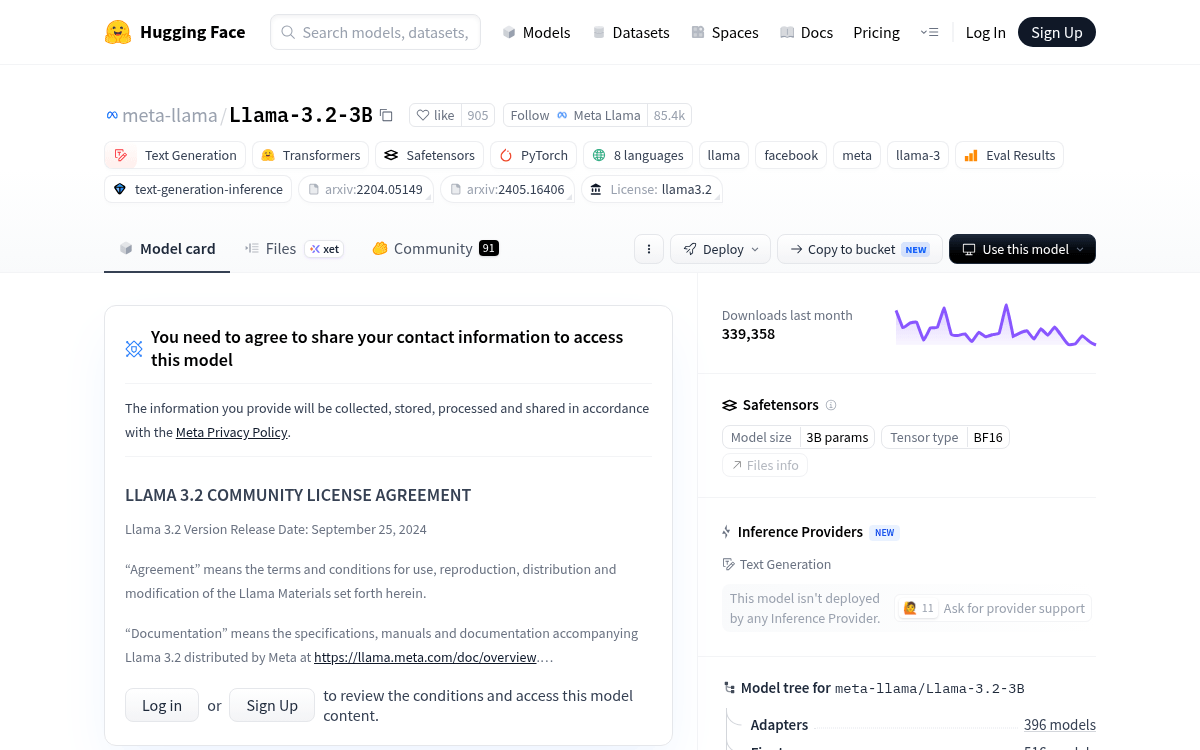
The Transformers path requires accepting the license on Hugging Face first:
from transformers import pipeline
import torch
pipe = pipeline(
    "text-generation",
    model="meta-llama/Llama-3.2-3B",
    torch_dtype=torch.bfloat16,
    device_map="auto",
)
print(pipe("The key to life is", max_new_tokens=64))
vLLM, SGLang, Ollama, LM Studio, and llama.cpp all support it. Hugging Face hosts 148 community quantizations and over 500 fine-tunes.
License constraints worth reading
Llama 3.2 is free for commercial use under the Llama 3.2 Community License, with two notable restrictions. Products that exceeded 700 million monthly active users on the release date require a separate Meta license. More relevant to most teams: the multimodal grants explicitly exclude individuals and companies whose principal place of business is in the European Union. The 3B text model is not directly affected, but EU-based developers mixing it with the 11B or 90B vision siblings should review the terms carefully.
When to reach for it
The 3B is the default choice when you need assistant-quality output in a few gigabytes of RAM. Practical fits include on-device summarization and rewriting, function-calling agents on constrained hardware, multilingual chat across eight supported languages (English, German, French, Italian, Portuguese, Hindi, Spanish, and Thai), and domain fine-tuning where the 8B is overkill. For long-document reasoning or graduate-level science, the 8B or larger will serve better. For everything where latency and memory footprint come first, this is the model to start with.