
Meta's Llama-3.2-1B Runs at 50 Tokens per Second on a Phone
Meta's 1.23B parameter chat model brings distilled Llama intelligence, 128k context, and mobile-ready quantization to edge deployments under an open license.
 Pro
Takeaways
- Meta's Llama-3.2-1B-Instruct is a 1.23B chat model with a 128k context window.
- Pretrained on 9T tokens using logit distillation from Llama 3.1 8B and 70B teachers.
- Scores 49.3 MMLU, 59.5 IFEval, 44.4 GSM8K; competitive with Gemma 2B at this size.
- SpinQuant 4-bit variant runs at 50 tokens/second on a OnePlus 12 phone, 1GB footprint.
- Supports 8 languages; aligned via SFT, Rejection Sampling, and DPO.
- Released under the Llama 3.2 Community License; free on most hosted providers.
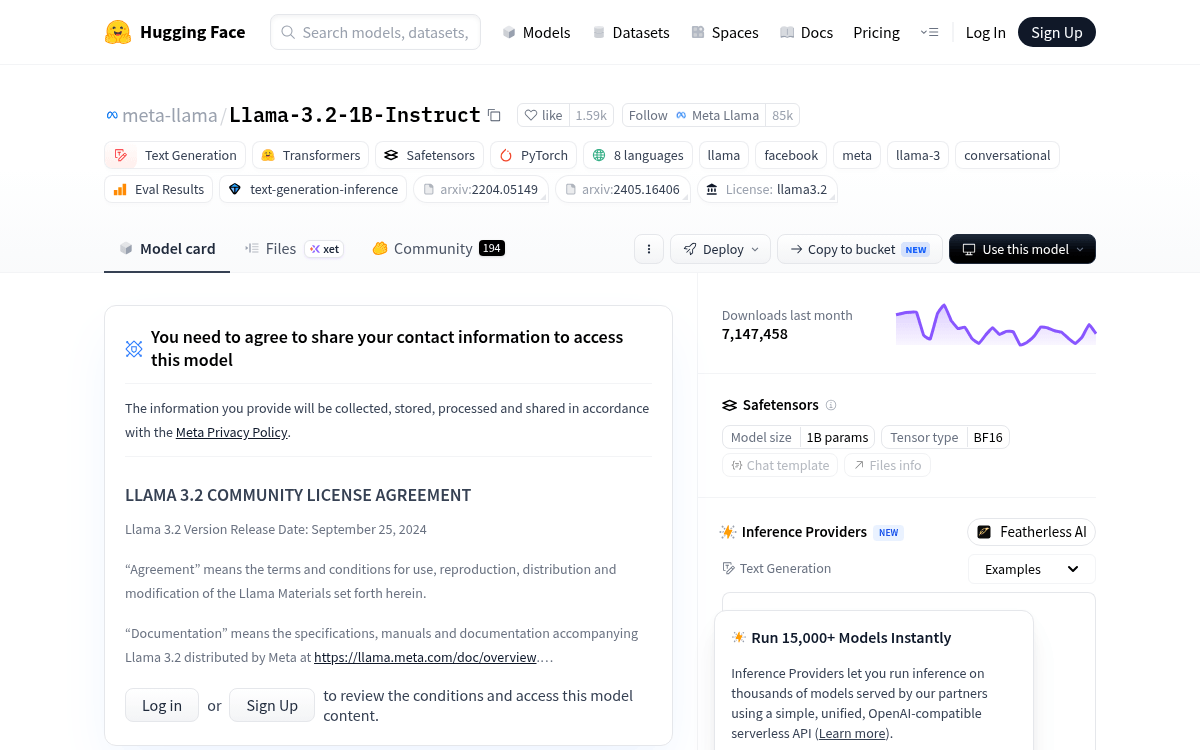
Meta's smallest instruction-tuned Llama slots into a niche that Gemma and Phi variants had dominated: a text-only chat model tiny enough to run on a phone, yet capable enough to handle summarization, rewriting, and light agentic work. Llama-3.2-1B-Instruct is a 1.23B parameter transformer with a 128k token context window, and it has quietly become one of the most downloaded open models on Hugging Face, with millions of pulls per month.
Distilling an 8B teacher into a 1B student
Llama 3.2 was pretrained on up to 9 trillion tokens from publicly available sources, but the 1B and 3B variants got a boost that earlier small models did not. Meta folded logits from the Llama 3.1 8B and 70B models into the pretraining stage for the smaller siblings, using outputs from the larger models as token-level targets. Knowledge distillation then recovered performance after pruning.
Post-training followed the recipe used for the larger Llama 3.1 models: several rounds of alignment involving Supervised Fine-Tuning, Rejection Sampling, and Direct Preference Optimization. The resulting model carries a 128k context length, grouped-query attention, and shared embeddings, with training data through December 2023.
How it actually scores
Nobody should expect frontier reasoning here. The 1B variant lands where a distilled small model tends to land:
- MMLU (5-shot): 49.3 (bf16), versus 63.4 for the 3B sibling and 69.4 for Llama 3.1 8B
- IFEval instruction following: 59.5
- GSM8K math with chain of thought: 44.4
- MATH: 30.6
- ARC-C reasoning: 59.4
- Tool use (BFCL V2): 25.7, a big gap from the 3B's 67.0
Meta positions the family against the obvious rivals, claiming the 3B outperforms Gemma 2 2.6B and Phi 3.5-mini on instruction following, summarization, prompt rewriting, and tool use, while the 1B stays competitive with Gemma. Independent trackers are less generous. Artificial Analysis notes that Llama 3.2 Instruct 1B is among the least intelligent models but well priced when compared to other open-weight non-reasoning models of similar size, which is a polite way of saying: use it for the right job.
The right job is a phone
Inference cost is the real headline. Meta benchmarked the quantized variants on a OnePlus 12 with an ARM CPU backend through ExecuTorch, and the numbers make the case for on-device deployment:
| Variant | Decode (tok/s) | Time to first token | Model size | RSS memory |
|---|---|---|---|---|
| 1B BF16 baseline | 19.2 | 1.0s | 2358 MB | 3185 MB |
| 1B SpinQuant | 50.2 | 0.3s | 1083 MB | 1921 MB |
| 1B QLoRA | 45.8 | 0.3s | 1127 MB | 2255 MB |
SpinQuant does the interesting engineering. It applies learned rotation matrices to the weight and activation tensors before quantizing, redistributing outlier values so that 4-bit weight quantization loses less accuracy. Every linear layer in every transformer block gets quantized to a 4-bit groupwise scheme with a group size of 32 for weights and 8-bit per-token dynamic quantization for activations, with the classifier and embedding layers held at 8-bit. That shrinks the model from 2.4GB to just over 1GB while cutting time-to-first-token by roughly 77 percent.
Deploying it
Access is gated behind a contact form and the Llama 3.2 Community License, which is permissive for anyone under 700M monthly active users. Once accepted, the model plugs into the standard toolchain:
from transformers import pipeline
import torch
pipe = pipeline(
    "text-generation",
    model="meta-llama/Llama-3.2-1B-Instruct",
    torch_dtype=torch.bfloat16,
    device_map="auto",
)
messages = [{"role": "user", "content": "Summarize this changelog in 3 bullets: ..."}]
print(pipe(messages, max_new_tokens=256)[0]["generated_text"][-1])
For serving, vllm serve meta-llama/Llama-3.2-1B-Instruct spins up an OpenAI-compatible endpoint. Quantized checkpoints target PyTorch ExecuTorch with an ARM CPU backend for on-device work, and Llama 3.2 supports Qualcomm, MediaTek, and ARM processors, making it a practical fit for mobile and edge deployments. Ollama, LM Studio, llama.cpp, and Jan all consume the community quantizations directly.
Where it fits in a real stack
Reach for a bigger model when you need serious reasoning or code generation. The 1B earns its keep when latency, privacy, or bandwidth constraints rule out an API call. Concrete cases:
- On-device summarization of email, notes, and chat history without shipping data to a server
- Prompt rewriting and query expansion as a preprocessing step in front of a larger model
- Structured extraction from short passages, particularly after fine-tuning
- Multilingual assistants across the eight officially supported languages: English, German, French, Italian, Portuguese, Hindi, Spanish, and Thai
- Draft generation for speculative decoding in front of a larger Llama, cutting latency without sacrificing final output quality
- Fine-tuning base for narrow domain classifiers; the ecosystem already lists close to 1,800 finetunes and 650 adapter variants on the Hub
Pricing is trivial. Hosted providers list the 1B at effectively zero per million tokens, and self-hosting cost is measured in RAM rather than dollars. If your problem fits what a distilled 1B can do, this is currently the strongest open option in its weight class.