
Meta's Llama-3.2-1B Runs 50 Tokens per Second Directly on Your Phone
Meta's smallest Llama fits on phones with a 128K context window, uses distillation from bigger siblings, and ships a quantized build that runs 2.6x faster.
 Pro
Takeaways
- Meta released Llama-3.2-1B, a 1.23B parameter text model with a 128K context window.
- Built via pruning and distillation from Llama 3.1 8B and 70B logits during pretraining.
- Instruction tuned scores: MMLU 49.3, IFEval 59.5, GSM8K 44.4, Needle in Haystack 96.8.
- Quantized SpinQuant build runs 2.6x faster decode and cuts model size 54% on ARM CPUs.
- Supports English, German, French, Italian, Portuguese, Hindi, Spanish, and Thai officially.
- Free under Llama 3.2 Community License, works with transformers, vLLM, SGLang, ExecuTorch, llama.cpp.
Meta shipped the smallest member of the Llama family: a 1.23B parameter text model aimed squarely at phones, laptops, and other resource-constrained hardware. Llama-3.2-1B is a text-in, text-out model with a 128K token context window, eight officially supported languages, and open weights under Meta's community license. It arrives alongside a 3B sibling and two much larger vision variants, though the 1B is the one worth paying attention to if you care about on-device inference.
Big model tricks in a tiny package
The interesting part is how the weights got there rather than the parameter count itself. Meta built the lightweight models to fit efficiently on mobile and edge devices using two techniques: pruning and distillation. Pruning trims the network by removing less critical parts while retaining as much learned behavior as possible, starting from the larger Llama 3.1 8B pretrained checkpoint.
Distillation here goes beyond the usual soft-label trick applied at fine-tuning time. According to the model card, logits from the Llama 3.1 8B and 70B models were used as token-level training targets during pretraining itself, and knowledge distillation was applied after pruning to recover performance. Post-training then followed the Llama 3.1 recipe: several rounds of supervised fine-tuning, rejection sampling, and direct preference optimization.
The pretraining budget was still substantial for a model this small. Meta reports the 1B consumed 370k H100-80GB GPU hours and saw up to 9 trillion tokens of publicly available data, with a knowledge cutoff of December 2023. It uses grouped query attention and shares embeddings between input and output layers, both of which matter more at 1B scale where the embedding table would otherwise dominate the parameter count.
What the benchmarks actually say
The base pretrained 1B will not replace a frontier model. On MMLU it scores 32.2 (5-shot), on ARC-Challenge 32.8, and on DROP F1 it lands at 28.0. The instruction tuned version fares better where it counts for small model use cases: 49.3 on MMLU, 59.5 on IFEval for instruction following, 44.4 on GSM8K math, and 41.6 on Open-rewrite eval.
One number stands out: on Needle in a Haystack the 1B pretrained model scores 96.8, which suggests the 128K context is actually usable for retrieval-style lookups rather than being a spec-sheet number. Meta's own framing is that the 3B outperforms Gemma 2 2.6B and Phi 3.5-mini on tasks such as following instructions, summarization, prompt rewriting, and tool use, while the 1B is competitive with Gemma.
The quantization story
The 1B ships with two officially supported quantized variants: SpinQuant with GPTQ, and quantization-aware training with LoRA adapters (Meta calls this QLoRA). Both target the same scheme: 4-bit groupwise weights with group size 32 for linear layers, 8-bit per-token dynamic activations, and 8-bit per-channel weights for the classification and embedding layers. The whole thing was designed with PyTorch's ExecuTorch inference framework and ARM CPU backends in mind.
Measured on a OnePlus 12 Android device, the numbers describe a real edge deployment story rather than a research artifact:
| Variant | Decode (tok/s) | Time to first token | Model size (MB) | Memory (MB) |
|---|---|---|---|---|
| 1B BF16 | 19.2 | 1.0s | 2358 | 3185 |
| 1B SpinQuant | 50.2 (2.6x) | 0.3s | 1083 | 1921 |
| 1B QLoRA | 45.8 (2.4x) | 0.3s | 1127 | 2255 |
Meta's writeup on the quantized releases reports that decode latency improved by 2.5x and prefill latency by 4.2x on average, while model size dropped by 56% and memory usage fell by 41% on average. A one gigabyte model generating 50 tokens per second on a phone CPU represents a different deployment profile than anything the community had shipped at this quality before.
Getting it running
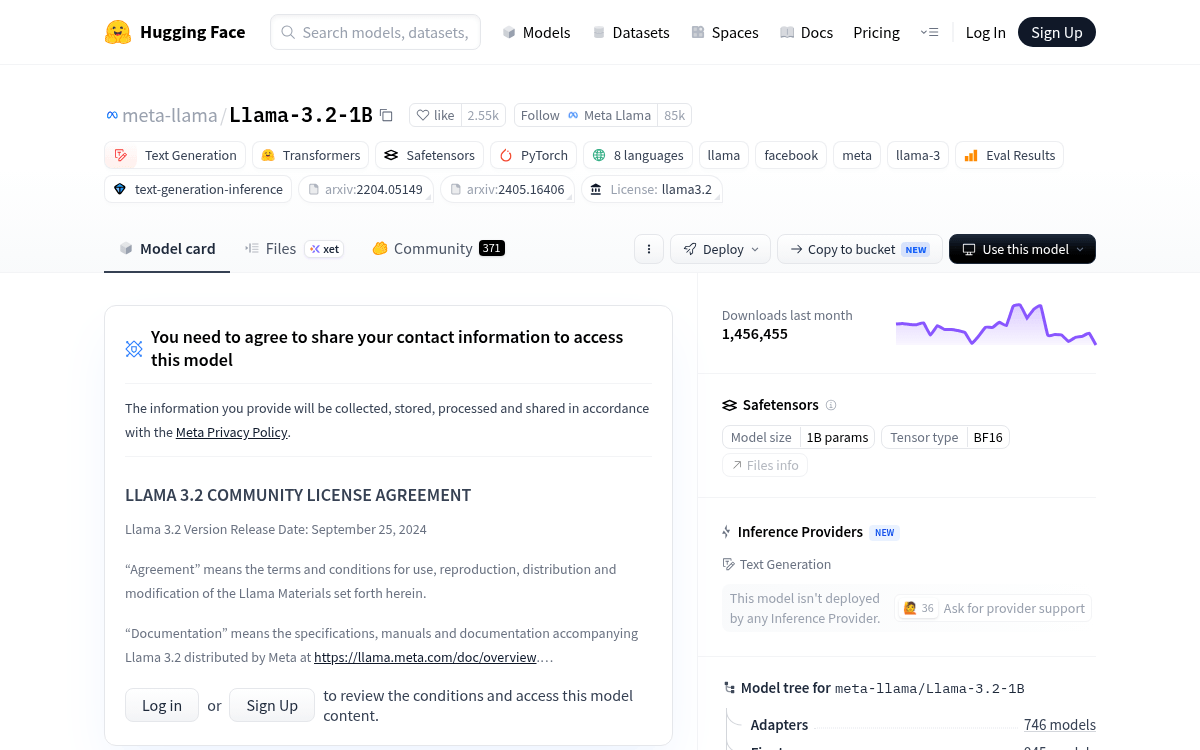
The weights are gated on Hugging Face but free once you accept the license. The transformers path is a two-liner:
from transformers import pipeline
import torch
pipe = pipeline(
    "text-generation",
    model="meta-llama/Llama-3.2-1B",
    torch_dtype=torch.bfloat16,
    device_map="auto",
)
print(pipe("The key to life is"))
For serving, vLLM and SGLang both work out of the box with OpenAI-compatible endpoints. For on-device deployments, ExecuTorch is the reference path, and quantized GGUF ports run in llama.cpp, Ollama, and LM Studio.
Where it fits and where it does not
The intended use case is narrow but real. Good fits include:
- On-device summarization, rewriting, and prompt reformulation where round trips to a server are unacceptable
- Agentic scaffolding where the 1B handles routing, tool selection, or query rewriting in front of a larger model
- Retrieval over long contexts up to 128K tokens for the BF16 build (quantized variants drop to 8K)
- Multilingual assistants across English, German, French, Italian, Portuguese, Hindi, Spanish, and Thai
- A cheap distillation target or base for domain-specific fine-tuning, with over 900 finetunes already published on the Hub
The weak spots are equally clear. Tool use scores drop hard, with BFCL V2 at 25.7 for BF16 and just 15.9 for SpinQuant, so complex function calling should stay on a bigger model. GPQA sits at 27.2, essentially chance level for hard scientific reasoning. Math beyond GSM8K falls off quickly, and hallucination rates on open-ended factual questions are what you would expect from a model with roughly one billion parameters worth of world knowledge.
What this shifts
The broader signal is that the frontier lab playbook, distillation from a 70B teacher into a pruned 1B student, produces something meaningfully better than training a 1B from scratch. On-device LLMs have also moved past proof of concept. A phone-class device can now run a coherent multilingual assistant locally, with sub-second time to first token and no network dependency, which changes the assumptions for anyone building offline-capable products or privacy-sensitive workflows. Llama 3.2 1B is not the smartest model you can call, but it may well be the smartest one you can ship inside your app binary.