
Meta's Llama-3.2-11B Vision Gives Open-Source Developers a Cheap Document AI
Meta's open-weights 11B multimodal model pairs a vision adapter with Llama 3.1, enabling document QA, chart reasoning, and image understanding at commodity cost.
 Pro
Takeaways
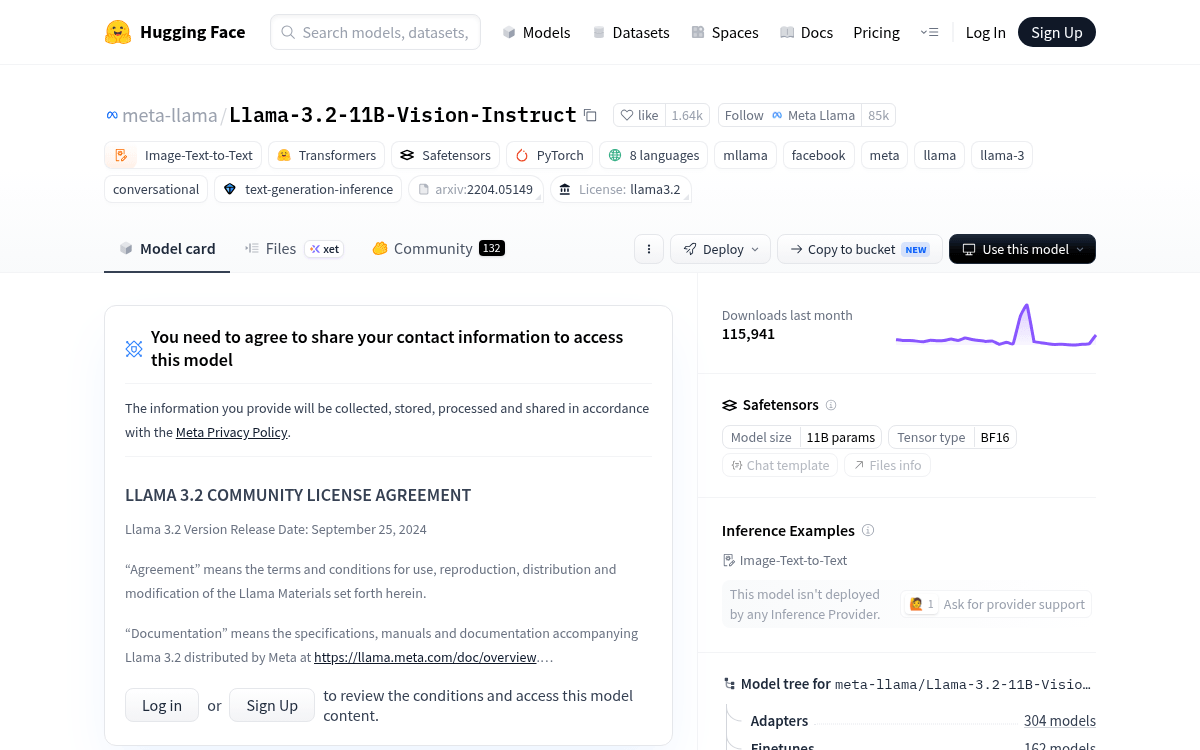
- Llama-3.2-11B-Vision-Instruct is Meta's open-weights multimodal model taking text and images, outputting text.
- Built by attaching a cross-attention vision adapter to the frozen Llama 3.1 text backbone, preserving language quality.
- Strong on document tasks: 88.4 DocVQA, 91.1 AI2 Diagram, 83.4 ChartQA with chain-of-thought.
- Pretrained on 6B image-text pairs plus 3M synthetic instruction examples across 245K H100-hours for the 11B.
- Hosted API pricing starts at $0.16 per 1M blended tokens on Amazon Bedrock.
- License blocks EU-domiciled developers from directly using the multimodal weights; end users of downstream products are unaffected.
Meta's mid-tier multimodal entry into the Llama family gives the open-source community something it had been missing: a genuinely capable vision-language model with permissive commercial licensing that fits on a single GPU. Llama-3.2-11B-Vision-Instruct takes text and images in, writes text out, and slots into the same tooling stack you already use for Llama 3.1.
Adoption has been quiet but meaningful. The model sits at roughly 139K monthly downloads on Hugging Face, and there are already 163 finetunes, 304 adapters, and 20 quantized variants built on top of it, which tells you developers are treating it as a foundation rather than an endpoint.
A vision adapter bolted onto a proven text model
Rather than train a multimodal model from scratch, Meta took a bolt-on approach. Llama 3.2-Vision sits on top of the Llama 3.1 text-only backbone, an auto-regressive language model with an optimized transformer architecture. The tuned versions use supervised fine-tuning (SFT) and reinforcement learning with human feedback (RLHF) to align with human preferences for helpfulness and safety.
The image side is handled by a separately trained vision adapter that plugs into the pre-trained Llama 3.1 language model. That adapter is a stack of cross-attention layers that inject image encoder representations into the core LLM. In practice, the text weights stay frozen, so language quality does not regress when you add vision, and you can serve the same model for pure text tasks without ceremony.
The relevant numbers:
- Parameters: 11B (10.6B actual)
- Context length: 128k tokens
- Input: text plus one or more images. Output: text only
- Attention: Grouped-Query Attention (GQA) for faster inference
- Precision: BF16 weights on Hugging Face
- Knowledge cutoff: December 2023
- Languages: English, German, French, Italian, Portuguese, Hindi, Spanish, Thai for text; English only for image plus text
What the training actually looked like
The scale is worth pausing on. Llama 3.2-Vision was pretrained on 6B image and text pairs, and the instruction tuning data includes publicly available vision instruction datasets alongside over 3M synthetically generated examples. Synthetic data at that volume is a bet that a smaller pool of high-quality machine-generated examples beats a larger pool of noisy scraped data for instruction following.
Compute for the 11B breaks down as 147K H100-hours of stage-1 pretraining, 98K hours of stage-2 annealing, 896 hours of SFT, and 224 hours of RLHF. The 90B sibling cost roughly six times more. Across both sizes, Meta reports 2.02M cumulative H100-hours, and notes that market-based emissions netted to zero thanks to renewable matching.
Benchmark reality check
The instruction-tuned 11B lands in a specific niche: strong on structured visual tasks, mid-pack on general reasoning. Highlights from Meta's reported numbers:
| Benchmark | Capability | 11B score | 90B score |
|---|---|---|---|
| DocVQA (test) | Document understanding | 88.4 | 90.1 |
| ChartQA (CoT) | Chart reading | 83.4 | 85.5 |
| AI2 Diagram | Diagram QA | 91.1 | 92.3 |
| VQAv2 | General visual QA | 75.2 | 78.1 |
| MathVista | Visual math | 51.5 | 57.3 |
| MMMU (CoT) | College-level multimodal | 50.7 | 60.3 |
| MMLU (CoT) | Text knowledge | 73.0 | 86.0 |
| MATH (CoT) | Text math | 51.9 | 68.0 |
The 88.4 on DocVQA and 91.1 on AI2 Diagram are the standout numbers. Those tasks show up constantly in real enterprise pipelines: reading invoices, parsing forms, extracting data from charts in a PDF. The MMMU-Pro Vision score of 23.7 is the reminder that this is a workhorse rather than a research-grade reasoning model. Third-party testing from Artificial Analysis puts it further into context, scoring Llama 3.2 Instruct 11B (Vision) at 9 on the Artificial Analysis Intelligence Index, at the lower end among comparable models (which average 12).
Getting it running
The transformers integration lands in version 4.45.0 and later. A minimal image-plus-text call looks like this:
from transformers import MllamaForConditionalGeneration, AutoProcessor
import torch, requests
from PIL import Image
model_id = "meta-llama/Llama-3.2-11B-Vision-Instruct"
model = MllamaForConditionalGeneration.from_pretrained(
    model_id, torch_dtype=torch.bfloat16, device_map="auto")
processor = AutoProcessor.from_pretrained(model_id)
image = Image.open(requests.get(url, stream=True).raw)
messages = [{"role": "user", "content": [
    {"type": "image"}, {"type": "text", "text": "Describe this."}]}]
inputs = processor(image, processor.apply_chat_template(
    messages, add_generation_prompt=True), return_tensors="pt").to(model.device)
print(processor.decode(model.generate(**inputs, max_new_tokens=128)[0]))
Beyond raw transformers, the weights are wired into vLLM and SGLang for OpenAI-compatible serving, run through Docker Model Runner, and ship as GGUF quantizations for llama.cpp, Ollama, and LM Studio. Hosted APIs are available if you would rather skip the infrastructure. On output speed, DeepInfra leads at 60.1 t/s with Amazon at 45.4 t/s. On latency, DeepInfra clocks 0.56s time to first token and Amazon 0.83s. On price, Amazon comes in at $0.16 and DeepInfra at $0.25 per 1M blended tokens.
Where it actually earns its keep
Meta's own list of intended uses lines up with the benchmark strengths. Practical use cases where the 11B is a defensible default:
- Document VQA over invoices, contracts, receipts, and forms
- Chart and diagram interpretation inside analytics dashboards
- Image captioning and alt-text generation at scale
- Visual grounding, where a natural language description needs to point at a region of an image
- Image-text retrieval for search over mixed-media corpora
- Synthetic data generation and distillation into smaller task-specific models, which the license explicitly permits
Weak spots: complex multi-step visual reasoning, math-heavy diagrams beyond the basics, and anything requiring current knowledge. The December 2023 cutoff means the model does not know about anything shipped in the last two years.
The license fine print that matters
Two clauses in the Llama 3.2 Community License deserve attention before you build. If your product has more than 700 million monthly active users, you need a separate license from Meta. More relevant to most teams: the multimodal grant does not extend to individuals domiciled in the EU or companies with a principal place of business there. End users of a downstream product that incorporates the model are unaffected, but EU-based developers cannot directly build on the vision weights. That has real consequences for European startups picking a foundation model.
The boring, cheap default
Open multimodal used to mean a research checkpoint with a permissive-ish license and no serving story. Llama 3.2 Vision Instruct resets the default. You get a model that runs on a single H100, plugs into every mainstream inference server, has quantizations for consumer hardware, and posts DocVQA numbers that were closed-source territory a year ago. The 11B will not top MMMU-Pro, and it should not be your pick for frontier visual reasoning. For the enterprise middle of the market, though, extracting structured data from documents, describing images, answering questions about charts, it is a strong, boring, cheap default. That is exactly what open models are supposed to be.