
Meta's Llama 3.1 8B Instruct Doubles Tool Calling Scores on a Single GPU
Meta's compact 8B instruction-tuned model packs a 128K context window, multilingual reasoning, and tool use into a laptop-friendly footprint.
 Pro
Takeaways
- Meta's Llama 3.1 8B Instruct ships with a 128K context window and eight-language multilingual support
- Benchmarks: 72.6 HumanEval, 84.5 GSM-8K, 51.9 MATH, 82.6 API-Bank tool use
- Pretrained on ~15T tokens plus 25M+ synthetic instruction examples via SFT and RLHF
- Available at $0.02/M input and $0.04/M output tokens on OpenRouter across five providers
- Runs on Transformers, vLLM, SGLang, Ollama, and llama.cpp with first-class tool-calling chat templates
- Weak spots: GPQA (30.4) and open-ended API selection; not a reasoning model
Meta's Llama 3.1 8B Instruct is the smallest sibling in the Llama 3.1 family, and arguably the most practical one for teams that want a capable open-weight model they can actually run without renting a rack of H100s. It ships alongside 70B and 405B variants, while the 8B fits on a single consumer GPU and still crosses the quality bar most production workloads care about.
The headline change from Llama 3 to 3.1 at this tier is a jump from an 8K context window to 128K tokens, native multilingual support, and a sharp improvement in tool calling. Meta's announcement frames this as the point where small open models start to overlap with closed chat models on the everyday tasks developers actually ship.
What's actually in the box
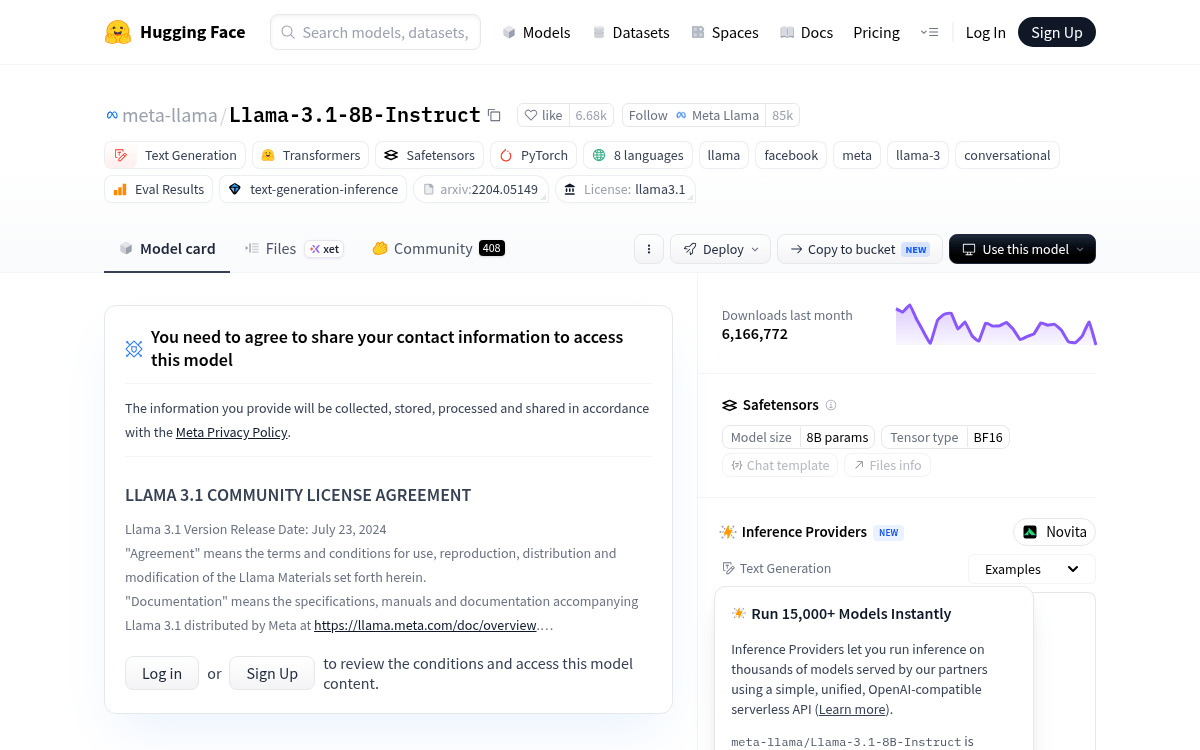
The Hugging Face repository contains two versions of Meta-Llama-3.1-8B-Instruct, one for use with transformers and one for the original llama codebase. Starting with transformers 4.43.0 you can run conversational inference using the pipeline abstraction or the Auto classes with generate(). Under the hood it's an auto-regressive transformer using Grouped-Query Attention (a trick that shares key/value projections across attention heads to keep memory manageable at long context), tuned with supervised fine-tuning and RLHF for helpfulness and safety.
Key specs at a glance:
- Parameters: 8 billion, BF16 weights
- Context length: 128K tokens
- Languages: English, German, French, Italian, Portuguese, Hindi, Spanish, Thai
- Knowledge cutoff: December 2023
- License: Llama 3.1 Community License (commercial use allowed under 700M MAU)
How it was built
Llama 3.1 was pretrained on roughly 15 trillion tokens of publicly available data, and the fine-tuning corpus includes public instruction datasets alongside over 25 million synthetically generated examples. That synthetic pipeline is a big part of why the 8B punches above its weight. Meta used larger models in the family to generate and filter training examples, then distilled that signal back into the smaller checkpoints.
The compute bill wasn't small even for the 8B. Training used H100-80GB GPUs at 700W TDP, with the 8B alone consuming 1.46 million GPU hours out of a cumulative 39.3 million across the family. For context, that's roughly 167 GPU-years for the smallest model in the lineup.
Where it shines on benchmarks
The 8B Instruct posts numbers that would have been flagship-tier a generation ago. On the instruction-tuned evaluations Meta published:
| Benchmark | Llama 3 8B Instruct | Llama 3.1 8B Instruct |
|---|---|---|
| MMLU (5-shot) | 68.5 | 69.4 |
| MMLU CoT (0-shot) | 65.3 | 73.0 |
| HumanEval (pass@1) | 60.4 | 72.6 |
| MATH (CoT) | 29.1 | 51.9 |
| GSM-8K (CoT) | 80.6 | 84.5 |
| API-Bank (tool use) | 48.3 | 82.6 |
| BFCL (function calling) | 60.3 | 76.1 |
| IFEval | 76.8 | 80.4 |
Two jumps are worth staring at. MATH climbs from 29.1 to 51.9, suggesting the synthetic reasoning data actually worked. API-Bank tool use nearly doubles from 48.3 to 82.6, which is what makes this model genuinely viable as an agent backbone rather than just a chat toy.
Where it still struggles
The 8B isn't magic. GPQA (a graduate-level science QA benchmark that stresses genuine expertise) actually dropped slightly to 30.4, and the Gorilla API Bench score of 8.2 shows that while structured function calling is strong, open-ended API selection across a huge tool space is still hard at this size. If your workload involves PhD-level reasoning or picking from thousands of tools with no scaffolding, reach for the 70B or a specialist model.
Independent analysis places the 8B above average in intelligence and reasonably priced against other open-weight non-reasoning models of similar size, with support for text input, text output, and a 128k context window. One caveat worth remembering: it's a non-reasoning model, so it doesn't do the extended chain-of-thought scratchpad that newer reasoning models use to crack hard problems.
Getting it running
The path of least resistance is the Transformers pipeline:
from transformers import pipeline
import torch
pipe = pipeline(
    "text-generation",
    model="meta-llama/Llama-3.1-8B-Instruct",
    model_kwargs={"torch_dtype": torch.bfloat16},
    device_map="auto",
)
messages = [{"role": "user", "content": "Summarize gradient descent in two lines."}]
print(pipe(messages, max_new_tokens=256)[0]["generated_text"][-1])
For production serving, vLLM and SGLang both expose OpenAI-compatible endpoints with a single command, and quantized builds run happily in llama.cpp, Ollama, and LM Studio. If you'd rather not host at all, five providers on OpenRouter serve the model: DeepInfra, NovitaAI, Groq, Cloudflare, and CoreWeave.
Pricing reality check
On OpenRouter, the model costs $0.02 per million input tokens and $0.04 per million output tokens, with a 131,072 token context window and up to 16,384 completion tokens. That's roughly two orders of magnitude cheaper than frontier closed models for comparable throughput on everyday chat, RAG, and classification tasks. Self-hosting drops the marginal cost further if you have GPU capacity sitting idle.
Tool calling, properly
One underrated win here: tool use is a first-class citizen in the chat template. You pass Python functions with type hints and docstrings straight to apply_chat_template, the model emits a structured call, you execute it, and append the result with the tool role. No brittle regex on generated text, no bespoke prompt engineering per function. The 82.6 on API-Bank is the benchmark reflection of that ergonomic design.
What it's actually good for
- Multilingual chatbots and assistants where you need consistent quality across the eight officially supported languages
- RAG over long documents, thanks to the 128K context and solid reading comprehension scores
- Agent backbones with structured tool calling, function routing, and API orchestration
- Synthetic data generation and distillation, which the license explicitly permits, including using outputs to train other models
- On-device or edge inference when quantized to 4-bit, where the footprint fits in about 5GB of VRAM
- Code assistance for common languages, with HumanEval pass@1 of 72.6 landing in useful territory for autocomplete and refactoring
The bigger picture
The Llama 3.1 release quietly shifted the assumption that small open models had to be dumb. An 8B model that clears 70+ on HumanEval, 80+ on IFEval, and handles 128K context is enough for most non-frontier production workloads. It also reset expectations around synthetic data: Meta explicitly credits over 25M synthetic instruction examples, and now lets you use Llama outputs to train other models, which has kicked off a wave of open fine-tunes and distillations. Nearly 3,000 finetunes and over 900 quantizations already exist for this checkpoint on Hugging Face alone, a fair proxy for how much of the current open ecosystem is built on top of this exact model.
If you're choosing a small open model to standardize on, the 8B Instruct remains the pragmatic default: cheap to serve, permissively licensed, well-supported by every serving framework, and good enough that the delta to closed models rarely justifies the price gap for routine work.