
Meta's Llama 3.1 70B Gives Developers a Real Alternative to GPT-4
Meta released Llama 3.1 70B Instruct with 128K context, multilingual support, and open weights that rival closed frontier models on benchmarks.
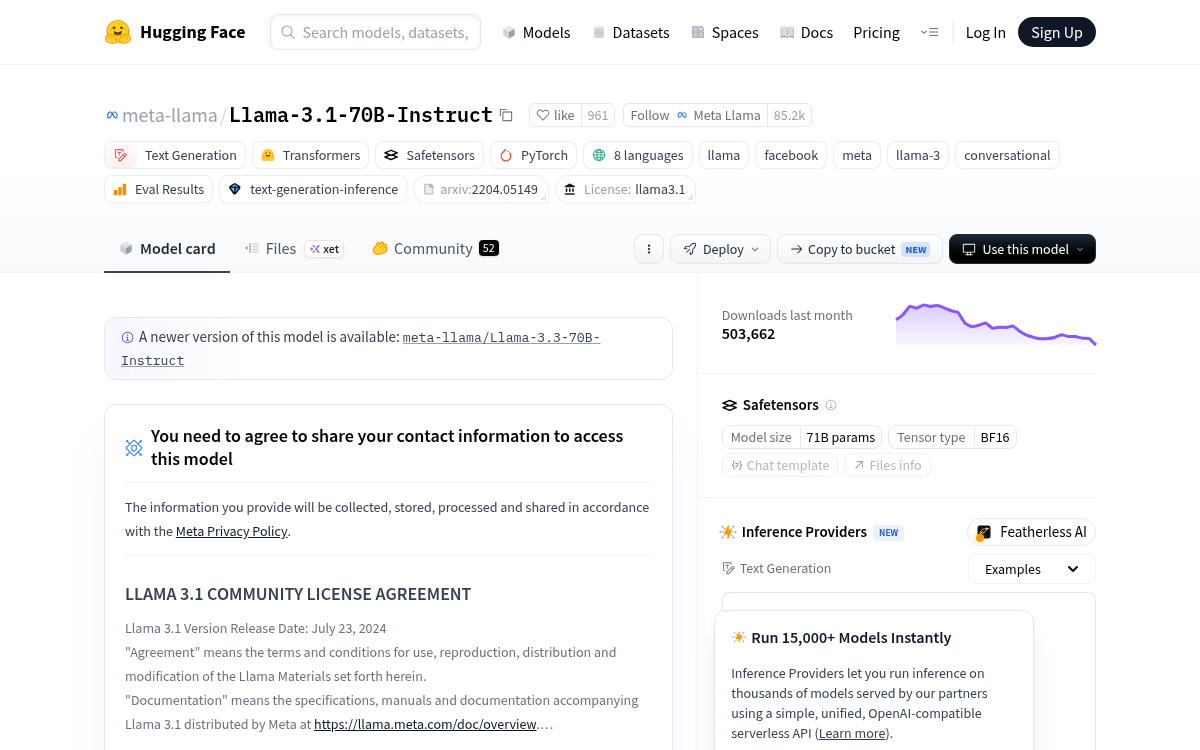 Pro
Takeaways
- Meta released Llama 3.1 70B Instruct with 128K context and open weights
- Scores over 83% on MMLU, rivaling the original GPT-4 at its size class
- Multilingual across 8 languages including English, German, French, Hindi, Spanish, and Thai
- New license permits using model outputs to train other models, enabling synthetic data workflows
- Requires transformers 4.43.0 or later; shipped with day-one support across AWS, NVIDIA, Databricks, Groq
- Post-training used iterative SFT, rejection sampling, and DPO on 25M+ synthetic examples
Meta pushed its open weights strategy into new territory with the release of the Llama 3.1 70B Instruct model, part of a broader collection that also includes 8B and 405B variants. The 70B version hits the sweet spot for most teams, delivering frontier-class performance without the infrastructure headache of running a 405B parameter model, with weights downloadable under a license that permits training on model outputs.
Meta framed the release as the moment open source catches up with closed models, and the 70B is the variant most developers will actually reach for.
What actually shipped
The Llama 3.1 collection consists of pretrained and instruction tuned generative models at 8B, 70B and 405B sizes, all text in and text out. The 70B Instruct model is the mid-tier option, tuned for dialogue and aligned with human preferences.
Three things stand out compared to the previous Llama 3 generation:
- A significantly longer context length of 128K, state-of-the-art tool use, and stronger reasoning
- Multilingual support across English, German, French, Italian, Portuguese, Hindi, Spanish, and Thai
- A license change allowing developers to use the outputs from Llama models, including the 405B, to improve other models
That last point is quietly important. You can now legally use the 405B to generate synthetic training data for your own smaller models, which was previously a legal gray area.
The numbers behind the hype
Independent evaluations back Meta's claims. With an MMLU over 83%, Llama 3.1 70B is state-of-the-art for its size, scoring close to the original GPT-4 and significantly improving on the previously best open models such as Qwen2 and Llama 3. On the internal evaluation set, the 70B Instruct posts strong numbers across the board: 80.5 on HumanEval (0-shot), 95.1 on GSM8K, 68.0 on MATH, and 87.5 on IFEval for instruction following.
Meta's evaluation methodology was aggressive. The team evaluated performance on over 150 benchmark datasets spanning a wide range of languages, and ran extensive human evaluations comparing Llama 3.1 with competing models in real-world scenarios.
Inside the training loop
The training pipeline is where things get interesting. The tuned versions use supervised fine-tuning (SFT) and reinforcement learning with human feedback (RLHF) to align with human preferences for helpfulness and safety, but Meta went further with an iterative loop rather than a single pass.
Each round of post-training combines Supervised Fine-Tuning, Rejection Sampling, and Direct Preference Optimization. Rejection sampling means generating many candidate responses and keeping only the best ones as training data. DPO is a lighter alternative to RLHF that skips the reward model and trains directly on preference pairs. The fine-tuning data includes publicly available instruction datasets, as well as over 25M synthetically generated examples, most of which came from the 405B model bootstrapping smaller variants.
For the architecture, Meta played it safe, picking a standard decoder-only transformer with minor tweaks rather than a mixture-of-experts design, prioritizing training stability over parameter efficiency. The pretraining data has a cutoff of December 2023.
Getting it running
Loading the model is straightforward if you're already in the Hugging Face ecosystem. Starting with transformers >= 4.43.0, you can run conversational inference using the Transformers pipeline abstraction or by leveraging the Auto classes with the generate() function. Make sure to update your transformers installation via pip install --upgrade transformers.
import transformers
import torch
pipeline = transformers.pipeline(
    "text-generation",
    model="meta-llama/Llama-3.1-70B-Instruct",
    model_kwargs={"torch_dtype": torch.bfloat16},
    device_map="auto",
)
messages = [{"role": "user", "content": "Explain FP8 quantization."}]
out = pipeline(messages, max_new_tokens=256)
print(out[0]["generated_text"])
For production, Meta quantized their own serving copies from BF16 to FP8, which cuts memory roughly in half and lets the 405B fit on a single server node. The 70B is more forgiving. You can run it on a single 8xA100 node in BF16, or dial down to INT4 quantization to serve from a pair of consumer GPUs.
Strengths, and where it stumbles
The 70B Instruct model was designed with specific workloads in mind: content creation, conversational AI, language understanding, R&D, and enterprise applications. It handles text summarization, classification, sentiment analysis, nuanced reasoning, language modeling, dialogue systems, code generation, and instruction following.
The weak spots are real. An independent evaluation showed worse performance on MMLU-Redux, a cleaner subset of MMLU, scoring 76.53 versus 88.01 for GPT-4o. Vision, audio, and native function calling schemas are missing. And at 70B parameters, you cannot exactly drop this on a laptop.
The ecosystem showed up on day one
Meta clearly learned from the Llama 2 rollout. The Llama 3.1 launch included coordinated availability across AWS Bedrock, NVIDIA, Databricks, Groq, Google Cloud, Snowflake, and more than 20 other partners.
Alongside the model, Meta shipped Llama Guard 3 for multilingual safety classification and Prompt Guard for prompt injection detection. The team also opened a GitHub reference implementation and a request for comment on the Llama Stack API for standardizing toolchain interfaces.
Why this matters for the field
The 405B gets the marketing attention, but the 70B is where the practical shift happens. It closes enough of the gap with GPT-4 class models that self-hosting becomes a real decision rather than a compromise. Teams that had been paying per-token to closed providers now have a defensible reason to pull inference in-house: predictable costs, no data leaving the perimeter, and the ability to fine-tune on domain data without vendor negotiations.
The synthetic data angle also opens up a specific workflow that was previously locked behind closed APIs. You can use the 405B to generate high-quality training examples, distill them into a specialized 70B or 8B student model, and ship the smaller version to production. That is a full training loop with no external dependencies and no output license restrictions, a genuinely new capability in the open weights world.
