
Meta's Llama 3.1 405B Becomes the First Open Model to Match GPT-4
Meta open-sourced a 405 billion parameter model that matches GPT-4o on major benchmarks and ships with a permissive commercial license.
 Pro
Takeaways
- Meta released Llama 3.1 405B, the first frontier-level open source LLM with 128K context.
- Instruction-tuned model scores 87.3 on MMLU, 89.0 on HumanEval, 96.8 on GSM-8K.
- Trained on ~15T tokens using 30.84M H100 GPU hours plus 25M synthetic fine-tuning examples.
- Updated license permits using outputs to train and distill other models.
- Supports 8 languages; deployable via vLLM, SGLang, Transformers, Ollama, and quantizations.
- Matches GPT-4 and Claude 3.5 Sonnet on benchmarks but trails GPT-4o in human preference tests.
Meta released Llama 3.1 405B, the largest openly available large language model at the time of its launch and the first open-weights system that trades punches with the frontier closed models. The release also refreshes the 8B and 70B siblings, but the 405B is the headline: a dense transformer that scored competitively against GPT-4, GPT-4o, and Claude 3.5 Sonnet across the benchmark suite Meta ran.
A frontier model you can actually download
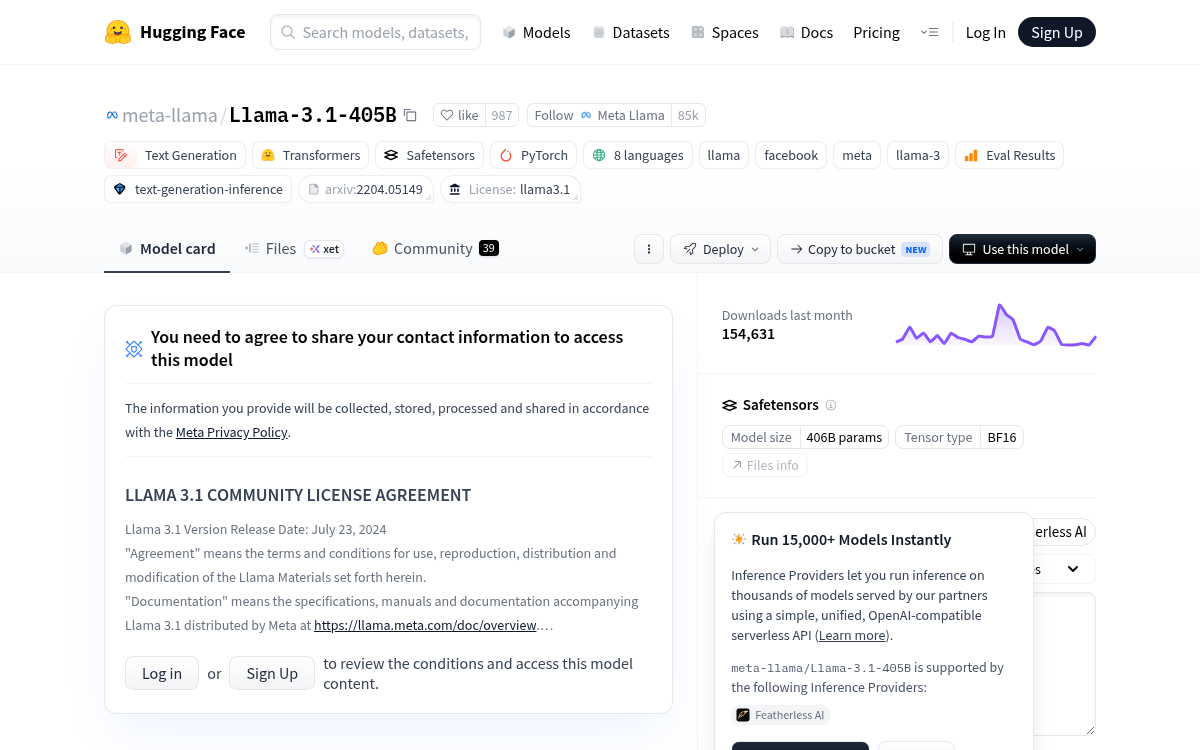
The new lineup expands context length to 128K tokens, adds support across eight languages, and introduces the 405B flagship alongside refreshed 8B and 70B variants. Weights are hosted on Hugging Face and can also be pulled directly from Meta. All three sizes ship as pretrained and instruction-tuned generative models, with the instruction-tuned versions optimized for multilingual dialogue and benchmarked against both open and closed chat models.
The architecture is text-in, text-out only: an auto-regressive optimized transformer, with tuned versions built via supervised fine-tuning (SFT) and reinforcement learning with human feedback (RLHF). Grouped-Query Attention (GQA) is used across all sizes to keep inference tractable at long context. Supported languages are English, German, French, Italian, Portuguese, Hindi, Spanish, and Thai.
The benchmark story
Key results for the instruction-tuned 405B from Meta's own evaluation library:
- MMLU (5-shot): 87.3
- MMLU-Pro (CoT): 73.3
- IFEval: 88.6
- HumanEval (pass@1): 89.0
- MBPP++: 88.6
- GSM-8K (CoT): 96.8
- MATH (CoT): 73.8
- ARC-C: 96.9
- GPQA: 50.7
- Multilingual MGSM (CoT): 91.6
Put in context, the instruction-tuned 405B more than matches OpenAI's GPT-4-Turbo (86.5%), Anthropic's Claude 3 Opus (86.8%), and Google's Gemini 1.5 Pro (85.9%) on MMLU, while cleanly outperforming Gemini 1.0 Ultra (83.7%). Head-to-head human preference evaluations tell a messier story. Against GPT-4-0125-Preview and Claude 3.5 Sonnet it wins and loses roughly the same share of comparisons; against GPT-4o it wins only 19.1%.
How it was built
Llama 3.1 was pretrained on roughly 15 trillion tokens from publicly available sources, with fine-tuning data drawn from public instruction datasets plus over 25M synthetically generated examples. The pretraining cutoff is December 2023.
Total compute across the family came to 39.3M H100-80GB GPU hours, with the 405B alone consuming 30.84M of those. The split from the model card:
| Model | GPU hours (H100-80GB) | Location-based CO2eq (tons) |
|---|---|---|
| Llama 3.1 8B | 1.46M | 420 |
| Llama 3.1 70B | 7.0M | 2,040 |
| Llama 3.1 405B | 30.84M | 8,930 |
At 406B parameters in BF16, the raw weights alone exceed 800GB. Running the full-precision model requires a multi-node H100 cluster; most practitioners will reach for a community quantization (FP8, INT4) to fit it onto a single 8xH100 or 8xA100 box.
Running it
The Hugging Face repo ships integrations for the standard inference stacks. A minimal vLLM launch looks like this:
pip install vllm
vllm serve "meta-llama/Llama-3.1-405B"
curl -X POST "http://localhost:8000/v1/completions" \
  -H "Content-Type: application/json" \
  --data '{
    "model": "meta-llama/Llama-3.1-405B",
    "prompt": "Once upon a time,",
    "max_tokens": 512,
    "temperature": 0.5
  }'
SGLang, Transformers pipelines, Ollama, and llama.cpp quantizations are all supported. For serious throughput, specialty hardware providers have pushed the model to extreme speeds. Cerebras Inference generates 969 output tokens per second on the 405B, which Artificial Analysis measured as up to 75 times faster than GPU-based offerings from hyperscalers, running at full 128K context and 16-bit precision.
The license shift that matters most
Arguably more consequential than the benchmarks is a quiet change to the Llama Community License. Developers can now use outputs from Llama models, including the 405B, to improve other models. That single clause turns 405B into a legally clean teacher for distillation and synthetic data generation.
In practice, if you have been paying OpenAI or Anthropic for synthetic training data with tight ToS restrictions on downstream use, this changes the math. The 405B becomes a data engine for training smaller specialist models without a contractual leash on what you can do with the results.
Where it actually helps
The strengths line up with what the numbers suggest:
- Synthetic data generation and distillation for training smaller, task-specific models.
- Reasoning-heavy pipelines where GSM-8K and MATH-style multi-step problem solving is the bottleneck.
- Code generation: 89.0 pass@1 on HumanEval puts it in the same league as the best coding-focused proprietary models at release time.
- Tool use and agents: BFCL 88.5 and API-Bank 92.0 make it viable as the reasoning core of an agentic system.
- Multilingual assistants: strong MMLU scores in Portuguese, Spanish, Italian, German, and French (all above 84).
- On-prem and regulated deployments where sending data to a hosted API is a non-starter.
Weaknesses are worth flagging. GPQA at 50.7 shows graduate-level science reasoning is still shaky. It is text-only, so vision or audio workloads fall outside its remit. And human preference evaluations put it a step behind GPT-4o for open-ended chat, so if response polish is the grading criterion, benchmark leadership does not fully translate.
What changes downstream
The release breaks the assumption that frontier-tier capability requires a closed API. Closed-source peers are accessible only through endpoints where the underlying model can change without notice. Llama 3.1-405B is a stable artifact that can be built on, modified, and run on-premises, giving researchers and enterprises the kind of reproducibility that vendor APIs cannot guarantee. For teams that were architecting around vendor lock-in as an unavoidable cost of using a top-tier LLM, that is no longer the default.