
Meta's DINOv3 Beats Specialized Vision Models With a Frozen 300M Backbone
Meta's 300M-parameter DINOv3 ViT-L delivers frozen visual features that beat specialized models on segmentation, depth, and retrieval tasks without fine-tuning.
 Pro
Takeaways
- Meta's DINOv3 ViT-L/16 is a 300M-parameter self-supervised backbone distilled from a 6.7B ViT-7B teacher
- Pretrained on LVD-1689M, a curated 1.689B image dataset drawn from 17B Instagram web images
- Introduces Gram anchoring, a new loss that stops dense features from degrading during long training
- Frozen features hit 54.9 mIoU on ADE20k and 90.2 on ImageNet-ReaL, matching much larger models
- Uses ViT with 4 register tokens, RoPE positional encoding, patch size 16, embedding dim 1024
- Released under a custom DINOv3 license, not Apache 2.0, so check terms for commercial use
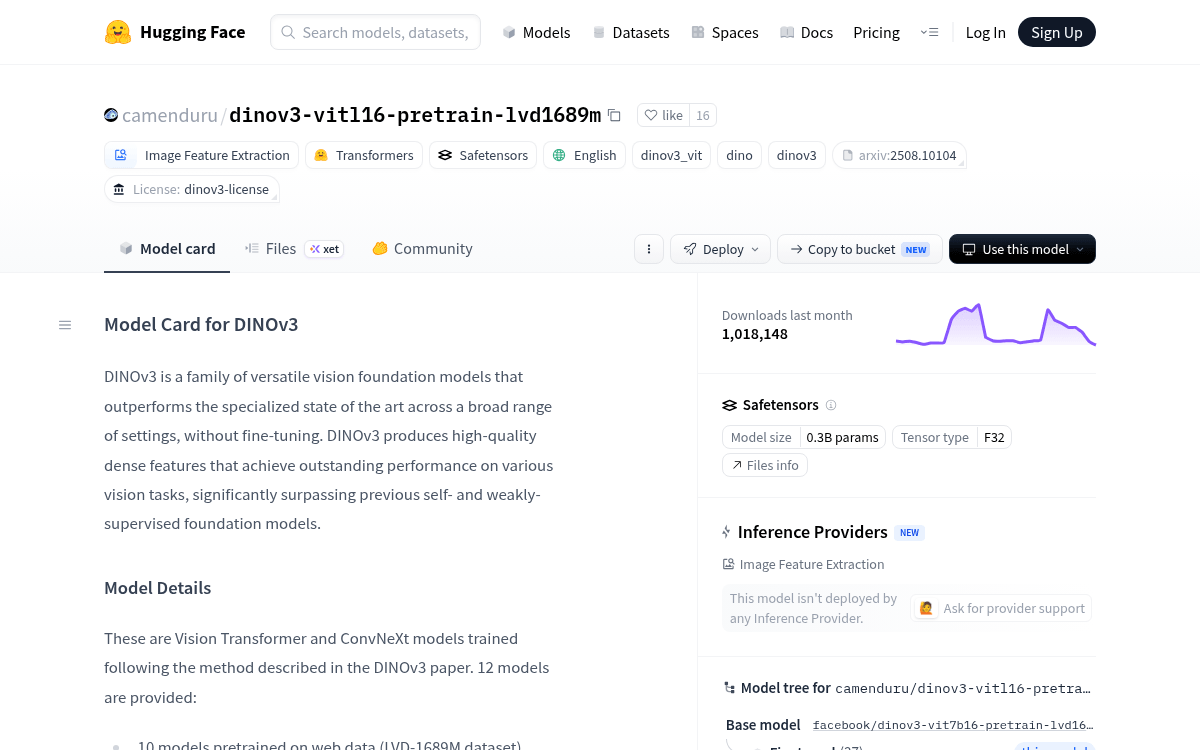
Meta's DINOv3 family has quietly become one of the most downloaded vision backbones on Hugging Face, and the ViT-L/16 checkpoint pretrained on LVD-1689M is the sweet spot most teams are gravitating toward. It packs the representational quality of a 6.7B-parameter teacher into a 300M-parameter student, and it does so without ever seeing a human-provided label. If you still reach for a CLIP or DINOv2 backbone by default, this release should make you reconsider.
A frozen backbone that refuses to be beaten
DINOv3 is Meta's self-supervised vision foundation model line, and the technical report pitches it as a general-purpose feature extractor rather than a task-specific model. The paper scales both dataset and model size through careful data preparation, introduces a method called Gram anchoring that stops dense feature maps from degrading during long training schedules, and applies post-hoc strategies that add flexibility around resolution, model size, and text alignment.
The result outperforms specialized state-of-the-art systems across a broad range of settings without fine-tuning, producing high-quality dense features that clearly surpass previous self- and weakly-supervised foundation models. In practice you can freeze the encoder, bolt on a linear head, and often match systems that were trained end-to-end for the specific task.
What ViT-L/16 actually is
The ViT-L/16 checkpoint is not trained from scratch. It is distilled from the flagship ViT-7B teacher, giving you most of the quality at a fraction of the compute. The architecture is a fairly standard modern ViT with a few upgrades:
- 300M parameters, patch size 16, embedding dimension 1024, 16 attention heads, MLP FFN, RoPE positional encoding
- 4 register tokens plus a CLS token, which cuts down on the attention artifacts that plagued earlier ViTs
- For a 224x224 image this produces 1 class token + 4 register tokens + 196 patch tokens = 201 tokens, versus 261 for DINOv2 with registers
- The encoder accepts larger images as long as dimensions are multiples of 16, otherwise it crops to the nearest smaller multiple
Register tokens are dedicated slots the model can use as scratchpad memory during attention, which stops it from hijacking real patch tokens for that purpose and cleans up the feature maps considerably.
How it was built
Training used LVD-1689M, a set of 1.689 billion curated web images from Instagram posts distilled down from a much larger pool of roughly 17 billion candidates. The training objective stacks several complementary losses:
- DINO self-distillation loss with multi-crop, where a student network learns to match a teacher's embeddings across different crops of the same image
- iBOT masked-image modeling, which hides patches and forces the model to reconstruct their features
- KoLeo regularization on CLS tokens to spread representations more uniformly in feature space
- Gram anchoring, the new ingredient that keeps dense patch features from collapsing during very long training runs
Compute was substantial: the teacher consumed 61,440 H100-hours, trained with PyTorch FSDP2 using bf16 and fp8 matrix multiplications. The ViT-L you actually download is the cheap part, a distillation pass with the frozen ViT-7B acting as teacher.
The benchmark numbers
ViT-L sits in an interesting position. It roughly matches the ViT-H+ (840M parameters) on dense tasks while being under half the size, and it closes most of the gap to the full 7B teacher. Reported results on frozen features:
| Task | ViT-L/16 | ViT-7B/16 |
|---|---|---|
| ImageNet-ReaL classification | 90.2 | 90.4 |
| ImageNet-R (robustness) | 88.1 | 91.1 |
| ObjectNet | 74.8 | 91.1 |
| ADE20k segmentation (mIoU) | 54.9 | 55.9 |
| NYU depth (lower is better) | 0.352 | 0.309 |
| DAVIS video segmentation | 79.9 | 79.7 |
On ADE20k semantic segmentation and DAVIS tracking, ViT-L is essentially indistinguishable from the 7B teacher. Classification robustness on ObjectNet is where the larger model still wins clearly.
Getting it running
Loading is standard transformers boilerplate. The model returns a class token, register tokens, and patch tokens in one forward pass:
from transformers import AutoImageProcessor, AutoModel
from transformers.image_utils import load_image
import torch
name = "facebook/dinov3-vitl16-pretrain-lvd1689m"
processor = AutoImageProcessor.from_pretrained(name)
model = AutoModel.from_pretrained(name, device_map="auto")
image = load_image("http://images.cocodataset.org/val2017/000000039769.jpg")
inputs = processor(images=image, return_tensors="pt").to(model.device)
with torch.inference_mode():
    out = model(**inputs)
print(out.pooler_output.shape)   # global embedding
print(out.last_hidden_state.shape)  # per-patch features
The weights are free but the license is not the usual permissive one. DINOv3 models ship under the DINOv3 license, and Meta recommends DINOv2 if you need permissive Apache 2.0 terms. Read the license carefully before shipping this in a commercial product.
Where it earns its keep
Meta's docs recommend keeping features frozen and adding lightweight heads. That covers a surprising amount of ground:
- k-NN or logistic regression on the class token for classification
- Nearest-neighbor image retrieval and visual similarity search
- Linear heads on patch tokens for depth estimation and semantic segmentation
- Unsupervised object discovery and geometric or semantic 3D keypoint correspondence
- Video segmentation tracking and video classification with a small attentive probe
Meta explicitly advises fine-tuning only as a last resort, a meaningful shift from the CLIP era, when full fine-tuning was often the default. In practice, DINOv3 ViT-L works well as a visual embedding backbone for image collections, video keyframes, satellite imagery, and fine-grained visual similarity tasks where label-free feature quality matters.
Where it stumbles
Two honest weaknesses stand out. The license is restrictive relative to what most open backbones ship with, which complicates commercial pipelines. Geographic and economic bias also remains: Meta's own model card acknowledges that DINOv3 shows somewhat consistent performance across income categories but drops notably in the low-income bucket compared to the highest-income bucket, and while it improves over DINOv2 across regions, a relative difference is still observed between Europe and Africa. If your use case involves global imagery, plan for domain-specific evaluation.
Why this matters beyond the numbers
The real breakthrough is that a frozen self-supervised backbone now beats specialized supervised systems on dense prediction tasks like segmentation and depth. That inverts an assumption most vision pipelines still bake in, namely that task-specific fine-tuning is where the gains live. With DINOv3, the gains live in the features themselves, and a linear probe is often enough.
For anyone building visual search, robotics perception, medical imaging pipelines, or satellite analysis, the practical implication is that the same 300M-parameter encoder can serve as the shared representation layer across every downstream task. The full reference implementation is on GitHub along with the satellite-pretrained SAT-493M variants, the same recipe applied to Maxar imagery for geospatial work.