
Meta Refreshes Llama 3 70B With One-Command Deployment on Hugging Face
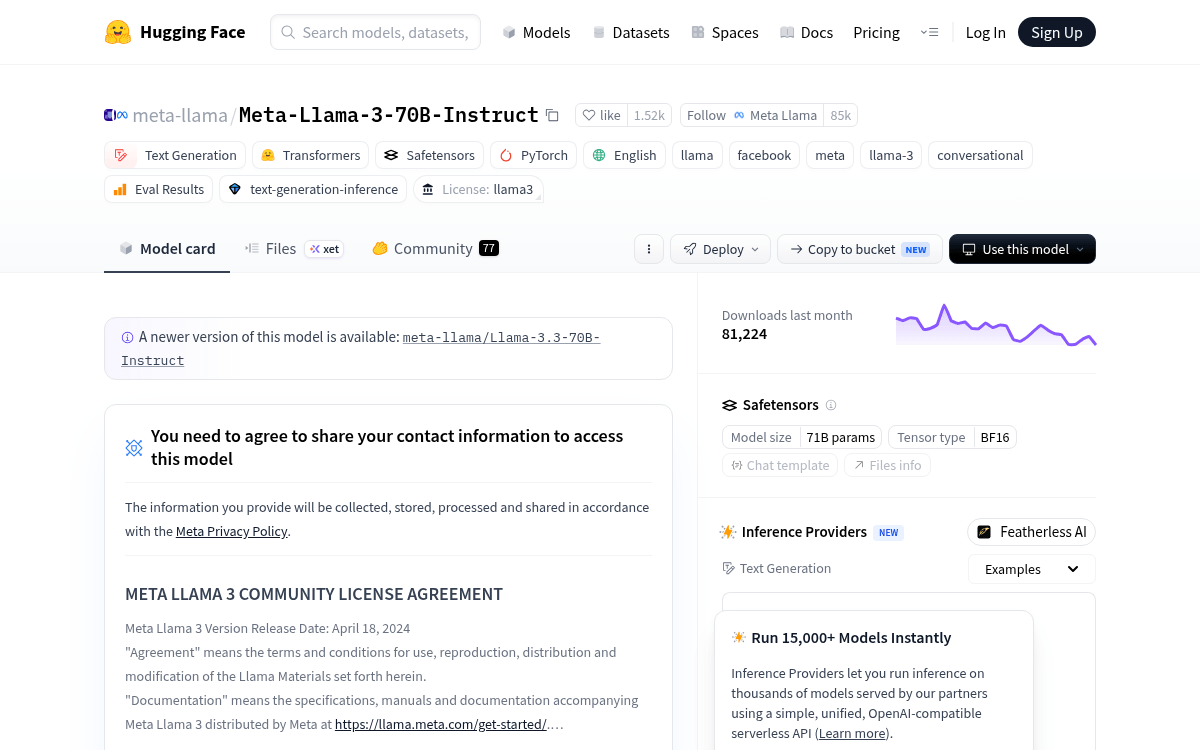
Hugging Face refreshed the Meta-Llama-3-70B-Instruct model card with one-command deploy paths for vLLM, SGLang, and Docker Model Runner.
 Pro
Takeaways
- Meta-Llama-3-70B-Instruct's model card now ships one-command deploy recipes.
- vLLM path installs and serves an OpenAI-compatible endpoint on port 8000 with a single command.
- SGLang recipe includes pip install plus an lmsysorg/sglang Docker image with GPU flags preset.
- Docker Model Runner supports
docker model run hf.co/meta-llama/Meta-Llama-3-70B-Instructfor one-line launch. - Weights and benchmarks unchanged: MMLU 82.0, HumanEval 81.7, GSM-8K 93.0, 8K context, English-only.
- Card now banners Llama-3.3-70B-Instruct as the newer recommended checkpoint.
The model card for Meta's 70-billion parameter instruction-tuned Llama 3 just picked up refreshed deployment recipes on Hugging Face. The weights and benchmarks are unchanged, but the page now surfaces copy-paste install and serve commands for vLLM, SGLang, and Docker Model Runner alongside the existing Transformers snippets. If you have been running this model behind a homegrown FastAPI wrapper, the new paths are worth a look.
What actually changed on the page
The card still describes Meta-Llama-3-70B-Instruct as the same model shipped under the Llama 3 Community License, with a knowledge cutoff of December 2023 and an 8K context window using grouped-query attention. What is new is the deployment surface:
- A vLLM path:
pip install vllmfollowed byvllm serve "meta-llama/Meta-Llama-3-70B-Instruct", which spins up an OpenAI-compatible endpoint on port 8000. - An SGLang path using
python3 -m sglang.launch_serverwith a matching OpenAI-compatible API on port 30000, plus a ready-madelmsysorg/sglang:latestDocker invocation with--gpus alland shared memory tuned to 32g. - A one-liner Docker Model Runner command:
docker model run hf.co/meta-llama/Meta-Llama-3-70B-Instruct. - A pointer to a quantizations browser for llama.cpp, Ollama, and LM Studio users who cannot fit the BF16 weights.
Each recipe is wired to Hugging Face's local-apps registry, so hitting Deploy on the model page drops the exact command into your terminal without hunting through separate docs.
Why one command matters for a 71B model
At 71B parameters in BF16, this model does not fit on a single 80GB GPU without quantization, so setup traditionally meant hand-configuring tensor parallelism, KV cache sizes, and an inference server. The refreshed vLLM and SGLang recipes hide that behind defaults that autodetect available GPUs and expose an OpenAI-shaped /v1/chat/completions endpoint. A minimal client call now looks like:
curl -X POST "http://localhost:8000/v1/chat/completions" \
  -H "Content-Type: application/json" \
  --data '{
    "model": "meta-llama/Meta-Llama-3-70B-Instruct",
    "messages": [{"role": "user", "content": "What is the capital of France?"}]
  }'
A project already targeting the OpenAI SDK can point base_url at localhost and swap models with no code change. For teams evaluating open-weight replacements for hosted APIs, this is the friction that usually kills the pilot.
What you are actually deploying
The underlying model has not moved since its original release. It is a dense decoder-only transformer with grouped-query attention for improved inference scalability, trained on over 15 trillion tokens from publicly available sources, then aligned with supervised fine-tuning and RLHF. Benchmark numbers on the card still show the instruction-tuned 70B at MMLU 82.0, GPQA 39.5, HumanEval 81.7, GSM-8K 93.0, and MATH 50.4 in the reported few-shot settings.
The weak spots have not moved either. The checkpoint is English-only by design, capped at 8K context, and the card explicitly warns that testing to date has been in English and has not covered all scenarios. If you need multilingual coverage, long-context retrieval over full codebases, or the reasoning traces that newer models expose, reach for something else.
A newer sibling worth knowing about
The card now carries a banner noting that a newer version is available: meta-llama/Llama-3.3-70B-Instruct. For most greenfield work, that is the checkpoint to try first. The refreshed 3.0 card matters mainly for teams already running 70B-Instruct in production, evaluating against a fixed baseline, or fine-tuning from it, since 51 models already list it as a base for further finetunes and dozens more as adapters.
Where this fits in practice
The refreshed deployment paths are most useful if you are in one of these situations:
- Standing up a local OpenAI-compatible endpoint for an internal chat or RAG app and want a single command rather than a Kubernetes manifest.
- Benchmarking vLLM against SGLang on the same weights, since both now install and launch identically from the card.
- Running a Docker-first shop where
docker model runis the preferred abstraction and you want to avoid managing a Python environment on the host. - Teaching or demoing a 70B open-weight model without walking students through server configuration.
The license terms have not moved either. Commercial use is permitted under the Llama 3 Community License, with the familiar carveout that any licensee whose products or services exceeded 700 million monthly active users in the calendar month preceding the release date must request a separate license from Meta. For everyone under that threshold, the new deploy buttons are the shortest path yet from model card to running endpoint.