
Mesolitica's wav2vec2 Quietly Hits 1.3M Downloads Solving Southeast Asia's Code-Switching Problem
A community-fine-tuned speech recognition model for Malay, Singlish, and Mandarin quietly crossed 1.3M downloads by solving a code-switching problem Whisper struggles with.
 Pro
Takeaways
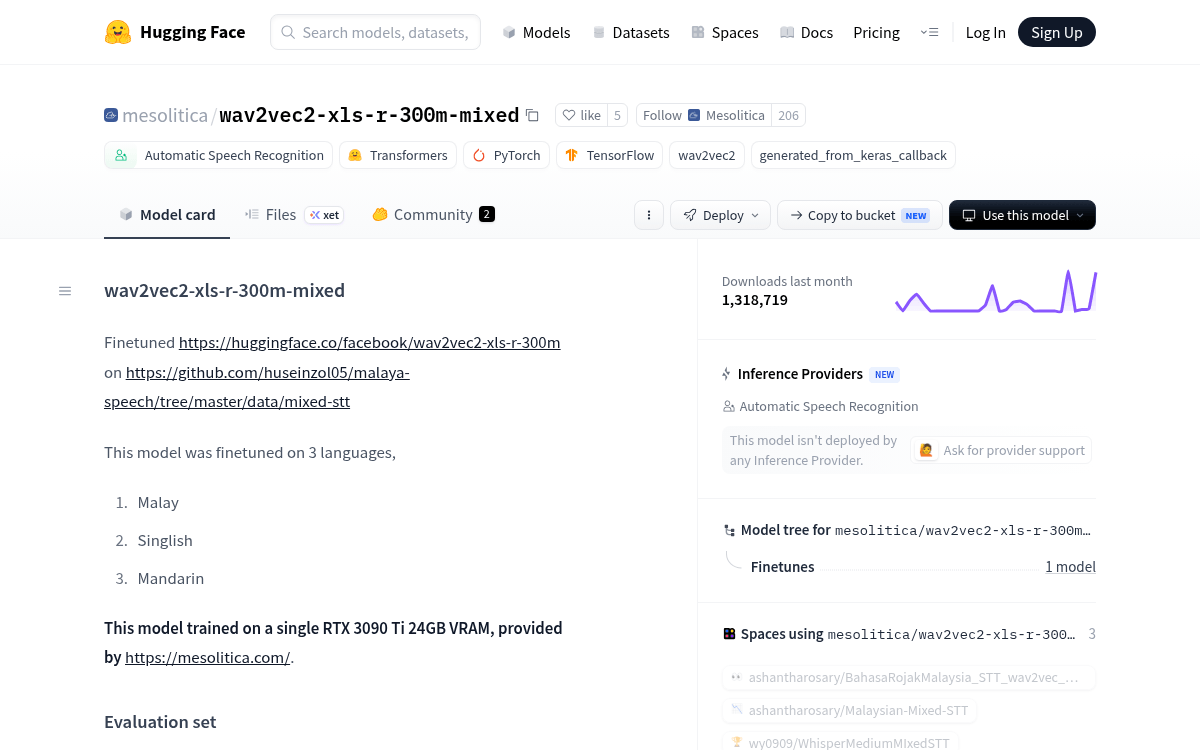
- Mesolitica's wav2vec2-xls-r-300m-mixed hit 1.3M+ downloads on Hugging Face.
- Fine-tunes Meta's XLS-R 300M on Malay, Singlish, and Mandarin code-switched speech.
- Achieves 9.88% WER on mixed-language eval when paired with a language model.
- Trained on a single RTX 3090 Ti 24GB GPU, showing low-resource fine-tuning is viable.
- Wired into the malaya-speech toolkit for STT and forced alignment out of the box.
- Community fine-tunes cut WER from 34% to 17% on domain code-switched audio.
A speech recognition model built by Malaysian AI shop Mesolitica has quietly become one of the most downloaded automatic speech recognition checkpoints on Hugging Face, racking up over 1.3 million downloads. The model, wav2vec2-xls-r-300m-mixed, targets a language mix that big commercial ASR systems consistently fumble: Malay, Singlish, and Mandarin, often spoken interchangeably in the same sentence.
The checkpoint is a fine-tune of Meta's wav2vec2-xls-r-300m, a 300M-parameter cross-lingual speech encoder. XLS-R shares the same architecture as the older XLSR-53, with 24 encoder layers and 300M parameters, but was pre-trained on 128 languages rather than 53. That broader pretraining is what makes the Southeast Asian fine-tune viable at this size.
The code-switching problem it actually solves
In Malaysia and Singapore, everyday speech routinely mixes three languages inside a single utterance, sometimes called Bahasa Rojak. English-heavy ASR models like Whisper handle isolated Malay or Mandarin passably but tend to collapse when speakers switch mid-sentence. Mesolitica finetuned on Malay, Singlish, and Mandarin using the mixed speech-to-text dataset from the malaya-speech project.
The evaluation numbers from the model card tell the story:
| Split | WER | WER with LM | CER with LM |
|---|---|---|---|
| Mixed | 13.22% | 9.88% | 4.12% |
| Malay | 19.56% | 12.71% | 3.92% |
| Singlish | 12.76% | 9.68% | 4.27% |
| Mandarin | 7.99% | 7.54% | 3.49% |
The gap between raw CTC output and results with a language model is significant, so pairing it with the companion bahasa-manglish language model is not optional for production use.
Trained on a single consumer GPU
One receipt worth noting: this model was trained on a single RTX 3090 Ti with 24GB of VRAM. That is a useful data point if you are budgeting a similar low-resource language fine-tune. XLS-R's pretraining did the heavy lifting, and the adaptation to three specific languages fit inside prosumer hardware.
Dropping it into your pipeline
The checkpoint is a standard CTC model that plugs straight into the Transformers pipeline API:
from transformers import pipeline
pipe = pipeline(
    "automatic-speech-recognition",
    model="mesolitica/wav2vec2-xls-r-300m-mixed",
)
result = pipe("audio.wav")
For loading the processor and model directly, the standard AutoProcessor and AutoModelForCTC classes work. It is also wired into the malaya-speech toolkit as the default backend for both stt.huggingface and force alignment, so if you need word-level timestamps for captioning or dataset labeling, that path is prebuilt.
Where it shines, and where it does not
Strengths:
- Best-in-class results on Mandarin within the mixed set, hitting under 8% WER without a language model.
- Handles Singlish, which most Western-trained ASR treats as noisy English.
- Small enough (300M params) to serve on a single GPU with real-time latency.
- Provides deterministic CTC alignments, useful for forced alignment and subtitle timing.
Weaknesses:
- Standalone Malay WER of 19.56% is rough; you almost certainly want the LM decoder.
- The evaluation sets are small (765 Malay, 3579 Singlish, 614 Mandarin clips), so real-world variance may differ.
- No English-only training, so pure English utterances will underperform Whisper or newer multilingual models.
- As a CTC model, it produces no punctuation and no casing out of the box.
What people are building on top of it
The community has been treating this as a base checkpoint rather than an endpoint. One derivative, langminer's wav2vec2-custom-asr, fine-tunes further on a custom Malay-English dataset to handle informal, conversational code-switching. That run used roughly 50 hours of manually curated Malay-English code-switched audio over 10 epochs, dropping WER from 34.29% with the base to 17.26%. The practical recipe: start from mesolitica's checkpoint, add a domain-specific dataset, and you get a much better model than starting from vanilla XLS-R.
Hugging Face Spaces have also cropped up comparing the model against Whisper Medium on Malaysian mixed speech, a decent signal that teams are benchmarking it head-to-head with the current default choice.
Why the download count matters
1.3M downloads for a niche Southeast Asian ASR model is a reminder that the ASR market covers uneven ground. Whisper handles a lot, but code-switched, low-resource language pairs remain a real gap, and a well-executed XLS-R fine-tune on the right data still wins on that segment. If you are shipping voice features for a Malaysian, Singaporean, or Indonesian audience, this is the checkpoint to benchmark against before reaching for a proprietary API.