
Maya Research's Maya1 Brings Expressive Open-Source Voice AI to Your GPU
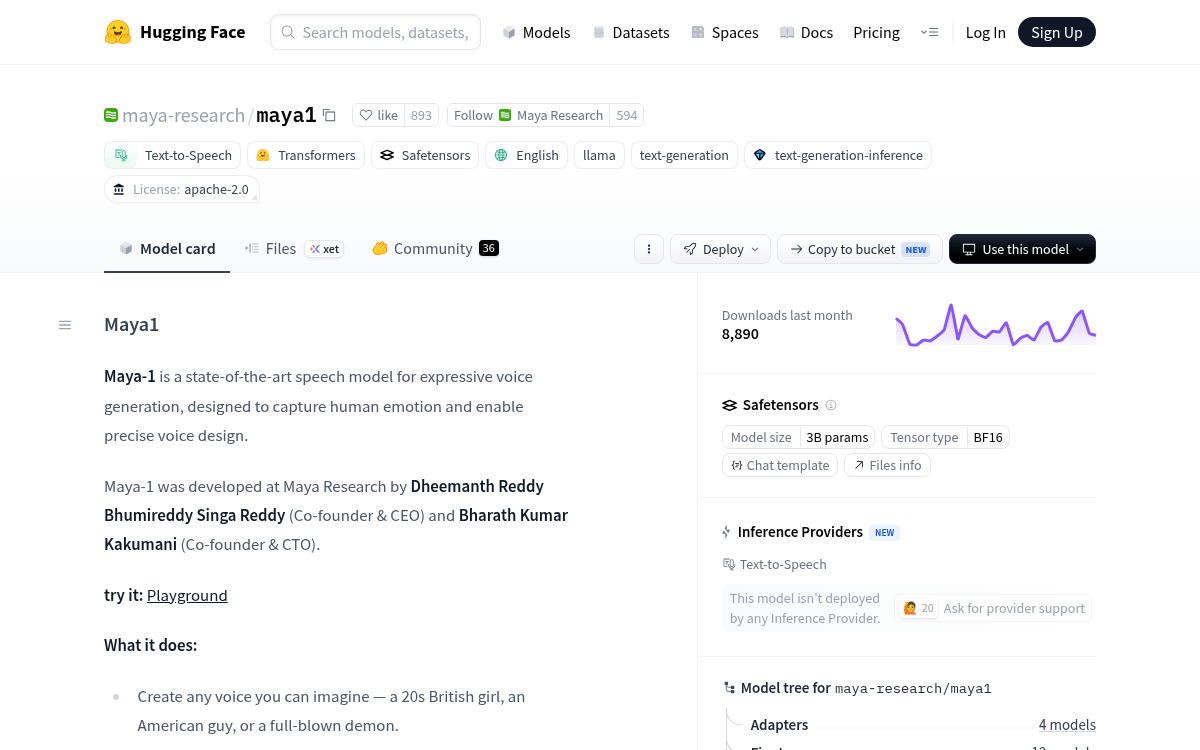
Maya Research drops a 3B open-source voice model that generates any character with 20+ inline emotion tags, streaming on a single GPU.
 Pro
Takeaways
- Maya Research released Maya1, a 3B open-source TTS model under Apache 2.0.
- Design voices with plain English descriptions instead of picking from a fixed voice library.
- Supports 20+ inline emotion tags like laugh, whisper, cry, gasp, and angry.
- Llama-style transformer predicts SNAC codec tokens for 24 kHz streaming at ~0.98 kbps.
- Runs on a single 16GB GPU, with vLLM support for sub-100ms production latency.
- Hosted option on fal.ai costs $0.002 per generated audio second.
Voice AI has been stuck in an awkward place. Closed APIs like ElevenLabs give you expressive, controllable speech but bill by the second, while open-source options tend to sound flat or lock you into a rigid preset voice library. Maya1, a new 3B-parameter text-to-speech model from Maya Research, targets that gap with promptable voice design plus inline emotion control, all under Apache 2.0.
You describe a voice in plain English, drop emotion tags into the transcript wherever you want them, and the model generates 24 kHz audio that streams as it decodes. That combination, open weights plus natural-language voice shaping, hasn't really existed in the open ecosystem until now.
Describe a voice, get a voice
Instead of picking from a fixed set of voices, you write a short description and include performance cues directly in the prompt. Tone, accent, emotion, and delivery are all fair game. A prompt looks like this:
<description="Female, 30s, American accent, event host, energetic, clear diction">
Wow. This place looks even better than I imagined <laugh> how did they set all this up?
The team tested four conditioning formats before landing on the XML-attribute style. Colon-separated descriptions caused the model to speak the description out loud. Rigid key-value tags were brittle and token-heavy. Only the XML-attribute format generalized well across arbitrary voice briefs.
Under the hood
Maya1 is a 3B-parameter decoder-only transformer with a Llama-style backbone. Rather than predicting raw waveforms, it predicts tokens from a neural audio codec called SNAC, which uses a multi-scale hierarchical structure operating at roughly 12, 23, and 47 Hz. That keeps the autoregressive sequence compact while preserving fine detail, at about 0.98 kbps.
During inference, the transformer generates SNAC tokens in packs of seven per frame. Those get unpacked into three hierarchical levels and passed to a SNAC decoder that reconstructs the 24 kHz waveform. Because it's a causal Llama-style model, standard inference stacks work without modification, which is why the team ships a vLLM streaming script with automatic prefix caching for repeated voice descriptions.
Training pipeline
Pretraining ran on an internet-scale English speech corpus, followed by fine-tuning on a proprietary dataset of studio recordings covering multi-accent English, more than 20 emotion tags per sample, and varied character and role types. Data preparation steps:
- 24 kHz mono resampling with -23 LUFS loudness normalization
- Voice-activity detection to trim silence; clips bounded to 1 to 14 seconds
- Montreal Forced Aligner for clean phrase boundaries
- MinHash-LSH for text deduplication and Chromaprint for audio deduplication
- SNAC encoding with 7-token frame packing
Strengths and current limits
The demos handle character work well: a gravelly British villain, a screaming demon with a Middle Eastern accent, a mythical goddess mid-cry. Inline tags like <laugh_harder>, <whisper>, <sigh>, and <gasp> land in the right spots rather than smearing across the sentence.
The constraints are worth knowing before you commit. Maya1 is English-only, with multi-accent support but no other languages. There's no voice cloning from a reference clip, so reproducing a specific person's voice isn't possible. The Hugging Face Space currently has capacity issues, and the release is a raw base model rather than a polished hosted API.
Running it
A 16 GB consumer GPU like an RTX 4090 is enough for local inference. The team claims sub-100ms latency through vLLM on the production path. For managed hosting, fal.ai runs it as an endpoint at roughly $0.002 per second of generated audio. A ComfyUI node covers creative workflow integrations. Twelve community fine-tunes and ten quantizations are already on the Hub, which suggests developers are actively building with it rather than just bookmarking it.
For game studios generating NPC dialogue, audiobook producers, or anyone building voice agents that need a specific persona over a stock voice, Maya1 offers something the open-source side has been missing: character-level voice design and inline emotional performance on hardware you already own, with no per-second billing.